 Anacortes Window
 Roofing in a Marine Microclimate: What Ship Harbor Homes Face
Ship Harbor sits about as close to the water as a house in Anacortes can get, tucked along Fidalgo Island near the ferry terminal with Rosario Strait and the Guemes Channel close by on either side. That location is part of why people love it, and it's also why roofs here take more punishment than roofs ten miles inland. Salt-laden air corrodes exposed metal faster than in a dry climate. Wind off the water drives rain sideways under poorly sealed flashing instead of letting it run straight down the slope. And the tree cover common in this part of Skagit County keeps roofs shaded and damp for long stretches, which is exactly what moss and algae need to take hold.
None of this means a roof in Ship Harbor is doomed to fail early. It means the details that get skipped on an easy inland job — underlayment choice, flashing laps, fastener material, ventilation balance — are the details that determine whether a roof here makes it fifteen years or thirty.
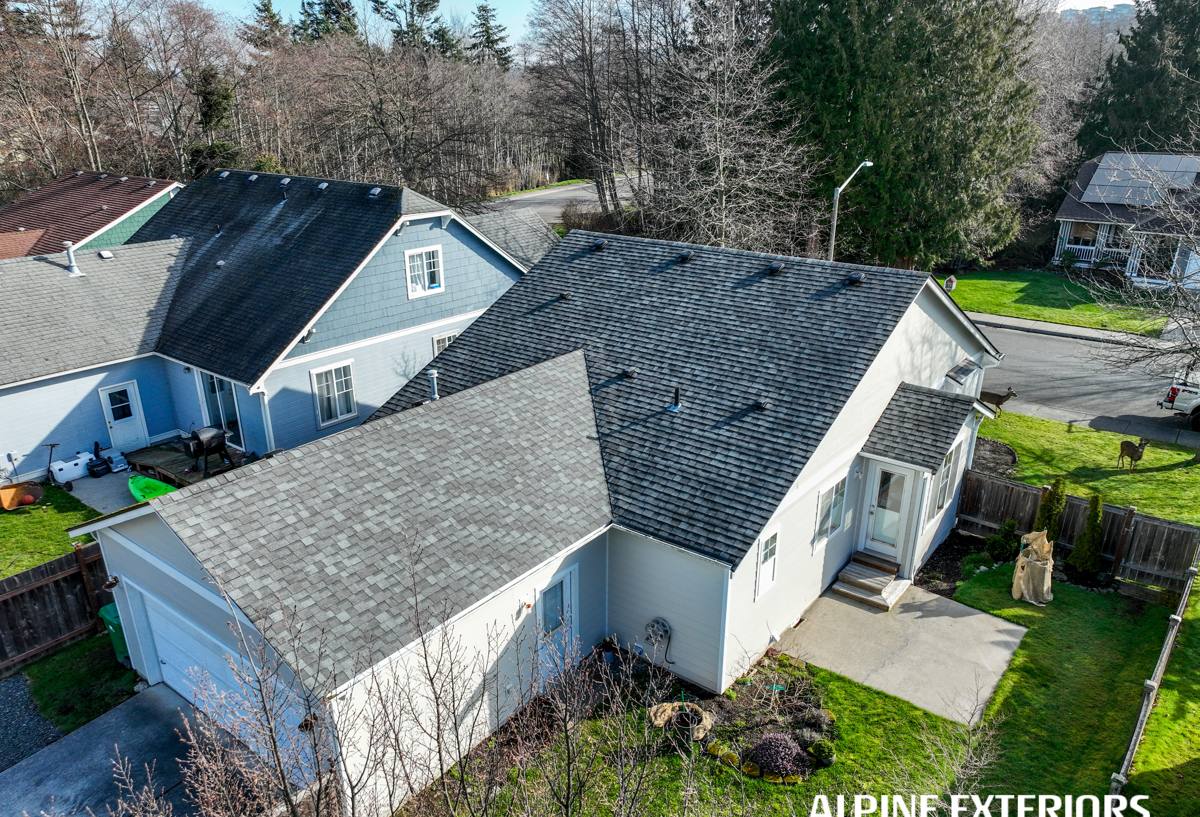
Signs Your Roof Needs Full Replacement, Not Another Repair
Coastal homeowners often patch the same trouble spot two or three times before calling for a real evaluation. Repairs make sense when a roof is otherwise sound. They stop making sense once the underlying materials are worn out everywhere, not just at the leak.
- Granule loss heavy enough that you can see bare, shiny patches on multiple slopes, not just one worn spot
- Shingles that are cupping, curling at the edges, or cracking when you walk the roof
- Soft or spongy decking felt underfoot, especially near valleys or the eaves
- Daylight visible through the attic sheathing, or damp insulation after a windy rain
- Moss that has worked its way under shingle tabs rather than just sitting on the surface
- Flashing around chimneys, vents, or skylights that's rusted, lifted, or was caulked instead of properly re-flashed
- A roof original to the home and past 20–25 years old, even if it "looks fine" from the ground
If you're seeing two or more of these, it's worth having someone walk the roof in person rather than guessing from a photo or the driveway.
What a Correct New Roof Installation Actually Involves
Tear-Off and Deck Inspection
A proper install starts with removing the old roofing down to the deck — not layering new shingles over old ones. That's the only way to actually see the plywood or plank sheathing underneath, which is where marine-climate damage usually hides. Any soft, delaminated, or rotted decking gets cut out and replaced before anything new goes down. Skipping this step is the single most common shortcut in the roofing trade, and it's the one that causes the most expensive surprises later.
Underlayment and Water Protection
Given how much wind-driven rain this stretch of coastline sees, we treat underlayment as more than a formality. Synthetic underlayment across the field, with self-adhered ice-and-water membrane at eaves, valleys, and any roof-to-wall transition, gives the roof a real second line of defense if wind ever pushes water past the shingles themselves — which happens more often here than in sheltered inland neighborhoods.
Flashing Details
Flashing is where most roof leaks actually originate, not the open field of shingles. Step flashing at walls, proper counter-flashing at chimneys, and correctly lapped valley metal all matter more in a place that gets sustained horizontal rain. We use corrosion-resistant flashing materials given the salt content in the air near the water, rather than standard galvanized steel that can start rusting within a few seasons this close to the shoreline.
Ventilation
A roof deck that can't breathe traps moisture, and trapped moisture rots sheathing from underneath regardless of how good the shingles above it are. Balanced intake at the eaves and exhaust at the ridge keeps the attic space closer to outdoor temperature and humidity, which also protects the shingles themselves from premature aging caused by heat and moisture buildup.
Choosing a Roofing Material for Salt Air and Heavy Rain
There's no single "right" material for every Ship Harbor home — it depends on your roof's pitch, your budget, and how much maintenance you want to do. Here's how the common options actually compare in this specific climate.
| Material | Moisture & Moss Behavior | Wind Performance | Typical Lifespan | Relative Cost |
|---|---|---|---|---|
| Architectural asphalt shingle | Good with algae-resistant granules; needs periodic moss removal in shaded areas | Solid when properly nailed and sealed; rated lines available for coastal wind | 25–30 years | $ |
| Standing seam metal | Sheds moss and water fastest; virtually no granule loss to worry about | Excellent; among the best options for exposed, wind-prone lots | 40–50+ years | $$$ |
| Synthetic shake/slate | Very good moisture resistance; won't absorb water or rot like real wood | Good, varies by product and fastening pattern | 35–50 years | $$ |
| Cedar shake | Attractive but needs real upkeep in a wet, mossy climate — regular treatment and cleaning | Moderate; performance depends heavily on installation quality | 20–30 years with maintenance | $$–$$$ |
We're honest with homeowners about cedar: it can look great, but in a shaded, marine-humid setting like Ship Harbor it demands more ongoing maintenance than most people plan for. If you want that look without the upkeep, a synthetic shake product is worth a serious look before committing to real wood.
Moss, Debris, and the Long Moss Season
Anacortes doesn't get a short moss season — it gets a long one, thanks to persistent cloud cover, tree canopy, and rain that lingers rather than passing through quickly. On a new install, we build in moss resistance from day one: algae-resistant shingle lines, and where the roofline runs under heavy tree cover, zinc or copper strips near the ridge that release trace metals with each rain to slow regrowth. That's a far better long-term answer than yearly power-washing, which strips granules and shortens shingle life if it's done aggressively or too often.
Gutter and valley debris is the other half of this equation. Needles and leaf litter from surrounding evergreens collect in valleys and behind chimneys, holding moisture against the roof surface long after the rain has stopped. Keeping those areas clear matters as much as the roofing material itself.
Our Process, Start to Finish
- On-site evaluation. We walk the roof and attic in person — not just a ground-level look — checking decking condition, ventilation, flashing, and any interior signs of past moisture.
- Written estimate. A clear scope and price, including what happens if we find deck damage once tear-off starts, so there are no surprise add-ons sprung on you mid-job.
- Material selection. We walk through options based on your home, budget, and how much maintenance you actually want to take on.
- Tear-off and deck repair. Full removal down to sheathing, with any compromised decking replaced before new materials go down.
- Underlayment, flashing, and roofing installation. Installed to manufacturer specifications and built for wind-driven rain, not just vertical rainfall.
- Final walkthrough. We review the finished roof with you, including ventilation and any maintenance recommendations specific to your lot and tree cover.
- Cleanup. Magnetic sweep for stray fasteners and full removal of old materials and debris from the property.
Why a Local Crew Matters in Ship Harbor Specifically
Roofing crews who mostly work drier, inland parts of Skagit County sometimes underestimate what a waterfront lot near Ship Harbor actually deals with — the wind exposure, the salt air's effect on fasteners and flashing, and how much shade certain lots get from surrounding evergreens. A crew that already works this pocket of Anacortes knows to spec corrosion-resistant hardware without being asked, knows which slopes typically need extra moss treatment based on tree orientation, and understands City of Anacortes and Skagit County permitting requirements for reroofing without it turning into a delay.
There's also a practical logistics side: working near the ferry terminal area means planning material delivery and dumpster placement around traffic patterns that don't exist in a typical inland neighborhood. It's a small thing, but it's the kind of detail that keeps a job running smoothly instead of turning into a headache for you and your neighbors.
What to Ask Before You Hire
- Do you tear off down to the deck, or do you install over existing layers?
- What underlayment and ice-and-water protection do you use at eaves and valleys?
- What flashing material do you use, and is it rated for coastal/salt-air exposure?
- How do you handle it if you find rotted decking once tear-off begins?
- What's the manufacturer warranty, and what's your own workmanship warranty?
- Are you licensed and insured to work in Washington, and can you show proof?
Any roofer who hesitates on these questions, or gives vague answers, is telling you something worth listening to.
Ready to Talk About Your Roof?
If your roof is showing its age or you just want an honest opinion on how much life it has left, we're happy to take a look. Use the form below to request a free, no-pressure estimate — we'll walk the roof, tell you what we actually see, and give you a clear price with no obligation.