 Anacortes Window
 Cap Sante's Exposure Is Not Like the Rest of Anacortes
Homes on and around Cap Sante sit close to open water, elevated above the marina and looking out over the channel. That position has real advantages — light, views, breeze — but it also means these roofs take a harder hit from the weather than a house tucked into a sheltered lot elsewhere in Anacortes. Salt-laden air moves off the water and settles on every exposed surface, wind gusts arrive with less to slow them down, and rain rarely falls straight down here; it comes in sideways, driven by wind off Rosario Strait and the surrounding Salish Sea waters. A roofing system that performs fine three miles inland can fail early on a bluff-facing home in this pocket of Skagit County.
Metal roofing is a strong answer to that exposure when it's specified and installed correctly for a marine environment. It's also a poor long-term investment when the wrong panel type, fastener grade, or finish gets used because it worked fine somewhere else. This page is about getting that match right for Cap Sante specifically.
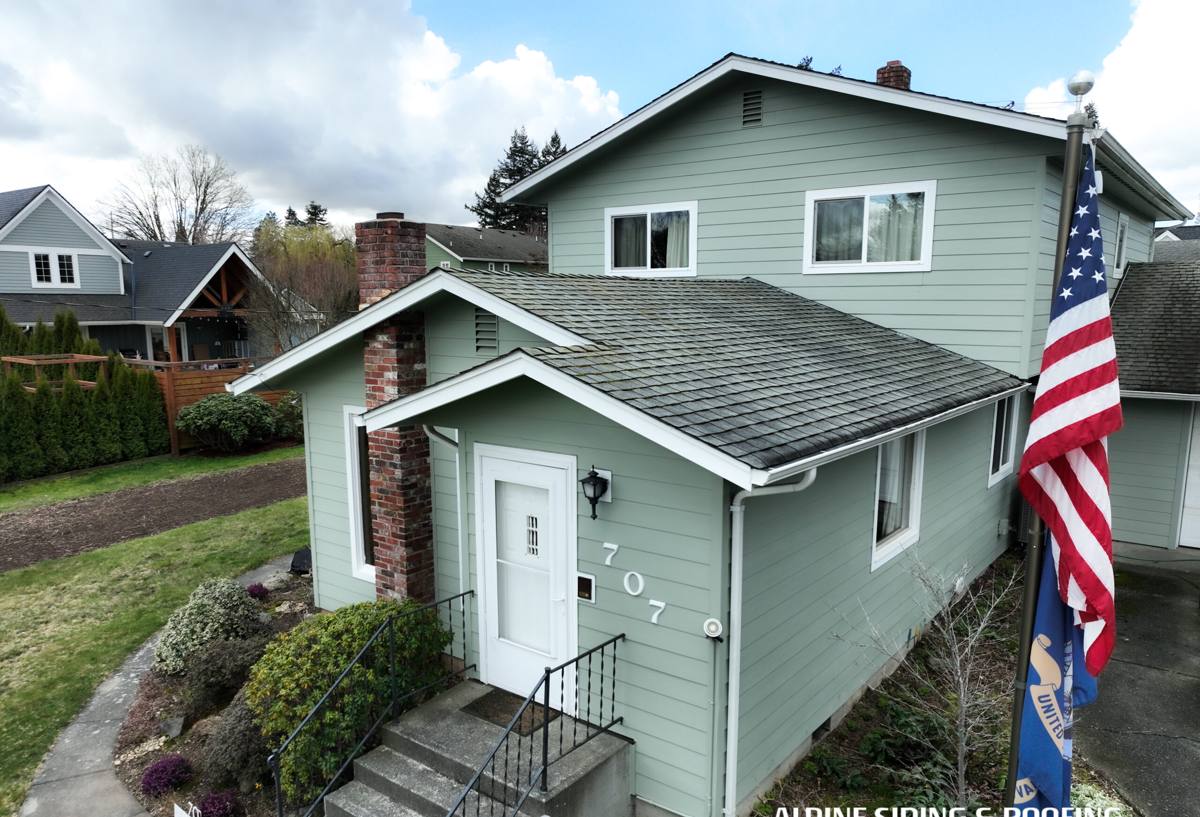
What Salt Air, Wind, and Rain Actually Do to a Roof Here
Corrosion, not just weathering
Ordinary weathering — UV fading, granule loss on asphalt, general aging — happens everywhere. Salt air adds a second, more aggressive process: airborne chloride settles on metal surfaces and accelerates corrosion, especially at cut edges, fastener heads, and any point where two dissimilar metals touch and set up galvanic reaction. On a home this close to the water, that process runs faster than it would a few miles inland, and it targets exactly the spots — screws, flashing seams, panel end caps — that are hardest to inspect from the ground.
Wind-driven rain finds the gaps
Rain that's being pushed sideways by wind behaves differently than rain falling straight down. It can work backward under lapped panels, around poorly sealed penetrations, and into fastener holes that would shed water fine in calmer conditions. Roofs on exposed sites need more conservative detailing at every transition — not because the metal itself is weak, but because wind pressure changes how water moves across it.
Moss and shaded north slopes
Metal sheds moss far better than asphalt shingles, but it isn't immune. On shaded, north-facing slopes — common on tree-lined Cap Sante lots — organic buildup can still collect in panel seams and around low-slope transitions during the long wet season this region gets from fall through spring. Left alone it holds moisture against the panel and its fasteners.
Choosing a Metal Roofing System for This Exposure
Panel profile: standing seam vs. exposed-fastener
Standing seam panels use concealed clips, so there are no exposed screw heads on the field of the roof for salt air to attack over time. Exposed-fastener panels cost less up front but rely on hundreds of gasketed screws driven through the panel face — every one of those is a future maintenance point and a potential corrosion site in a marine environment. We don't tell homeowners exposed-fastener panels are bad; we tell them honestly what the trade-off is: lower material cost against a longer list of points that need periodic attention on an exposed, salt-air site.
Metal type and finish
Steel panels need a factory finish rated for coastal exposure and a galvanized or Galvalume base coat to resist corrosion; aluminum resists salt corrosion inherently and is a common upgrade choice specifically for waterfront and near-waterfront homes. Paint finish matters as much as the base metal — a PVDF (Kynar-type) coating holds color and chalk resistance far longer near salt air than a lower-grade polyester finish.
Fasteners and flashing
Every fastener, clip, and flashing piece on a Cap Sante roof should be stainless steel or another corrosion-rated material matched to the panel metal — not a generic fastener chosen because it's what's in the truck. Mixing incompatible metals anywhere in the system sets up galvanic corrosion that will show up as staining and pitting well before the panels themselves are due for replacement.
| Panel Type | Fastening | Salt-Air Suitability | Typical Lifespan* | Relative Cost |
|---|---|---|---|---|
| Standing seam, steel (Galvalume/PVDF) | Concealed clips | Very good | 40-60 years | Higher |
| Standing seam, aluminum | Concealed clips | Excellent | 40-60+ years | Highest |
| Exposed-fastener steel panel | Gasketed screws through panel face | Fair — needs fastener maintenance | 25-40 years | Lower |
*Lifespan ranges are broad industry expectations for a correctly installed system with normal upkeep, not a guarantee — actual performance depends on exposure, installation quality, and maintenance.
What Goes on Underneath the Panels Matters as Much as the Metal
A metal roof is only as good as what's beneath it. On an exposed, wind-driven-rain site like Cap Sante, we pay particular attention to a few layers most homeowners never see once the job is done:
- Self-adhered ice-and-water membrane at eaves, valleys, and all penetrations — the areas most likely to see wind-forced water intrusion
- A synthetic underlayment across the full roof deck as a secondary water barrier beneath the panels
- Properly lapped and sealed flashing at every wall intersection, chimney, and vent — not just caulked, but mechanically detailed to shed water even under wind pressure
- Balanced intake and exhaust ventilation, so moisture-laden air isn't trapped against the deck and fasteners from the underside
Skimping on any of these to save a day of labor is exactly the kind of shortcut that turns into a leak two or three winters later, once the panels themselves have already earned their reputation as a long-lived roof.
Our Process for a Cap Sante Metal Roof
The steps aren't unusual, but on this kind of site the details inside each step are:
- Site and exposure assessment — we look at which direction the home faces relative to the water, existing corrosion or moss patterns, tree cover, and roof slope before recommending a system.
- Tear-off and deck inspection — we check for water damage or soft decking that a corroded old roof may have been hiding, and repair before anything new goes down.
- Underlayment and flashing detail — membrane and flashing installed to the standard described above, with extra attention at wall-roof transitions common on view-oriented Cap Sante homes.
- Panel installation — correct fastener spacing, clip type, and expansion allowance for the panel system chosen, installed by crew experienced with that specific profile.
- Final walk-through — we go over what maintenance the system needs and how often, so there are no surprises later.
Maintenance in a Salt-Air, Moss-Prone Climate
A metal roof is genuinely low-maintenance compared to most other roofing materials, but "low" isn't "none" — especially this close to the water. A simple annual routine keeps small issues from becoming expensive ones:
- Rinse accumulated salt film and debris off the roof surface once a year, particularly after dry summer stretches when salt residue builds up unwashed
- Clear moss and organic debris from valleys, seams, and shaded slopes before the wet season sets in
- Check exposed fasteners (if applicable) for backing out, corrosion staining, or gasket wear
- Keep gutters and downspouts clear so wind-driven rain has a clear path off the roof instead of backing up at the eaves
- Have flashing and penetrations inspected every few years, or after any major windstorm off the water
What Drives the Cost
Metal roofing costs more up front than asphalt shingles, and pricing on Cap Sante specifically depends on a few factors beyond square footage: panel type (standing seam runs higher than exposed-fastener), metal choice (aluminum costs more than steel but resists salt corrosion better), roof complexity (dormers, valleys, and multiple planes add labor), and site access — some Cap Sante lots have steeper driveways or tighter setups than a typical inland home, which affects staging and equipment. We give a firm, itemized number after seeing the actual roof, not a phone estimate based on square footage alone.
Why a Crew That Already Works Cap Sante Matters
Metal roofing done wrong on a coastal-exposure home doesn't fail in a way that's obvious right away — it fails slowly, at the fastener and flashing level, over several winters. A crew that hasn't worked this kind of site before tends to default to whatever spec works fine for a typical inland roof, because that's what they know. Working regularly in Anacortes and around Skagit County's waterfront neighborhoods means we've already seen which fastener grades hold up here, which finishes chalk out early in salt air, and which flashing details actually keep wind-driven rain out on a bluff-exposed roof. That's the difference between a metal roof that lives up to its reputation for longevity and one that needs early repair because it was installed to a generic standard.
If you're weighing a metal roof for a Cap Sante home, we're glad to take a look and walk you through the options honestly — including where a lower-cost system is a reasonable choice and where it isn't. Reach out for a free, no-pressure estimate using the form below.