 Anacortes Window
 Why Flounder Bay Roofs Wear Differently Than Roofs Inland
Flounder Bay sits right on the water on Fidalgo Island, and that waterfront position changes the math on roof maintenance. Homes just a few miles inland in Anacortes can go years between issues, while a roof exposed to the open air off the bay is dealing with salt-laden wind, near-constant moisture, and heavy tree cover that keeps shaded sections of the roof damp long after a storm passes. None of that means a Flounder Bay roof is doomed to fail early — it means the repair work has to account for conditions that a generic patch job usually ignores.
Three things drive most of the roof repair calls we get in this neighborhood: salt air corroding metal components faster than manufacturers' warranties assume, driving rain that finds its way through marginal flashing and worn underlayment, and a moss season that runs long in Skagit County's damp, mild winters. A repair that doesn't address all three tends to fail again within a season or two.
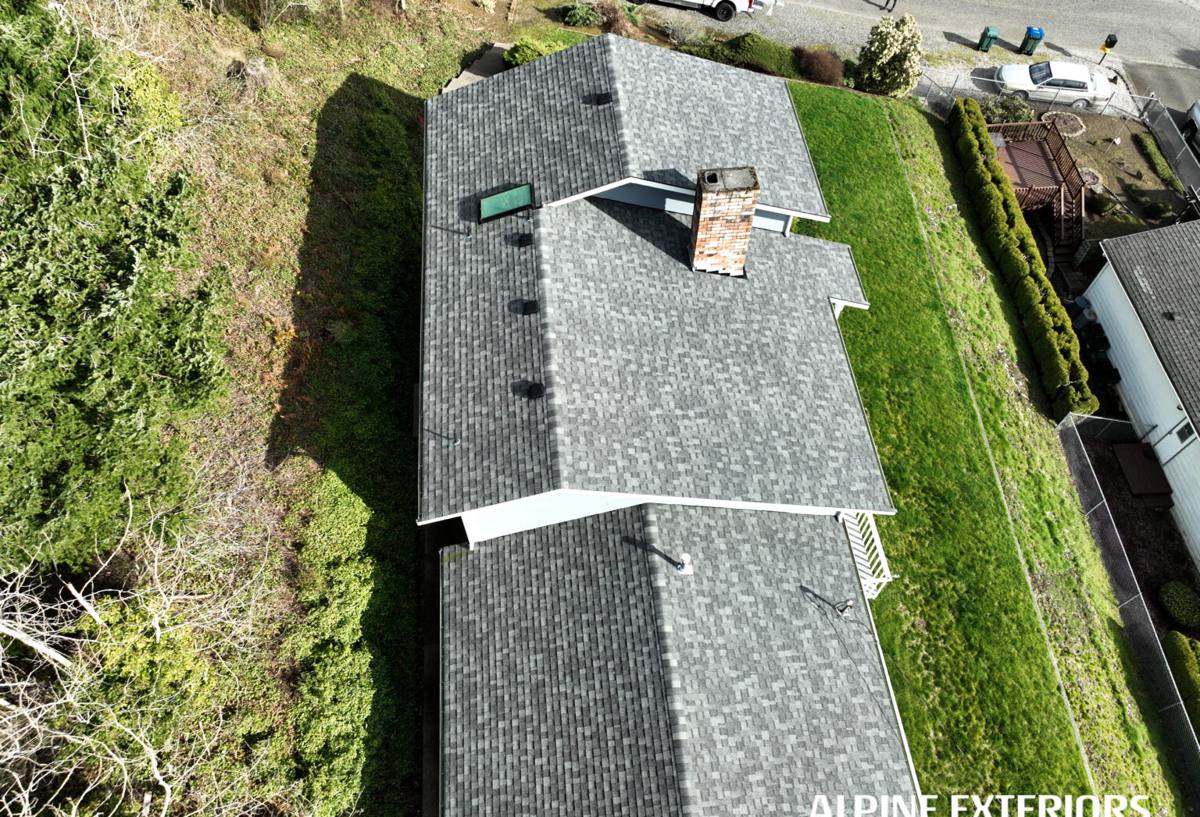
The Salt Air Problem
Salt air is corrosive to unprotected or lower-grade metal. On a roof, that shows up first in the small parts homeowners never think about: nail heads, flashing seams, vent boots, and the metal drip edge along eaves and rakes. Once corrosion starts on a fastener or a flashing seam, it doesn't stay small — it opens a path for water, and water finds the nearest wood to soften.
This is why a repair crew working near the water needs to think about material grade, not just matching shingle color. Standard electro-galvanized fasteners and lightweight flashing hold up fine a few miles from the shoreline, but they're the wrong call for a bay-facing roof. It's a judgment call that only shows up if the estimator actually looks at what's failing and why, rather than just patching the visible leak.
What Salt Exposure Actually Damages
- Fasteners and nail heads — surface rust spreads and eventually lets shingles or panels work loose
- Flashing at valleys, chimneys, and roof-to-wall transitions — pinholes and seam failure let water in quietly
- Vent boots and pipe collars — rubber and low-grade metal collars degrade faster in salt air and UV combined
- Gutter systems and drip edge — corrosion here backs water up under the roof edge instead of carrying it away
Driving Rain and Wind-Driven Water Intrusion
Anacortes gets its share of storms rolling in off the water, and wind-driven rain behaves differently than a straight downpour. It gets pushed sideways and upward under shingle laps, around vent penetrations, and into any gap in the flashing that would never leak in calm conditions. That's why a roof can look fine in dry weather and still leak reliably every time the wind kicks up out of a certain direction.
Diagnosing this kind of leak takes more than looking at the spot on the ceiling. It usually means tracing water back along rafters or sheathing to find where it actually entered, which can be several feet from where it shows up inside. A repair that just seals the interior stain without finding the true entry point is a temporary fix at best.
Moss, Debris, and a Long Wet Season
Flounder Bay's tree cover and the region's mild, damp winters give moss a long growing season. Moss holds moisture against the roof surface, lifts shingle edges as it grows, and traps organic debris in valleys and behind chimneys where water should be draining freely instead. Left alone, it accelerates granule loss on asphalt shingles and can work into seams on other roofing materials.
Moss removal has to be done carefully — aggressive scraping or pressure washing can do more damage than the moss itself by stripping granules or lifting shingle tabs. A proper repair addresses both the existing moss and the conditions that let it take hold, which usually comes down to shade, debris buildup, and airflow across the roof deck.
What a Correct Roof Repair Actually Involves
A repair worth paying for starts with figuring out why the roof failed, not just where. That means:
- Full inspection, not just the leak spot — checking flashing, fasteners, underlayment condition, and ventilation across the whole roof plane, since salt air and moss damage rarely stay contained to one area
- Identifying the actual water path — tracing intrusion from the interior symptom back to the real entry point, especially for wind-driven leaks
- Matching or upgrading materials appropriately — using corrosion-resistant fasteners and flashing where salt exposure warrants it, even if that costs a bit more than standard hardware
- Correcting the underlying cause — clearing debris paths, addressing moss, or improving ventilation so the same failure doesn't recur
- Verifying the repair once complete — checking the work holds under the next real weather event, not just a visual sign-off
Skipping any of these steps is how a homeowner ends up paying for the same repair twice.
Repair or Replace? Cost and Condition Factors
Not every roof problem in Flounder Bay calls for a full replacement, and not every leak is a quick, cheap fix either. The right call depends on the roof's age, how widespread the damage is, and how many prior repairs it's already had.
| Factor | Favors Repair | Favors Replacement |
|---|---|---|
| Roof age | Under 15-20 years, depending on material | Near or past expected service life |
| Damage extent | Isolated to one area (flashing, one valley, a few shingles) | Widespread granule loss, multiple leak points |
| Fastener/flashing corrosion | Localized, caught early | Corrosion spread across multiple roof planes |
| Prior repair history | First or second repair | Repeated patches in the same areas |
| Underlying decking condition | Solid, no rot found | Soft spots or rot found during inspection |
An honest inspection will tell you which column your roof falls into. We'd rather give a homeowner a straight answer that saves money on a solid repair than talk them into a replacement they don't need yet — and we'll also tell you plainly when a repair is just delaying an inevitable replacement.
Materials and Fasteners Suited to Bay-Facing Exposure
For roofs facing the kind of salt air and wind Flounder Bay sees, we lean toward hardware built for the exposure rather than whatever is standard elsewhere in Skagit County:
- Stainless steel or higher-grade coated fasteners in place of standard electro-galvanized nails, especially near the shoreline-facing side of the roof
- Properly lapped and sealed flashing at valleys, chimneys, and wall transitions, sized generously rather than to the bare minimum
- Durable pipe boots and vent collars rated for UV and moisture exposure rather than the cheapest available option
- Ice-and-water shield or equivalent underlayment at eaves and valleys, which does double duty against wind-driven rain and ice dams during cold snaps
We're not chasing brand names here — we're matching materials to what the site actually demands. A fastener or flashing choice that's overkill on an inland roof is often just appropriate on a Flounder Bay roof.
Our Repair Process
We keep the process straightforward:
- Inspection and estimate — we look at the whole roof, explain what we find in plain terms, and give you a written scope before any work starts
- Root-cause diagnosis — especially important for wind-driven leaks and recurring moss issues, since patching the symptom without finding the cause wastes your money
- The repair itself — done with materials appropriate to the exposure, not just whatever's fastest
- Cleanup and debris removal — including clearing moss and organic material that contributed to the problem in the first place
- Follow-up — we stand behind the work and want to know if anything shows up after the next real storm
Repairs typically don't require a permit through the City of Anacortes unless structural work is involved; larger replacement projects usually do. We handle that paperwork when it applies so you don't have to track it down yourself.
Signs You Need a Roof Repair Now, Not Later
A lot of roof damage in this area is quiet until it isn't. Watch for:
- Visible moss buildup, especially in shaded valleys or behind chimneys
- Rust streaks below flashing, vents, or metal fasteners
- Granules collecting in gutters or at the base of downspouts
- Water stains on ceilings that only appear after wind-driven storms
- Lifted, curling, or missing shingles along roof edges facing the water
- Soft or spongy spots when walking the roof or attic decking
- Daylight visible through the roof deck from inside the attic
Catching any of these early is almost always cheaper than waiting for an active leak to show up inside the house.
Why Local Experience in Flounder Bay Matters
A crew that's worked waterfront roofs in this part of Skagit County knows what to check first — they've seen how fast salt air corrodes standard hardware here, how moss behaves under this area's tree cover, and where wind-driven rain tends to find its way in on homes facing the bay. That experience shortens the diagnosis phase and means fewer surprises once the repair is underway. It also means realistic expectations about material choices and cost, instead of a one-size-fits-all approach borrowed from drier, more sheltered neighborhoods.
If you're dealing with a leak, visible moss, or just want an honest read on your roof's condition before it becomes a bigger problem, we're happy to take a look. The estimate is free, there's no pressure to move forward, and you'll get a straight answer about what your roof actually needs — use the form below to get started.