 Anacortes Window
 Decking Built for Mount Vernon's Weather, Not Just Its Looks
Mount Vernon sits in a stretch of Skagit County where marine air, long wet winters, and a heavy moss season put real stress on outdoor structures. Homes here deal with driving rain off the Salish Sea corridor, persistent humidity, and shaded yards that stay damp long after the rain stops. A deck that looks good on installation day but wasn't detailed for this climate will show its age fast — cupping boards, black staining in low-light corners, and fasteners that back out as wood moves through repeated wet-dry cycles.
Composite decking earns its keep here because it doesn't absorb water the way wood does, doesn't need annual staining, and resists the algae and moss growth that thrives in shaded, damp Skagit Valley yards. But composite is only as good as the substructure under it and the details around it. This page covers what a correctly built composite deck looks like for a Mount Vernon home, not just what the product brochure promises.
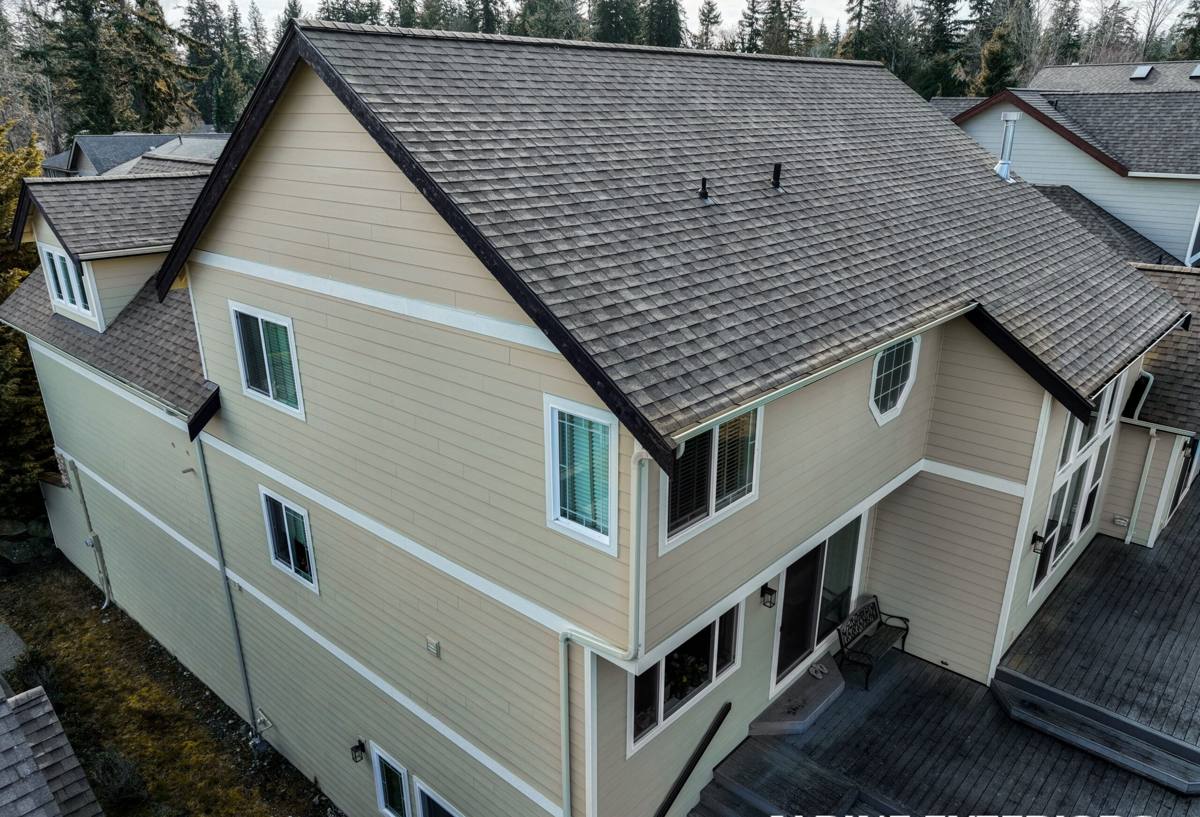
What Local Conditions Actually Demand From a Deck
Moisture Management
Rain in this region tends to come in long, soaking stretches rather than short bursts. That means moisture has time to work into any gap, fastener hole, or ledger connection that wasn't sealed correctly. The framing and flashing details matter as much as the decking material itself — a beautiful composite surface over a poorly flashed ledger board or unsealed joist tops will still lead to rot and water intrusion underneath, even though the decking on top never shows it.
Moss and Algae
Shaded lots and north-facing decks around Mount Vernon are prone to moss and algae buildup, especially where boards run tight against siding or fencing that blocks airflow. Board spacing, ventilation under the deck, and surface texture all affect how much moss takes hold and how easy it is to keep clean.
Salt Air Exposure
While Mount Vernon is inland from the immediate coastline compared to some Skagit County communities, the region still sees salt-influenced air moving up the valley, which accelerates corrosion on lower-grade fasteners, hidden clips, and metal railing hardware. Fastener and hardware selection isn't a place to cut corners here.
Temperature Swings
Composite materials expand and contract with temperature, and the Skagit Valley sees enough swing between summer afternoons and winter mornings that gapping and fastening have to account for movement — not just fit tight on install day.
What a Correctly Built Composite Deck Includes
- Pressure-treated or properly protected framing rated for ground contact where required
- Ledger board flashing that directs water away from the house structure, not into it
- Joist tape or a sealing membrane over the tops of joists to stop moisture wicking into the frame
- Corrosion-resistant, code-rated fasteners and hidden fastening systems sized for coastal-influenced air
- Proper board gapping for both drainage and thermal movement
- Ventilation clearance underneath the deck to reduce trapped moisture and moss growth
- Railing and stair connections that meet current code for spacing and load, not just what looks right
Skipping any one of these doesn't necessarily show up in year one. It shows up in year four or five, usually as soft framing, staining, or a railing post that's started to work loose — problems that cost more to fix after the fact than they would have to do right the first time.
Composite vs. the Alternatives
Homeowners in Mount Vernon usually compare composite against pressure-treated wood or cedar. Each has a legitimate place — the right call depends on budget, how much upkeep you want to take on, and how the deck will be used.
| Factor | Composite Decking | Pressure-Treated Wood | Cedar |
|---|---|---|---|
| Upfront cost | Higher | Lowest | Mid-to-high |
| Annual maintenance | Occasional wash | Stain/seal every 1-2 years | Stain/seal every 1-2 years |
| Moisture resistance | High — doesn't absorb water | Moderate, relies on treatment | Moderate, natural oils help but fade |
| Moss/algae resistance | Good, especially with capped boards | Poor in shaded areas | Fair |
| Expected lifespan (with proper build) | 25-30+ years | 15-20 years | 15-20 years |
| Appearance over time | Consistent, doesn't gray or splinter | Grays and splinters without upkeep | Grays without upkeep, ages naturally |
We install wood decking too when that's the right fit for a project's budget or a homeowner's preference for a natural material. But for most Mount Vernon homeowners who want to stop re-staining a deck every couple of summers, composite is the more honest long-term investment once you account for the maintenance costs wood carries over its life.
Fascia Boards, Fasteners, and Railings We Trust for This Climate
Not every composite board or hardware system holds up the same way under Skagit Valley conditions. We favor capped composite boards over uncapped — the cap layer resists moisture absorption and staining far better at the cut ends and board faces, which matters in a climate this wet. We're selective about fastener and hidden-clip systems too, choosing hardware rated for coastal or high-moisture environments rather than generic interior-grade fasteners that can corrode and streak the decking over time.
On railings, we lean toward systems with solid, code-compliant post connections and materials that won't corrode or degrade under the same salt-influenced air affecting the decking. If a manufacturer's product line doesn't hold up to scrutiny on moisture behavior or installation consistency, we'll say so and recommend an alternative — our standard is what performs reliably in this specific climate, not what's cheapest to install.
Our Process for a Mount Vernon Composite Deck
- On-site assessment: We look at drainage, sun/shade exposure, existing structure condition (if replacing an old deck), and how the space will actually be used.
- Design and material selection: Board color, railing style, and layout, matched to your home and budget — with honest guidance on which composite lines perform best for a shaded or exposed Mount Vernon lot.
- Permitting: We handle the permit process with the City of Mount Vernon or Skagit County as applicable, so the structure meets current code from the start.
- Demolition and framing: Old decking removed, framing inspected and repaired or rebuilt as needed, ledger flashing and joist protection installed correctly.
- Decking and railing installation: Boards installed with proper gapping and fastening, railings set to code.
- Final walkthrough: We check every connection and go over basic care with you before we consider the job done.
Why Hiring a Crew That Knows Mount Vernon Matters
A deck built to a generic national spec doesn't account for the fact that Mount Vernon's weather pattern is different from a drier inland region or a fully coastal one. We work in Skagit County regularly, which means we already know how local permitting works, what framing details actually hold up through a Pacific Northwest wet season, and where moss and moisture problems tend to show up first on a shaded lot. That local experience shows up in the small decisions — flashing details, fastener choice, board spacing — that determine whether a deck is still solid in year fifteen or needs framing repair by year six.
Maintenance: What Owning a Composite Deck Actually Looks Like
Composite decking is low-maintenance, not no-maintenance. In a climate like this, a few habits go a long way:
- Rinse or sweep off debris and standing moisture regularly, especially in shaded areas
- Wash the deck surface once or twice a year to prevent moss and algae buildup before it takes hold
- Keep gutters and downspouts clear so water isn't dumping directly onto or under the deck
- Trim back vegetation that shades the deck and keeps it damp longer than it needs to be
- Check railing connections annually for any looseness
None of this is heavy work, but skipping it entirely in a climate this wet will shorten the life of even a well-built deck.
What This Costs
Composite decking costs more upfront than pressure-treated wood, largely due to material cost, but the gap narrows significantly once you factor in years of staining and sealing that wood requires. Final project cost depends on deck size, framing condition, railing style, and site access — every Mount Vernon property is a little different, especially on sloped or shaded lots where extra framing or drainage work is often needed. We'll give you a clear, itemized estimate after seeing the site, not a rough number pulled from a national average.
If you're planning a new deck or replacing an aging one, we're happy to take a look and walk you through your options honestly — no pressure, no upsell. Fill out the form below to schedule a free estimate for your Mount Vernon property.