 Anacortes Window
 Why Conway's Climate Is Hard on Siding
Conway sits in the low-lying flats of the Skagit River valley, close enough to Skagit Bay and the Salish Sea that homes here deal with a mix of salt-laden air, heavy seasonal rain, and long stretches of damp, low-light weather that keeps moisture sitting on exterior walls far longer than it does in drier parts of the state. That combination is tough on siding no matter what it's made of. Salt air accelerates corrosion of fasteners and metal trim. Driving rain off the water finds every gap, seam, and nail hole that wasn't sealed correctly the first time. And the long moss season — often stretching from fall through spring in this part of Skagit County — means north-facing and shaded walls stay wet and grow organic growth that traps moisture against the siding surface.
None of this means Conway homes are doomed to constant siding trouble. It means siding here needs to be installed and repaired with those specific conditions in mind, not treated the same way you'd treat a house in a dry inland climate.
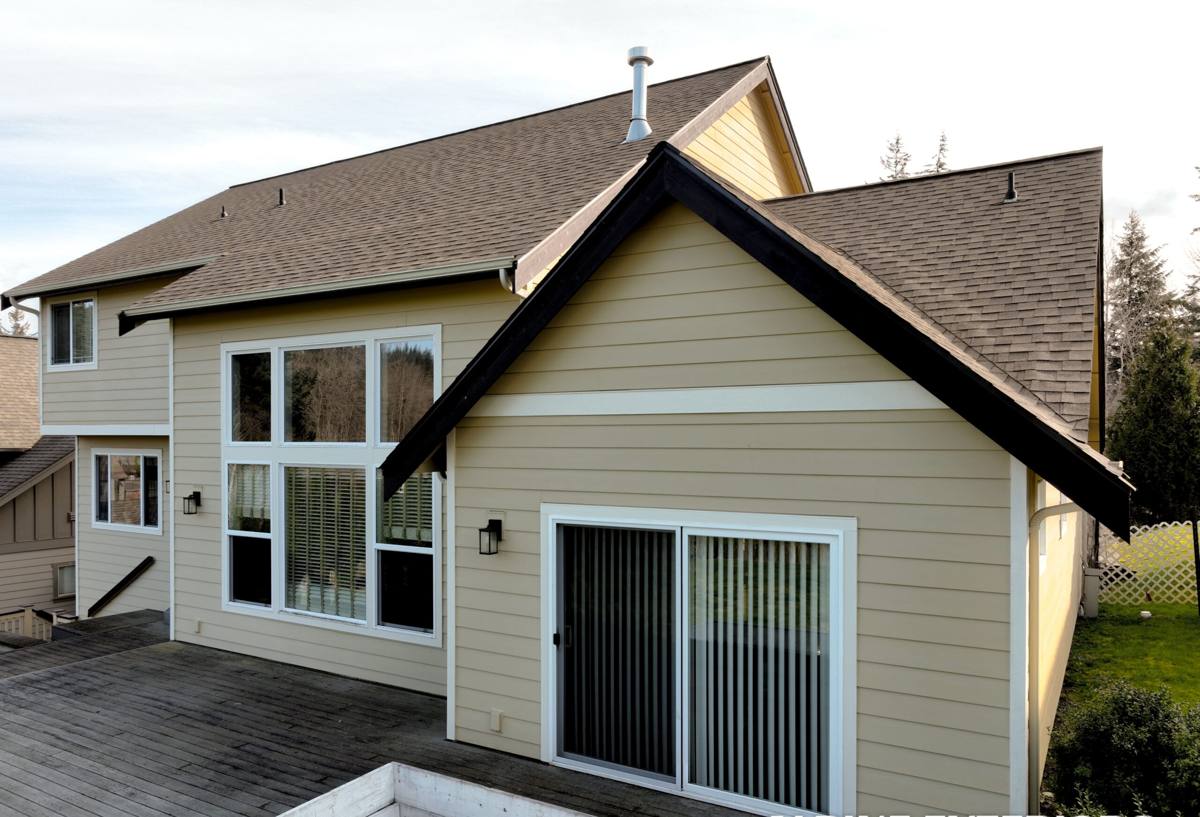
Common Siding Problems We See in Conway
Moisture and Rot
Wood-based and improperly sealed siding products absorb water at seams, butt joints, and anywhere caulking has failed. Once moisture gets behind the siding, it can sit against sheathing and framing for weeks during a wet Skagit County winter, leading to soft spots, delamination, or rot that isn't visible until you press on the board.
Moss and Mildew Staining
Shaded and north-facing walls, fence lines, and areas under overhangs are prone to moss and mildew growth. Beyond the cosmetic issue, moss holds water against the siding surface, which is exactly the kind of sustained dampness that shortens the life of any siding material.
Impact and Age Damage
Cracked or chipped boards, loose panels, and failed caulk joints are common simply from age and weather cycling — siding expands and contracts with temperature and moisture swings, and over years that movement stresses joints, trim, and fastener points.
Signs It's Time to Call for a Repair
Most siding problems are easier and cheaper to fix the earlier they're caught. Homeowners in Conway should walk their home's exterior at least once or twice a year and watch for:
- Soft, spongy, or bubbling sections of siding, especially near the ground or under windows
- Visible cracks, splits, or missing pieces of siding or trim
- Peeling or bubbling paint, which often signals moisture trapped underneath
- Dark streaking, green or black growth, or a persistently damp look on shaded walls
- Gaps at seams, corners, or window and door trim where caulking has failed
- Warping or buckling panels that no longer sit flat against the wall
- A musty smell or visible staining on interior walls that back up to exterior siding
Any one of these on its own may be a small, contained repair. Several at once, especially on the same wall, usually means moisture has been getting in for a while and the repair needs to start with finding out how far it's spread.
What a Correct Siding Repair Actually Involves
A siding repair that's done right isn't just about swapping a damaged board for a new one. It starts with figuring out why that board failed in the first place — because if the underlying cause isn't addressed, the replacement piece will eventually fail the same way. A proper repair process includes:
- Removing the damaged section carefully to avoid cracking adjacent boards
- Checking the house wrap, flashing, and sheathing underneath for water damage or gaps
- Repairing or replacing any compromised weather barrier before new siding goes back on
- Re-flashing windows, doors, or penetrations if that's where water was getting in
- Installing new siding with correct fastening, spacing, and caulking per manufacturer spec
- Matching color, texture, and reveal so the repair blends with the surrounding siding
Skipping the second and third steps is the most common shortcut in siding repair, and it's the reason the "same spot" keeps failing every couple of years. A patch on top of an unresolved moisture problem is a temporary fix, not a repair.
Repair or Replace? How We Help You Decide
Not every damaged wall needs full replacement, and not every problem area should just be patched. The right call depends on how much of the wall is affected, what's causing the damage, and how old the existing siding is.
| Situation | Usually a Repair | Usually Points to Replacement |
|---|---|---|
| Damage location | Isolated to one or two boards or a small section | Spread across a wall or multiple walls |
| Cause | Impact damage, a single failed caulk joint, or localized flashing issue | Widespread moisture intrusion or systemic installation flaws |
| Siding age and condition | Siding is otherwise sound and well-maintained | Siding is near end of life or already failing in several places |
| Underlying structure | Sheathing and house wrap test dry and intact | Sheathing shows rot or the weather barrier has failed broadly |
| Product match | Existing siding is still available or a close match is achievable | Product is discontinued or a seamless match isn't realistic |
We'll always tell you honestly which category your home falls into. There's no reason to sell a Conway homeowner a full re-side when a targeted repair will hold up — and no reason to keep patching a wall that's telling you it's done.
Why We Repair — and Replace — Only With James Hardie Fiber Cement
When a repair calls for new siding material, we use James Hardie fiber cement, and only James Hardie. We don't install or repair with LP SmartSide, vinyl, Cemplank, Allura, primed spruce, or cedar. That's a deliberate standard, not a brand preference for its own sake.
Fiber cement doesn't absorb water the way wood-based products can, which matters directly in a climate where wet weather sticks around. It's non-combustible, holds its factory-applied ColorPlus finish far longer than field-painted materials, and Hardie's HZ product lines are engineered for the moisture and temperature swings of Pacific Northwest climates specifically — including the kind of salt-air, high-humidity conditions Conway sits in. When we repair a section of Hardie siding, the replacement piece is made to hold up the same way the rest of the wall does, and it's backed by a strong transferable manufacturer warranty rather than a shorter or more limited one.
If your current siding is a wood, vinyl, or engineered wood product and it's failing, we'll still repair it honestly where a repair makes sense. But when the conversation turns to full replacement, our recommendation is Hardie, and we'll explain exactly why rather than just asserting it.
Our Siding Repair Process in Conway
We approach every repair call the same methodical way, because guessing at a moisture problem usually costs more in the long run than diagnosing it properly up front.
- On-site assessment. We inspect the damaged area and the surrounding siding, not just the spot you called about, since moisture problems rarely stay contained to one board.
- Diagnosis. We check the source — flashing, caulk failure, moss buildup, grading or drainage issues near the foundation — so the repair fixes the cause, not just the symptom.
- Honest scope and estimate. You get a clear explanation of what needs to happen and why, in plain terms, before any work starts.
- Repair. Damaged material comes off, the weather barrier and flashing are corrected as needed, and new material goes back on to spec.
- Finish and match. We match color and reveal as closely as the existing siding allows so the repair doesn't stand out.
- Prevention notes. We'll flag anything else worth watching — a moss-prone wall, a marginal caulk joint elsewhere — so you're not caught off guard next season.
Why Hiring a Crew That Already Works in Conway Matters
Siding repair isn't one-size-fits-all across Washington. A contractor who mostly works drier, inland areas may not think twice about a caulk joint or flashing detail that's fine in Wenatchee but inadequate for a wall that takes direct rain off Skagit Bay for months at a time. A crew that regularly works Conway and the surrounding Anacortes and Skagit County area already knows which walls in this kind of setting take the worst weather, how moss and moisture actually behave on local homes through the wet season, and what a repair needs to survive here — not just look fine on the day it's finished.
That local familiarity also means faster, more accurate diagnosis. We're not guessing at how Skagit County winters treat a given wall orientation or siding detail — we've seen it repeatedly on homes near yours.
Keeping Your Siding Ahead of the Next Repair
A repair is a good moment to also get ahead of the next one. Simple maintenance habits go a long way in a climate like this:
- Keep gutters clean and downspouts directed away from the foundation so water isn't sheeting down walls
- Trim back vegetation and tree cover on shaded sides to cut down on moss growth
- Re-check and refresh caulking at seams and trim every few years, since caulk fails well before siding does
- Rinse moss and mildew off siding gently rather than letting it build up over multiple seasons
- Walk the exterior after major storms to catch new damage early
These habits won't eliminate the need for repairs entirely — no siding is maintenance-free in this climate — but they meaningfully stretch the time between them.
If you're seeing damage, staining, or soft spots on your Conway home's siding, we're happy to take a look and give you a straightforward, no-pressure estimate on what it would take to fix it right. Use the form below to get started.