 Anacortes Window
 Why West Anacortes Decks Wear Out Faster Than the Manuals Say
Fidalgo Island sits surrounded by marine water, and homes on the west side of Anacortes catch the full effect of that: salt-laden air, wind-driven rain that gets pushed sideways under railings and against ledger boards, and a wet season that runs long even by Skagit County standards. A deck built to a generic national spec, without accounting for that combination, tends to show its age years before it should.
Salt air accelerates corrosion on anything metal — fasteners, joist hangers, post bases, and railing hardware. Driving rain doesn't just fall straight down here; it drives in at an angle, which means water finds its way into joints, ledger connections, and end grain that a drier climate would never test. And the moss season is long: shaded or north-facing sections of a deck can stay damp for weeks at a stretch, which is exactly the environment moss, algae, and rot fungi need to take hold.
None of that means a deck in West Anacortes is doomed. It means the build has to be matched to the conditions — the right fasteners, the right flashing details, the right drainage, and decking that can handle sustained moisture without breaking down. That's the standard we build to on every replacement.
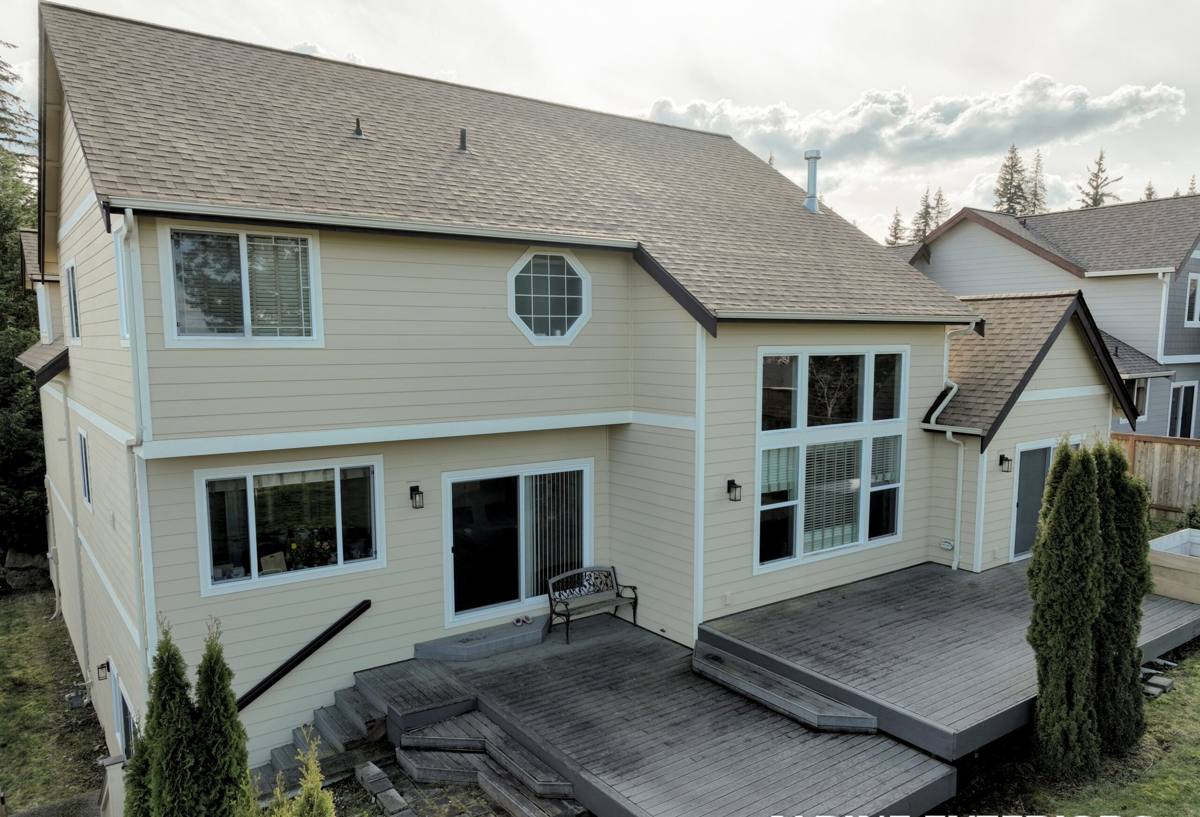
Signs a Deck Needs Replacement, Not Another Repair
Homeowners often call us thinking they need a few boards swapped, and sometimes that's true. But there's a point where patching a deck costs more over time than replacing it, and it's worth knowing where that line is.
- Soft, spongy, or spring-back decking in multiple areas, not just one board
- Rot or splitting at the ledger board — where the deck attaches to the house
- Rusted, corroded, or missing joist hangers and structural fasteners
- Posts or footings that have shifted, settled, or show visible rot at ground contact
- Railings that flex or feel loose when leaned on — a safety issue, not cosmetic
- Persistent moss or algae staining that keeps returning within weeks of cleaning
- A deck older than 15-20 years built with older fastener or flashing standards
If the framing underneath is sound and it's really just surface boards showing wear, repair or resurfacing can make sense. If the problems are structural — ledger, footings, or framing — replacement is almost always the more honest answer, because you don't want to spend money re-skinning a deck that isn't safe underneath.
Why Repairs Sometimes Just Delay the Real Problem
A common pattern we see on older West Anacortes decks: the visible decking gets replaced at some point, but the ledger flashing, joist hangers, and post bases underneath never get touched. A few years later, the new boards are fine but the structure underneath has kept rotting quietly, hidden by the fresh surface. That's why we always evaluate the framing before recommending a resurface over a full rebuild — a deck is only as good as what you can't see.
What a Correct Deck Replacement Actually Involves
A deck replacement done right isn't just pulling old boards and nailing down new ones. In a climate like this, the parts you don't see matter more than the parts you do.
Ledger and House Connection
This is the single most important connection on the whole structure, and it's the one most likely to fail from water intrusion in a wet climate. A correct install uses proper flashing that sheds water away from the house framing, not just a bead of caulk over the top edge, plus structural fasteners rated for the load and spaced to code.
Framing and Footings
Joists, beams, and posts need to be sized for the actual span and load, not just "what was there before." Footings need to sit below frost depth and bear on solid, undisturbed soil — something worth checking carefully given how much rain saturates the ground here through the winter months.
Fasteners and Hardware
In a salt-air environment, fastener choice isn't a minor detail. Hot-dip galvanized or stainless hardware resists corrosion far longer than standard coated fasteners, and mismatched metals (the wrong screw in the wrong hanger) can actually accelerate corrosion through galvanic reaction. We match every fastener and connector to the decking and framing material being used.
Drainage and Airflow
Water needs somewhere to go, and air needs to move underneath the deck to let framing dry out between rain events. Proper spacing between boards, grading away from the house, and keeping vegetation from choking off airflow underneath all reduce the moisture load that leads to rot and moss.
Decking Material Options: What Actually Holds Up Here
There's no single "best" decking material for every home — it depends on budget, maintenance appetite, and how exposed the deck is to weather. Here's an honest comparison of the main options we install and repair.
| Material | Moisture Behavior | Maintenance | Relative Cost |
|---|---|---|---|
| Pressure-treated lumber | Resists rot when properly sealed; needs re-sealing regularly in wet climates | High — annual cleaning and periodic re-staining/sealing | Lowest upfront |
| Cedar | Naturally rot- and insect-resistant, but still needs finish maintenance to fight graying and moisture uptake | Moderate to high | Mid-range |
| Composite decking | Doesn't absorb water or rot; some early-generation products had moisture issues at cut ends, modern capped composites handle it well | Low — periodic washing, no sealing/staining | Higher upfront |
| PVC/vinyl decking | Fully water-resistant, unaffected by rot or insects | Lowest — occasional wash-down | Highest upfront |
In a salt-air, high-moisture area like West Anacortes, we generally steer homeowners who want a low-maintenance long-term deck toward a quality capped composite or PVC product, and homeowners who want a traditional wood look toward cedar with a clear maintenance plan they're comfortable keeping up with. Both are legitimate choices — the trade-off is upfront cost versus ongoing upkeep, and we'll walk through that honestly based on your budget and how you actually use the space.
Our Deck Replacement Process
- On-site assessment. We inspect the existing deck, ledger, framing, and footings to determine what's actually failing and whether replacement or repair makes sense.
- Design and material selection. We go over decking materials, railing options, and layout, matched to your budget and how exposed the site is to sun, shade, and weather.
- Permitting. Most deck replacements in Anacortes require a permit through the City, especially for elevated decks or any structural work tied to the house. We handle that process rather than leaving it on you.
- Demolition and disposal. The old deck comes out, including hardware and any rotted framing, with the site left clean.
- Rebuild from the ground up. Footings, framing, ledger flashing, decking, and railings are installed to code, with fastener and flashing choices matched to the local climate.
- Final walkthrough. We go over the finished deck with you, including any maintenance recommendations specific to the material you chose.
Permits and Code Considerations in Anacortes
Deck work in Anacortes typically falls under the City's building permit requirements, particularly once a deck is attached to the house or elevated above a certain height. Skagit County's building and environmental regulations can also come into play depending on the property — proximity to shorelines or critical areas can trigger additional review in some parts of the city. Skipping permits on a deck rebuild isn't just a legal risk; it can also create real problems at resale, since unpermitted structural work often gets flagged during a home inspection. We pull the appropriate permits as part of the job so you're not left sorting that out after the fact.
What to Check Before You Hire Anyone for Deck Replacement
- Are they licensed, bonded, and insured in Washington State?
- Will they pull the required City of Anacortes permit, or expect you to?
- Do they inspect the ledger and framing before quoting, or just quote based on square footage?
- Do they specify fastener and hardware grade in the estimate (galvanized vs. stainless vs. standard)?
- Can they explain the trade-offs between decking materials in plain terms, without pushing one product regardless of your situation?
- Do they have current, verifiable experience working on homes in this specific area and climate?
Why Local Experience in West Anacortes Matters
A deck built for a dry inland climate and a deck built for a home a few blocks from the water are not the same project, even if they look identical from the street. A crew that regularly works in West Anacortes already knows which fastener grades hold up, which framing details keep water out of a ledger connection, and which decking products actually perform through a long, wet Skagit County winter rather than just looking good on a showroom sample. That experience shows up in the details — flashing laps, hardware choice, drainage grading — long before it would ever show up as a visible problem.
It also means fewer surprises during the permit process, since local crews are familiar with what the City of Anacortes expects to see on a deck permit application, and fewer callbacks after the job, because the build was matched to the actual conditions the deck will face.
Caring for Your New Deck Through the Wet Season
Whatever material you choose, a little seasonal attention goes a long way in this climate. Keep debris out of the gaps between boards so water and organic matter don't collect and feed moss growth. Clean shaded or north-facing sections more often, since they dry out slower. If you chose wood, plan on resealing or restaining on the schedule the product calls for — skipping a cycle in a climate this wet lets moisture in fast. Composite and PVC decking need far less attention, but an occasional wash-down still keeps salt residue and organic buildup from dulling the surface over time.
Get a Straightforward Estimate
If your deck is showing its age, or you're just not sure whether it needs a repair or a full replacement, we're happy to take a look and give you an honest read on where things stand. There's a free, no-pressure estimate form below — reach out and we'll walk the site, answer your questions, and give you a clear picture of your options.