 Anacortes Window
 March Point's Siding Problem Is Water, Not Weather
March Point sits on a low peninsula surrounded by water on several sides, which means homes here don't get "weather" in the abstract sense — they get wind-driven rain coming off the bay, near-constant salt air, and long stretches of gray, damp months where siding rarely gets a chance to fully dry out. That combination is harder on exterior materials than most homeowners realize until they're dealing with the results: chalky paint, soft trim, streaking, or siding that's holding moisture behind it without any visible sign until a board starts to fail.
Fiber cement siding was engineered specifically for climates like this. It doesn't absorb water the way wood does, it doesn't corrode the way some metal trims do, and it holds paint and factory finish far longer than wood siding exposed to salt-laden air. But "fiber cement" isn't a single product with a single outcome — how it's engineered, finished, and installed determines whether it holds up on a peninsula like March Point for thirty-plus years or starts showing problems in five.
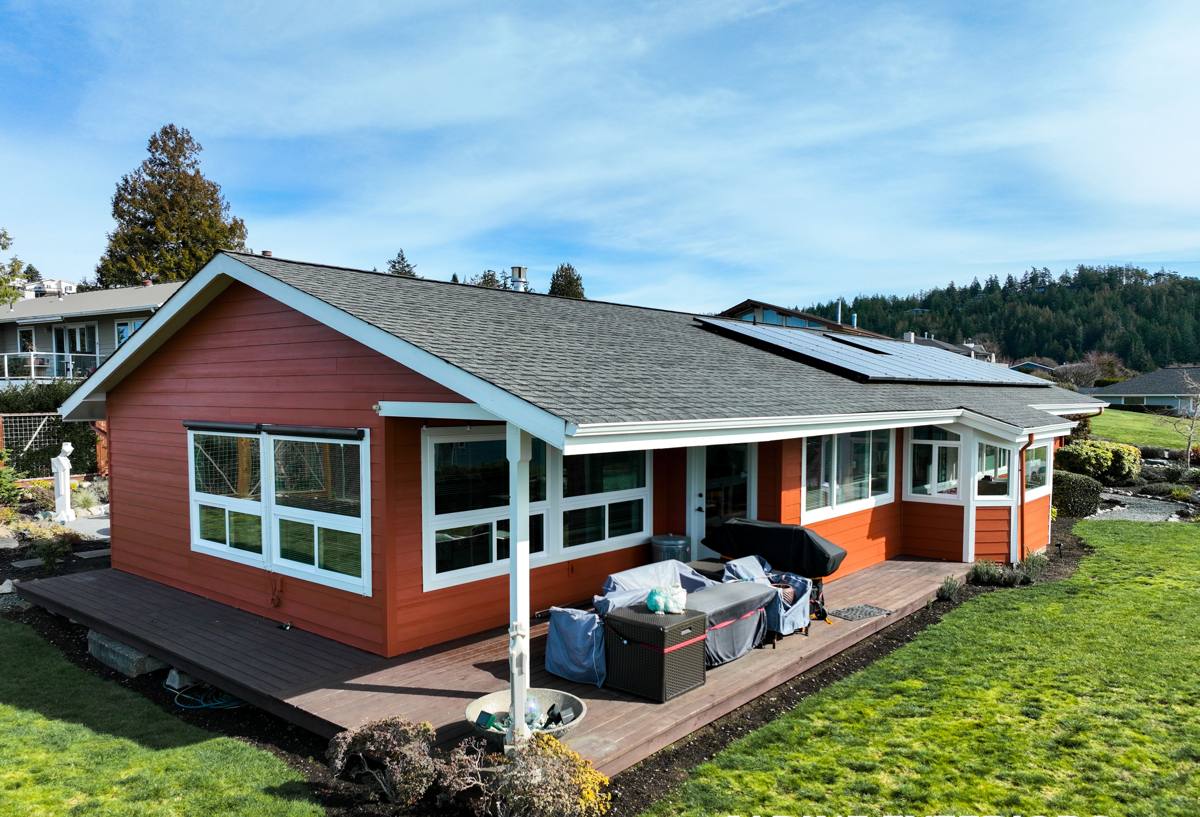
What Salt Air and Moss Season Actually Do to Siding
It's worth being specific about the mechanisms, because they drive every decision in a correct siding job here in Skagit County:
- Salt air accelerates the breakdown of paint film and speeds corrosion of exposed fasteners, flashing, and trim hardware that isn't rated for coastal exposure.
- Wind-driven rain doesn't just hit siding — it gets pushed sideways and upward at laps, seams, and penetrations, which is where most water intrusion problems actually start.
- Long moss season means constant low-level moisture and organic growth on north-facing and shaded walls, which holds water against the surface longer than direct rain does.
- Extended damp stretches mean siding assemblies rarely get a full dry-out cycle, so any built-in moisture management (or lack of it) matters more here than in drier parts of the state.
None of this is unique to March Point specifically, but the exposure is more constant here than in more sheltered parts of Anacortes, simply because of how much water surrounds the peninsula and how directly the wind can drive rain into a wall.
Why We Only Install James Hardie Fiber Cement
We install James Hardie exclusively — not LP SmartSide, not vinyl, not primed wood, not other fiber cement brands. That's a standard we hold across every job, and it matters more, not less, in an exposure like March Point's.
The material itself
Hardie's fiber cement is non-combustible and dimensionally stable — it doesn't expand and contract with moisture the way wood-based products do, which means fewer seams opening up over time and less opportunity for water to find a way behind the siding. For a coastal or near-coastal property, that stability is the difference between a wall system that stays tight for decades and one that needs recaulking and touch-up paint every few years.
The finish
Hardie's ColorPlus factory finish is baked on under controlled conditions, not sprayed on-site. In a climate where field-applied paint has to cure in damp, cool air and rarely gets ideal conditions, a factory finish is a real advantage — it's more consistent, resists fading and chalking longer, and comes with its own finish warranty separate from the substrate warranty.
The HZ5 engineering
Hardie makes climate-specific product lines, and the HZ5 line is engineered for the freeze-thaw and moisture-heavy conditions common to the Pacific Northwest. That's not a marketing distinction — it affects the product's moisture resistance and how it performs over a long, wet installed lifespan.
What a Correct Installation Actually Involves
The product only performs as well as the installation behind it. In a high-moisture, salt-exposed area like March Point, a handful of details separate a job that lasts from one that fails early — and most of them are invisible once the siding is up.
Rainscreen and drainage
A proper installation includes a drainage gap between the water-resistive barrier and the siding, so any moisture that does get past the outer layer has somewhere to go instead of sitting against the sheathing. This matters everywhere, but especially where wind-driven rain is a regular event rather than an occasional storm.
Flashing and fastening
Every window, door, and penetration needs flashing detailed to shed water outward, not trap it. Fasteners and any exposed trim hardware should be corrosion-resistant and rated for coastal or near-coastal exposure — standard interior-grade hardware corrodes faster in salt air and can stain the siding as it does.
Clearances and gaps
Hardie's own installation specifications call for minimum clearances from grade, roofing, and decking, plus specific gaps at butt joints and trim. Skipping these to save time is one of the most common ways a fiber cement job fails prematurely — not because the material is weak, but because water was allowed to sit where it shouldn't.
Caulking and sealant
Sealant needs to be a paintable, high-quality exterior-grade product applied at the joints Hardie specifies — not everywhere, since over-caulking can trap moisture just as badly as under-caulking. Getting this balance right takes experience with the product, not just a caulk gun and general instinct.
| Detail | Why It Matters at March Point |
|---|---|
| Drainage gap / rainscreen | Gives wind-driven rain a path out instead of trapping it against the sheathing |
| Corrosion-resistant fasteners | Salt air accelerates rust on standard hardware, leading to streaking and loosened boards |
| Proper clearances from grade/roofing | Prevents constant moisture wicking in a climate that rarely fully dries out |
| Factory ColorPlus finish | More consistent and durable than field-applied paint cured in damp, cool conditions |
| HZ5 product line | Engineered for Pacific Northwest moisture and freeze-thaw conditions specifically |
How Our Process Works
We keep the process straightforward because the value is in getting the details right, not in a complicated sales process.
1. On-site assessment
We walk the exterior, check current siding and trim condition, look at drainage and grading around the foundation, and identify any moisture damage that needs to be addressed before new siding goes on — installing over a problem never solves it.
2. Product and color selection
We go over Hardie's plank profiles, panel options, and ColorPlus palette so you can choose a look that fits the home, with a clear explanation of what each option involves.
3. Prep and removal
Old siding comes off, sheathing gets inspected and repaired as needed, and the water-resistive barrier and drainage system go in correctly before a single piece of Hardie siding is installed.
4. Installation to spec
Installation follows Hardie's published specifications for fastening, clearances, and flashing — the same specifications that keep the manufacturer's warranty valid.
5. Final walkthrough
We review the completed job with you, cover basic care, and make sure everything meets both our standard and Hardie's installation requirements.
Maintenance in a Salt Air, High-Moss Environment
Fiber cement is low-maintenance compared to wood, but "low-maintenance" doesn't mean "no maintenance," especially this close to the water. A simple annual routine goes a long way:
- Rinse siding with a garden hose once or twice a year to clear salt residue and organic buildup, especially on shaded or north-facing walls prone to moss.
- Avoid pressure washing directly at seams and joints, which can force water past caulking rather than clean the surface.
- Walk the exterior after major windstorms and check for any loose or displaced trim, especially around windows and corners.
- Keep gutters clear so overflow doesn't run down the siding face repeatedly in one spot.
- Watch for caulking that's cracked or pulled away at joints and have it addressed before it becomes a water entry point.
Why Local Experience with March Point Specifically Matters
A crew that's worked on homes in this exposure knows which walls take the worst of the wind-driven rain, how much salt exposure to plan hardware around, and how the moss season affects timing and drying conditions during the job itself. That's different from general siding experience — it's familiarity with this specific stretch of Skagit County's coastline and how it behaves across a full year, not just on the day the estimate happens to be dry.
It also means fewer surprises. A contractor who already understands the site conditions around March Point isn't discovering drainage issues or corroded flashing for the first time on your job — they've seen the pattern before and know what to check.
Cost Factors Worth Understanding
Every home is different, so we don't quote broad numbers without seeing the property, but the factors that most affect cost are consistent:
| Factor | Why It Affects Cost |
|---|---|
| Extent of siding removal and sheathing repair | Hidden moisture damage found during tear-off adds labor and material |
| Home size and complexity of trim/architecture | More corners, windows, and trim detail means more labor time |
| Plank vs. panel selection | Product choice affects material cost and installation time |
| Access and site conditions | Waterfront or tight-lot properties can affect staging and equipment access |
If you're weighing siding replacement for a home in March Point, we're glad to walk the property, explain what we find, and put together a clear, no-pressure estimate — no obligation, just an honest look at what your home actually needs.