 Anacortes Window
 Why West Anacortes Decks Wear Out Faster Than the Manual Says
Every deck manufacturer publishes a lifespan number, and almost none of those numbers account for a marine climate like ours. West Anacortes sits close enough to the water that salt-laden air is a constant, low-grade stressor on every exposed fastener, hinge, and metal bracket on a deck. Add Skagit County's long, wet fall-through-spring stretch and the shade that many West Anacortes lots get from mature trees and hillside positioning, and you get a recipe for wood that stays damp far longer than it should between rain events.
None of that means a deck is doomed. It means the repair work has to account for moisture cycling and corrosion in ways that a dry-climate repair job never has to consider. A deck repaired correctly for this area should look at drainage, fastener material, and hidden framing just as much as the visible boards.
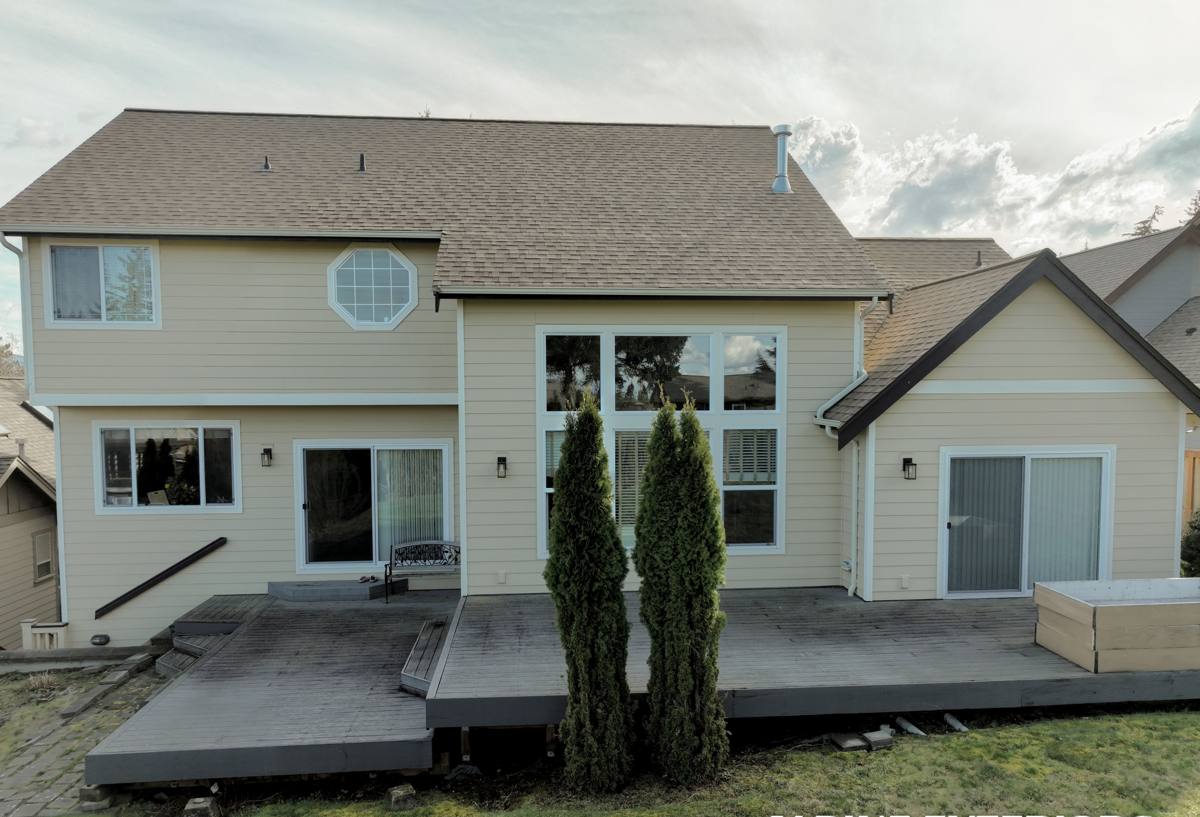
Warning Signs Worth Acting On
Most deck problems don't show up as a dramatic collapse — they show up as small, easy-to-ignore signals first. Catching these early is what keeps a repair a repair, instead of turning it into a full rebuild.
What to look for
- Boards that feel spongy or flex noticeably underfoot
- Rust streaks bleeding out from screw heads or joist hangers
- Gaps opening up where the deck meets the house (the ledger board)
- Railings or posts that wiggle more than they used to
- Green or black staining on the underside of boards or on framing
- Stairs that feel slightly springy or uneven step to step
Any one of these on its own might be minor. Two or three together usually means moisture has been getting into the structure for a while, and it's worth having someone look underneath, not just at the walking surface.
Where Deck Failures Actually Start
Homeowners often assume a failing deck means the decking boards themselves are bad. In our experience, the boards are frequently the last thing to fail — they're the part you can see, so they get replaced, painted, or sealed, while the real problem sits underneath.
The ledger connection
The ledger board — where the deck attaches to the house — is the single most important structural connection on most decks, and it's also the piece most exposed to water running off the house siding or roofline. A poorly flashed ledger lets water track behind it for years before anyone notices rot in the rim joist or sheathing.
Fasteners and hardware
Salt-influenced air accelerates corrosion in fasteners and joist hangers that aren't rated for it. We regularly find galvanized hardware that's held up fine inland but has started rusting through in coastal-influenced spots like West Anacortes, especially where it sits in a damp, shaded pocket.
Posts and footings
Posts that sit directly on or near grade, or footings that were never poured to the depth or size a deck this size actually needs, are a quiet long-term liability. Movement here shows up as a deck that feels slightly "off" — not obviously broken, just not solid.
Repair or Replace? How We Decide
Not every problem deck needs to be torn out. A lot of what looks like widespread failure is actually isolated damage that can be cut out and replaced without touching the rest of the structure. The honest answer depends on how much of the framing is still sound.
| Situation | Repair is usually enough | Replacement is worth considering |
|---|---|---|
| Decking boards | A handful of boards are cracked, cupped, or splintering | Most boards show the same wear at the same time (original installation is aging out together) |
| Framing | Rot is isolated to one joist or a section near a leak | Rot shows up in multiple joists or the rim joist itself |
| Ledger board | Flashing has failed but the rim joist behind it is still solid | Sheathing or rim joist behind the ledger has softened |
| Posts & footings | Hardware is corroded but posts and footings are sound | Footings are undersized, cracked, or posts are rotted at the base |
| Railings | Loose balusters or a wobbly section | Post connections throughout the railing system have failed |
We always open things up before quoting a repair as a repair. Guessing from the surface is how homeowners end up paying twice — once for a patch that didn't address the real problem, and again for the rebuild that follows a year or two later.
Our Deck Repair Process
Every job starts with getting underneath the deck, not just walking the surface. That's the only way to see what the ledger, joists, and posts are actually doing.
- Inspection from below and above — checking framing, connections, and drainage paths, not just the decking
- Probing suspect areas — a screwdriver or awl test on wood that looks discolored or feels soft tells us far more than a visual check alone
- Scoping the repair — an honest breakdown of what's structural versus cosmetic, so you know what you're actually paying for
- Removing and replacing only what's compromised — sound framing stays, damaged sections get cut back to solid wood
- Correcting the cause, not just the symptom — re-flashing a ledger, adding proper drainage, swapping to better-suited fasteners
- Final check — confirming the deck is solid, level, and draining the way it should before we call it done
That last step matters more here than it would in a drier climate. A repair that doesn't fix how water moves off and around the deck is a repair that will need to be redone.
Materials and Fasteners That Actually Hold Up Here
What you rebuild with matters as much as the workmanship. In a climate that keeps wood damp for extended stretches and pushes salt-influenced moisture into every exposed connection, some common choices simply don't age well locally.
Fasteners and hardware
Standard galvanized screws and hangers are fine in a lot of the country. Along Puget Sound they're a weak point over time. We use stainless steel or coated fasteners rated for the exposure a given repair actually faces, and we match joist hangers and structural hardware to the same standard — mixing metals or downgrading hardware to save a few dollars is a false economy on a deck.
Decking material trade-offs
Wood decking is cheaper up front and easy to repair board-by-board, but it needs regular sealing or staining to keep moisture out — skip that maintenance for a couple of seasons in our climate and it shows. Composite decking costs more initially and needs far less upkeep, but it's less forgiving to repair invisibly since replacement boards can be harder to match to sun-faded originals, and it depends entirely on solid framing underneath since the boards themselves won't warn you the way wood sometimes does. Neither is wrong — it's a maintenance-versus-upfront-cost decision, and we'll walk through both honestly for your situation rather than push one option.
Moss, Shade, and Drainage
West Anacortes's tree cover and hillside lots mean a lot of decks get partial shade most of the day, which is exactly the condition moss and algae need to take hold. Beyond making boards slippery, moss holds moisture against the wood surface far longer than open sun exposure would, which speeds up rot in the boards it's growing on.
Good repair work addresses this directly: gaps between boards need to stay clear enough for water to actually drain through rather than pool, framing underneath needs airflow, and any low spots that collect standing water need to be corrected, not just power-washed and left to repeat the same cycle next moss season. A deck that drains properly will always outlast one that just gets cleaned more often.
Permits and Local Considerations
Deck repair and replacement work in Anacortes and unincorporated Skagit County can fall under local building code depending on the scope — generally, structural repairs (framing, footings, ledger reattachment) are more likely to require a permit than simple board or railing replacement, but the threshold depends on the specific work and current code. We handle the permit conversation as part of the estimate rather than leaving you to sort it out separately, and we won't cut corners on structural work just to avoid the paperwork.
A Quick Checklist Before You Call Anyone
A few minutes of your own inspection helps you describe the problem clearly and gives any contractor — us included — a head start on scoping the job accurately.
- Walk the deck slowly and note any soft or bouncy spots
- Look underneath for rust streaks, dark staining, or visible gaps at the ledger
- Check railing posts for wobble by pushing firmly at the top
- Note any areas that stay wet or mossy longer than the rest of the deck
- Check stair stringers for the same sponginess you're checking on the deck itself
- Take note of the deck's age and whether it's been resealed or restained recently, if it's wood
None of this replaces a proper inspection, but it gives you a clearer picture of whether you're likely looking at a minor repair or something more involved.
Why Hire a Crew That Already Works This Area
Deck problems in West Anacortes tend to follow patterns — the same ledger flashing shortcuts, the same corroded hardware, the same shaded, moss-prone corners — because the climate and building conditions here are consistent. A crew that already repairs decks in this specific area has seen those patterns enough times to know where to look first, instead of treating every job as a blank slate. That translates into a faster, more accurate diagnosis and a repair that's built for the conditions your deck actually faces, not a generic fix pulled from a manual written for a different climate.
If your deck is showing any of the signs above, or you just want an honest read on its condition, we're happy to take a look. Estimates are free and there's no pressure to move forward — you'll just get a clear picture of what's going on and what it would take to fix it right.