 Anacortes Window
 Edison sits inland from Anacortes among the flat farmland and tidal flats near Samish Bay, and while it feels like a different world from the bluffs and waterfront lots closer to town, the exterior of a house here still takes a beating. The open fields around Edison offer little wind break, marine air moves through freely off the bay, and the wet season settles in for months at a time. If the siding on a home in Edison is original, or if it's been patched instead of properly maintained, there's a good chance it's past the point where another repair makes sense. This page is about what siding replacement actually involves for a home in this specific area, and why the exposure here shapes the decisions we make on the job.
What Edison's Setting Means for Siding
A lot of homes in and around Edison sit out in the open on farmland, with wide exposure to wind and rain moving in off Samish Bay and the surrounding tidal flats. That open exposure means driving rain hits walls at an angle more often than it would on a sheltered, tree-lined lot, and it means siding has to shed water on its own rather than relying on trees or neighboring structures to break the wind first. Salt-laden air is part of the equation too, even a few miles inland from the water — it accelerates corrosion on fasteners and trim and speeds up the breakdown of coatings that aren't built for it.
Then there's the moss and mildew side of things. Skagit County's wet season runs long, and shaded or north-facing walls on rural properties, often bordered by trees, hedgerows, or outbuildings, stay damp for extended stretches. That combination — open exposure on some walls, persistent shade and moisture on others — means a single home in Edison can have two very different siding problems happening on opposite sides of the house at the same time.
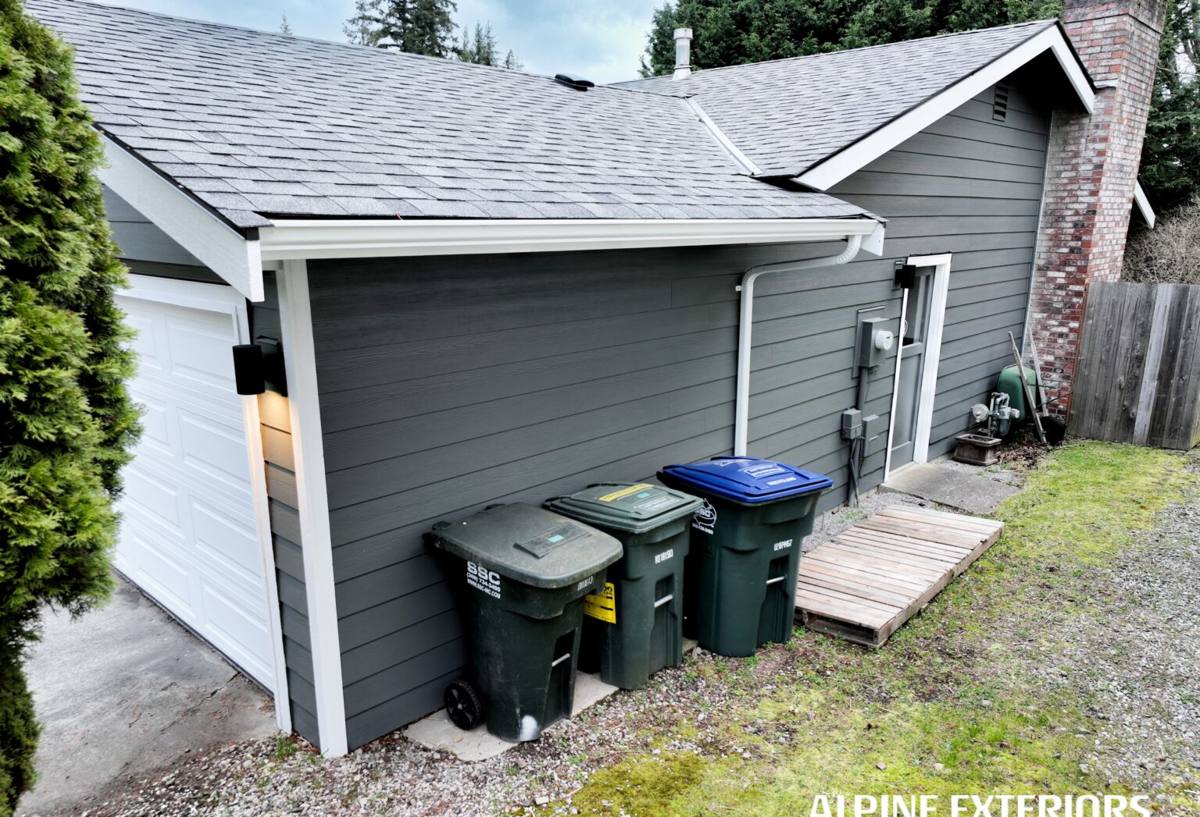
Signs an Edison Home Needs Replacement, Not Just Repair
Water and Rot Damage
Soft or spongy spots when you press on siding, especially near the bottom courses, around window and door trim, or wherever two rooflines meet, usually mean water has already gotten behind the cladding and into the sheathing. On older homes with wood or hardboard siding, this is one of the most common reasons a repair job turns into a full replacement — once rot sets in, patching the visible boards doesn't address what's happening underneath.
Moss, Mildew, and Coating Failure
A thin layer of surface moss or algae can usually be cleaned. But chalky, peeling, or bubbling paint, siding that's visibly warped or cupped, or moss that keeps coming back within a season of cleaning are signs the material itself is failing, not just dirty. On wood and older composite siding, repeated wet-dry cycling eventually breaks down the surface faster than any amount of maintenance can keep up with.
- Boards that flex, feel soft, or crumble at the edges when pressed
- Paint or coating that's chalking, peeling, or bubbling across multiple wall sections
- Visible gaps, warping, or cupping in individual boards or panels
- Moss or algae that returns quickly after cleaning, especially on shaded walls
- Stains or discoloration around seams, corners, and window trim that suggest water tracking behind the siding
Why We Only Install James Hardie Fiber Cement in Edison
We install one siding product on the homes we work on: James Hardie fiber cement. We don't install vinyl, LP SmartSide, Cemplank, Allura, primed spruce, or cedar, and that's a deliberate standard, not a limitation of what we're capable of doing. In an area like Edison, where a home can face open wind-driven rain on one side and persistent shade and moisture on the other, we want a material that performs consistently across both conditions without depending on constant upkeep to stay ahead of the weather.
Fiber cement is non-combustible and dimensionally stable, so it doesn't expand, contract, warp, or crack the way wood and some composite products do as moisture and temperature swing through the seasons. James Hardie's ColorPlus finish is baked on at the factory rather than applied on site, and it's engineered to resist fading and chalking under UV exposure and repeated wet weather — the two things that wear out ordinary paint fastest in this climate. Hardie also builds climate-engineered HZ product lines specifically for regions like ours, with moisture and impact resistance suited to the Pacific Northwest rather than a one-size-fits-all product sold everywhere in the country. It's backed by a strong, transferable warranty, which matters if the home changes hands down the road.
What a Correct Siding Replacement Job Actually Involves
Siding replacement is more than pulling off old boards and nailing up new ones. The work that happens underneath the siding is what determines whether the new install lasts fifteen years or fifty, and it's also the part that's easiest for a corner-cutting crew to skip because nobody sees it once the job is done.
Once the old siding is off, the sheathing underneath needs a real inspection, not a glance. Any rot, delamination, or soft spots have to be cut out and replaced before anything new goes up — covering damaged sheathing with new siding just hides a problem that keeps getting worse. From there, a proper water-resistive barrier goes on, lapped and taped correctly at every seam, with flashing integrated at windows, doors, and any place where a roofline or deck meets the wall. Fastening pattern and spacing matter too; Hardie siding installed with the wrong nail spacing, at the wrong depth, or without proper clearance above grade, decks, and roof lines will fail prematurely no matter how good the product itself is.
| Step | What It Involves | Why It Matters in Edison |
|---|---|---|
| Sheathing inspection | Check for rot, delamination, soft spots after tear-off | Damaged sheathing under new siding leads to repeat failure |
| Water-resistive barrier | Continuous, properly lapped and taped house wrap | Backstops the siding against wind-driven rain off the flats |
| Flashing details | Integrated at windows, doors, rooflines, and penetrations | Most water intrusion starts at these transitions, not the field |
| Fastening and clearance | Correct nail pattern, depth, and grade/roof clearance | Improper fastening voids warranty and shortens siding life |
Our Process for an Edison Siding Replacement
- On-site assessment of existing siding, trim, and any visible signs of water or moisture damage
- Written estimate covering material, labor, and any anticipated sheathing repair, so there are no surprises once tear-off starts
- Removal of existing siding and trim, with sheathing exposed and inspected before anything new is installed
- Repair or replacement of any compromised sheathing, framing, or trim found underneath
- Installation of a continuous water-resistive barrier and flashing at every window, door, and roofline intersection
- Installation of James Hardie siding and trim to manufacturer fastening and clearance specifications
- Caulking, final detailing, and site cleanup, with a walkthrough before we consider the job finished
What Affects the Cost of Siding Replacement in Edison
Every home is different, and the honest answer to "what will this cost" depends on a handful of factors we can only pin down after seeing the property. That said, a few things consistently move the number up or down on rural and farmland-adjacent homes in this area.
| Cost Factor | Why It Matters |
|---|---|
| Home size and wall complexity | More square footage and more corners, gables, and trim details mean more labor and material |
| Condition of existing sheathing | Hidden rot found during tear-off adds repair scope that can't always be quoted up front |
| Siding profile and finish choice | Lap, panel, and shingle-style Hardie products, plus color and trim options, price differently |
| Site access | Long driveways, outbuildings, fencing, or landscaping near the house can slow material staging and tear-off |
| Amount of trim and detail work | Window and door surrounds, corner boards, and fascia add labor beyond the field siding itself |
Why Hiring a Crew That Already Works in Edison Matters
Rural and farmland-adjacent properties come with their own set of practical considerations — longer driveways, septic systems and wells to work around, outbuildings, fencing, and sometimes livestock or crops close to the work area. A crew that's already done projects in and around Edison knows to ask about these things up front instead of discovering them the day material shows up. Local experience also means a realistic read on how the specific exposure on your lot — open field on one side, shaded tree line on the other — should factor into flashing details and product choice.
- Ask how they handle site access on rural or acreage properties, including material staging and protecting driveways, septic fields, or landscaping
- Ask what happens if they find rotted or damaged sheathing once tear-off starts, and how that's priced
- Ask for specifics on fastening pattern, flashing details, and clearance above grade and rooflines — not just "we install to code"
- Ask whether they carry manufacturer certification for the products they're installing, and what the workmanship warranty actually covers
- Ask for references or completed work in the same general area, so you know they understand the local exposure conditions
Caring for New Siding After It's Installed
Fiber cement siding installed correctly needs very little upkeep, but "very little" isn't "none." An occasional rinse to clear pollen, dust, and early moss growth keeps the ColorPlus finish looking the way it should, particularly on shaded walls facing tree lines or outbuildings. Keeping gutters clear and making sure sprinklers or irrigation aren't hitting the siding directly helps avoid unnecessary moisture exposure. Beyond that, an occasional visual check of caulking at trim joints and around windows — the same places most water problems start on any home — is worth doing once a year, especially heading into the wet season.
If you're weighing siding replacement for a home in Edison, we're glad to come take a look, walk the property, and give you a straight read on what your siding is actually dealing with and what it would take to fix it right. Reach out for a free, no-pressure estimate.