 Anacortes Window
 Building new on Fidalgo Island means making window decisions before there's even a wall to hang them on — and in this part of Skagit County, those early decisions matter more than they would somewhere inland. Salt air off the surrounding water, driving rain that doesn't fall so much as it's pushed sideways, and a moss season that can stretch across most of the year all work on a house from day one. New construction is the one chance to get the window openings built and flashed correctly before siding and trim close everything in. Get it right here, and you're not chasing leaks or premature hardware failure a few years down the road.
What Fidalgo Island Building Sites Are Actually Up Against
Nearly every lot on Fidalgo Island sits within reach of saltwater in one direction or another, and that changes the math on window installation compared to a build further inland. Salt-laden air accelerates corrosion on hardware, fasteners, and any lower-grade frame components — a slow process, but a steady one, and it doesn't pause for a construction schedule. Add in the driving, wind-pushed rain that comes through on winter storms, and water finds any gap in a flashing detail that would never get tested in a calmer climate. Shaded, damp corners of a lot — common wherever tree cover or north-facing exposure limits sun — support moss and algae growth for much of the year, and that moisture holds against sills and trim longer than it would on a drier site.
None of this is exotic information to anyone who's built here before, but it does mean a new-construction window package needs to be planned around the specific exposure of the lot — not just pulled from a generic spec sheet written for an average climate zone.
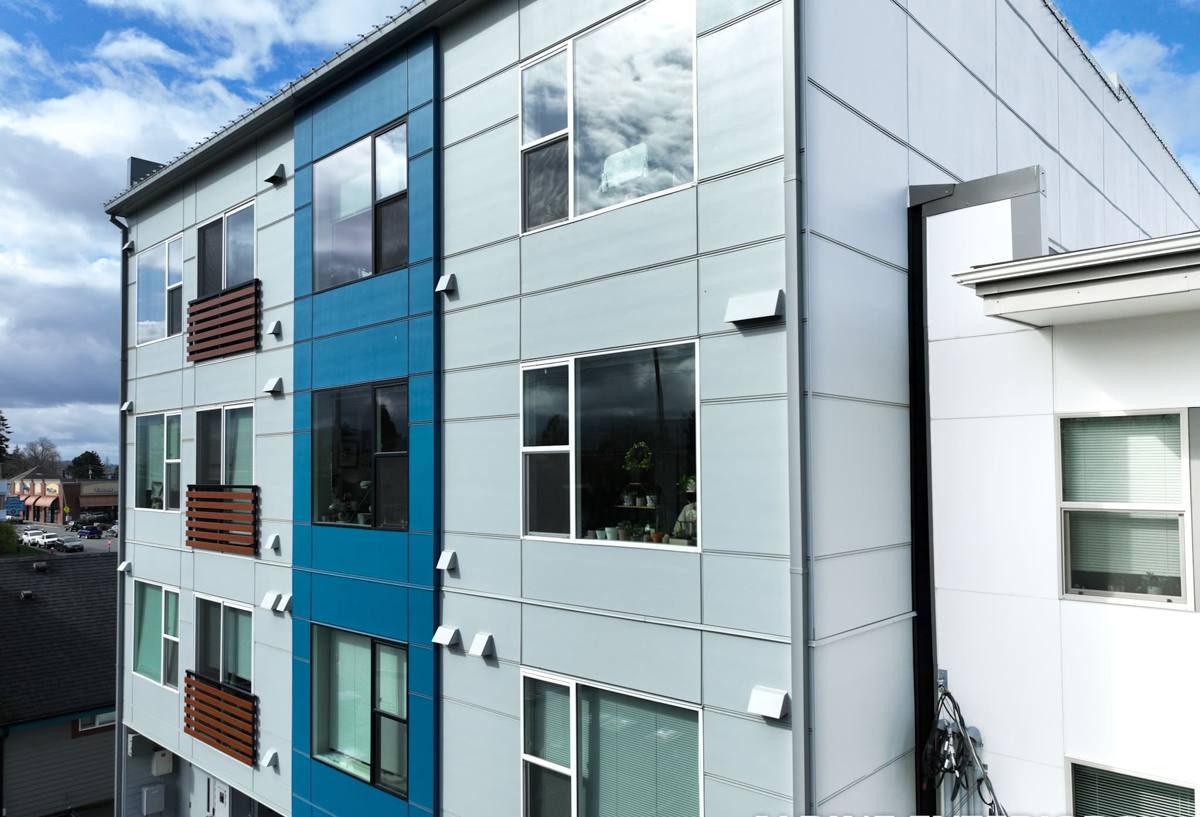
New Construction vs. Replacement: Why the Job Is Different
Replacement window work happens inside an existing wall, matching to what's already there. New construction is the opposite: the opening is framed to spec, the weather-resistive barrier (WRB) is going up around it for the first time, and the window has to be integrated into that assembly correctly from the very first step — there's no prior installation to reference, and no way to "see how the old one held up" for clues. That's an advantage in one sense, because it means every detail can be done right the first time rather than working around whatever compromises were baked into an older install. But it also means there's no margin for skipping steps — a poorly flashed new-construction opening doesn't show a problem on day one. It shows up as a soft spot near a sill or a stain on interior drywall two or three wet seasons later, after the siding and interior finish are long since done.
New construction also means working inside someone else's schedule. Windows typically go in after the framing is inspected and the WRB is up, but before siding starts — a specific window in the build sequence that has to line up with the general contractor's timeline, weather permitting, and material lead times for the units themselves.
What a Correct New-Construction Window Installation Actually Involves
Flashing and Water Management Before the Wall Closes Up
This is the step that decides whether the install performs for decades or causes problems in a few years. Flashing has to be sequenced correctly with the WRB — sill pan flashing set first to catch and direct any water that gets past the window, side flashing lapped over that, and head flashing lapped over the siding's water-resistive barrier above the opening, so water is always directed outward and down, never trapped behind the assembly. On a site with driving rain, we don't treat this as a minimum-code checkbox — we build in the redundancy that a genuinely wet, wind-exposed lot calls for.
Fastening, Shimming, and Air Sealing
A window that's shimmed square and plumb, fastened per the manufacturer's schedule, and sealed with the correct sequence of sealant and backer rod performs the way it's supposed to for the life of the house. Skipping or rushing this step is invisible at final walkthrough and only shows up later as drafts, condensation, or a unit that's harder to operate than it should be. On a coastal lot, we also pay attention to fastener spec — hardware that isn't rated for sustained salt-air exposure corrodes faster here than it would inland, and a corroded fastener at a structural attachment point is a bigger problem than a cosmetic one.
Sequencing With the Build Schedule
Windows need to go in at the right point in the build — after framing inspection and WRB installation, before siding closes things in, and ideally during a weather window that doesn't leave an open wall assembly exposed to a storm system longer than necessary. Coordinating that timing with your general contractor, rather than treating window install as an isolated task, is part of doing the job correctly on a real job site.
Frame Materials for a Marine New Build
Frame material choice matters more on a coastal new build than it does in a sheltered inland location, since the frame is going to face sustained salt air and moisture exposure for the life of the house. We'll walk through the real trade-offs for your specific plans and elevations rather than defaulting to whichever option is easiest to install.
| Frame Material | Salt-Air / Moisture Resistance | Maintenance | Typical Cost Tier |
|---|---|---|---|
| Vinyl | Good — won't rot or corrode, though hardware quality varies by manufacturer | Low — no painting, occasional cleaning | Lower |
| Fiberglass | Very good — dimensionally stable, resists the expansion/contraction that stresses seals | Low | Mid to higher |
| Wood-clad (exterior cladding, wood interior) | Depends entirely on the exterior cladding's integrity — a breach lets moisture reach the wood | Higher — cladding and seals need periodic inspection | Higher |
| Aluminum | Conducts heat and cold and can corrode without a marine-grade finish | Moderate | Varies |
For most Fidalgo Island new builds, vinyl and fiberglass frames give the best combination of moisture resistance and low ongoing maintenance for the money. Wood-clad units still make sense when the interior look matters and the exterior cladding is genuinely well-detailed and maintained — the trade-off is a maintenance commitment that a busy homeowner needs to be honest with themselves about before choosing it.
Glazing, Energy Code, and Egress on a Skagit County New Build
New construction has to meet current Washington State Energy Code requirements for window performance, which generally means dual-pane, low-E glazing at a minimum for most builds in this climate zone — a meaningful step up from what older homes on the island were built with. Beyond code minimums, low-E coatings and gas-filled units help with comfort and heating costs through a Skagit County winter that's damp and cool for much of the year. Tempered glass is required in specific locations by code — near doors, in low sills, in wet areas — and that's not optional or negotiable on a new build; it's checked at inspection. Bedroom windows also have to meet egress size and sill-height requirements, which is worth confirming early in the design phase rather than discovering a conflict once framing is already up.
Our Process When We Work Alongside Your Builder
- Plan and window schedule review — we look at the plans, confirm sizes, styles, and frame materials against the site's actual exposure, and flag anything that needs a closer look before ordering
- Ordering and lead time — we give you a realistic timeline for units to arrive, factored into the overall build schedule rather than assumed
- Coordination with your GC — install timing is set around framing inspection, WRB completion, and the siding start date so nothing gets rushed or left exposed longer than necessary
- Installation and flashing — units are set, shimmed, fastened, and flashed to a sequence built for the site's exposure, not a generic minimum
- Walkthrough — we check operation, seals, and flashing integration before the wall closes up behind siding, while it's still easy to correct anything
A Pre-Install Checklist for Fidalgo Island New Construction
- Confirm window sizes and rough openings match the current framing, not an earlier plan revision
- Ask what flashing sequence will be used at sills, jambs, and heads, and how it ties into the WRB
- Confirm fastener and hardware specs are appropriate for sustained salt-air exposure, especially on water-facing elevations
- Verify egress sizing and sill heights on bedroom windows before framing locks them in
- Confirm which openings require tempered glass under current code
- Get a realistic install date that lines up with your GC's WRB and siding schedule
- Ask what's covered under the window manufacturer's warranty versus the installation labor warranty
Why a Crew That Already Works Fidalgo Island Matters
Exposure varies a lot across a fairly small area here — a lot facing open water takes a different beating than one tucked behind a hill or tree line just a short distance away, and the difference shows up in how much flashing redundancy and hardware spec actually matter on a given elevation. A crew that's installed new-construction windows across Fidalgo Island and the rest of Anacortes has already seen which details are non-negotiable on an exposed lot and where standard practice is genuinely sufficient — that judgment doesn't come from a manufacturer's install guide, which is written for average conditions, not this specific stretch of coastline.
There's also a practical side to local experience: knowing how Skagit County inspections typically go, working smoothly alongside general contractors who build here regularly, and understanding how a build schedule actually moves through a wet-season timeline instead of an idealized one. That familiarity keeps a new-construction window package from becoming the thing that holds up the rest of the job.
If you're planning new construction on Fidalgo Island and want window sizes, frame materials, and flashing details worked out correctly from the start, we're glad to take a look at your plans. Reach out for a free, no-pressure estimate — use the form below to get a time on the schedule.