 Anacortes Window
 Oak Harbor sits on Whidbey Island, across the Deception Pass Bridge from our home base in Anacortes, and it deals with the same core weather pattern that shapes exterior work throughout this part of the Salish Sea — salt-laden air off the water, rain that comes in sideways more often than it falls straight down, and a moss season that runs long even by Pacific Northwest standards. We do siding work throughout Island and Skagit Counties, and Oak Harbor is one of the towns where getting the installation details right, not just picking a good material, determines whether a siding job holds up for decades or turns into a maintenance problem within a few years.
We install James Hardie fiber cement siding exclusively. That's not a marketing preference — it's the product we trust to actually perform on a marine-exposed property like the ones common around Oak Harbor, provided it goes on correctly. This page covers what the local climate does to siding, what a correct installation actually involves, and why we think hiring a crew that already works this stretch of Whidbey Island matters more than homeowners sometimes assume.
What Oak Harbor's Marine Climate Does to Siding
Whidbey Island sits fully exposed to Puget Sound and the broader Salish Sea, and Oak Harbor's waterfront and near-waterfront properties feel that exposure directly. Even homes set back a few blocks from the water still deal with marine air carried inland on winter storms. That combination of salt, sustained moisture, and a long wet season is exactly the kind of environment that separates siding materials and installations that hold up from ones that don't.
Salt Air and Corrosion
Salt-laden air off the water accelerates corrosion on fasteners, flashing, and any exposed metal on a house, and it can also degrade lesser-quality coatings and finishes faster than an inland climate would. This matters as much for the hardware behind the siding as it does for the siding itself — a fastener that starts corroding years before it should can loosen a panel or trim board long before the material itself would have failed on its own.
Driving Rain Off the Water
Storms moving across the Salish Sea push rain sideways into walls rather than letting it fall straight down and run off, and Oak Harbor's open water exposure means driving rain is a regular event here, not an occasional one. Siding, trim, and flashing that aren't detailed to shed wind-driven rain — rather than just ordinary rainfall — tend to show water damage first at seams, corners, and butt joints, exactly the spots where installation quality matters most.
A Long Moss Season
Mild temperatures and near-constant dampness through fall, winter, and spring give moss and algae a long growing season across Whidbey Island, and shaded or north-facing walls are where it shows up first. It's not just cosmetic — sustained organic growth holds moisture directly against the wall assembly, and a wall that stays damp longer is a wall that's more likely to develop hidden problems behind the siding, not just on its surface.
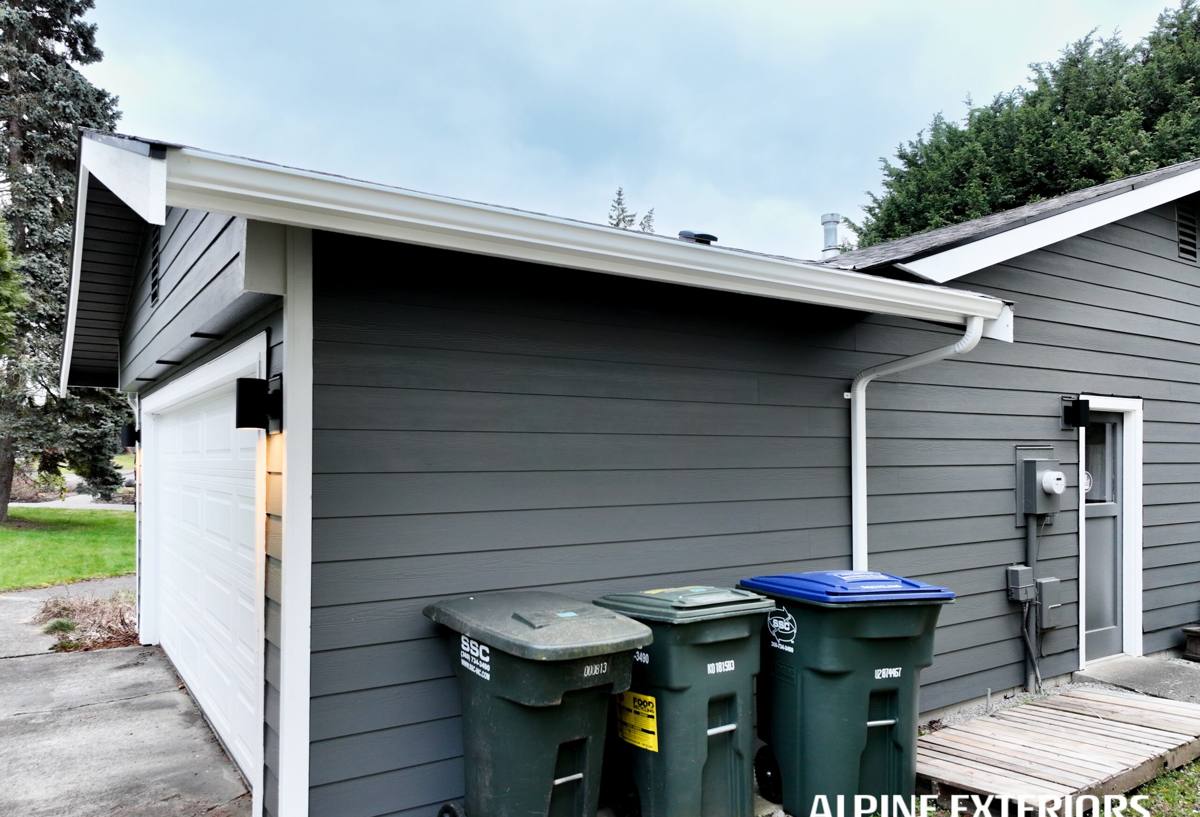
What a Correct Siding Installation Actually Involves
Material choice only gets an Oak Harbor home halfway to a siding job that lasts. The rest comes down to installation detail, and on a marine-exposed property those details carry more weight than they would somewhere drier and more sheltered.
- A weather-resistant barrier installed correctly behind the siding, with seams lapped and taped rather than just stapled and left
- Flashing at windows, doors, and any wall penetration that actually sheds water outward instead of relying on caulk to make up the difference
- Proper clearance between the bottom of the siding and grade, roof lines, decks, and patios so the material isn't sitting in standing moisture
- Fastening patterns and fastener types rated for the wind exposure and corrosion risk of a waterfront or near-waterfront property
- Joints that are lapped, back-primed where required, and sealed to manufacturer spec rather than simply butted together
- Trim and corner details finished so water is directed away from the wall assembly at every transition
Skip any one of these on a sheltered inland lot and it might take years to show. Skip it on an Oak Harbor property taking direct wind and rain off the water, and the problem tends to surface much sooner — sometimes within a single wet season.
Why We Install Only James Hardie Fiber Cement
We don't install LP SmartSide, vinyl siding, Cemplank, Allura, primed spruce, or cedar. Each of those products has a place in the broader market, and plenty of homeowners elsewhere get reasonable service out of them. We made a professional decision, after years of exterior work on marine-exposed homes, to put our name behind one system instead: James Hardie fiber cement.
- Non-combustible core: Fiber cement doesn't feed a fire the way wood-based or wood-derived siding can, which matters for household safety and can matter for insurance underwriting as well.
- Factory-applied ColorPlus finish: The color is baked on under controlled conditions rather than brushed on in the field, which holds up far better against fading, chalking, and moisture intrusion than site-applied paint does over repeated marine wet-dry cycles.
- Climate-engineered HZ product lines: Hardie builds different formulations for different climate zones, including versions engineered for regions with sustained moisture and salt exposure — a real match for a Whidbey Island property.
- Dimensional stability: Fiber cement doesn't swell, cup, or warp the way engineered wood siding can after repeated wet-season moisture cycles.
- Strong transferable warranty: Hardie backs its products with a solid warranty structure when installed to spec, which gives a homeowner real protection rather than a sales claim.
None of that is a knock on every other product on the market in every setting. It's a professional standard we hold to because we've seen, over years of jobs on exposed Puget Sound properties, which materials actually hold up and which ones quietly become a maintenance burden a few years down the road.
Choosing the Right Hardie Product for an Oak Harbor Home
| Product Line | Best Use | Why It Fits This Area |
|---|---|---|
| HardiePlank lap siding | Most single-family homes, traditional and modern styles | Traditional lap profile sheds wind-driven rain effectively when installed with proper overlap and flashing |
| HardiePanel vertical siding | Accent walls, gables, modern designs | Clean vertical lines that pair well with lap siding on mixed-profile homes |
| HardieShingle siding | Craftsman-style homes and accent sections | A textured, shingled look without the moisture absorption and upkeep of real wood shingle |
| HardieTrim boards | Corners, window and door casing, fascia | Factory-finished trim resists the same salt and moisture exposure as the field siding |
Color and profile come down to the individual home and the homeowner's preference, but the underlying product family and installation approach stay consistent — we spec what fits the property's actual exposure to wind and water rather than defaulting to whatever's easiest to install.
Our Siding Installation Process
- On-site walkthrough to assess current siding condition, wall orientation relative to prevailing weather, and any signs of existing moisture damage
- A written scope and estimate covering tear-off, substrate repair if needed, materials, and a realistic timeline
- Tear-off of the old siding down to the sheathing, which is also when hidden rot or moisture damage gets found and addressed before anything new goes on
- Installation of the weather-resistant barrier and flashing system, the part of the job that does the real work of keeping water out
- Hardie siding and trim installed to manufacturer spec, with fastening and clearance details set for the property's actual exposure
- A final walkthrough with the homeowner to review the finished work before we consider the job done
Repair vs. Full Re-Side: How We Make the Call
Not every siding problem on an Oak Harbor home calls for a full tear-off. A section damaged by wind, an isolated trim failure near a window, or storm-impact damage can often be repaired and matched into existing Hardie siding without touching the rest of the house. But if water has been tracking behind the wall for a while, or the home still has an older, non-Hardie product nearing the end of its service life, patching usually just delays a bigger job while hidden rot keeps spreading underneath where it can't be seen. We'll walk the property and tell you honestly which situation you're actually looking at, rather than defaulting to whichever option is more profitable for us.
Cost Factors for Siding Installation in Oak Harbor
| Factor | What It Affects | Why It Matters Here |
|---|---|---|
| Tear-off vs. overlay | Labor scope and substrate access | Tear-off reveals hidden moisture and rot damage common under older siding in a marine climate |
| Substrate condition | Repair costs before new siding goes on | Long-term trapped moisture behind siding can rot sheathing and framing that isn't visible until tear-off |
| Wind and fastening spec | Material and labor requirements | Waterfront and near-waterfront lots can call for tighter fastening patterns than a sheltered inland site |
| Home size and wall complexity | Material quantity and labor time | More corners, gables, and window openings mean more flashing and trim detail work |
| Site access | Labor time and equipment needs | Waterfront lots and steeper sites on Whidbey Island can have more limited staging space than an in-town lot |
Exact costs depend on the specific property and its exposure, which is why we walk the home in person before giving a real number instead of quoting off a generic price sheet.
Why a Crew That Already Works Oak Harbor Matters
Oak Harbor isn't one uniform environment — waterfront properties along the harbor take a different beating than homes set back on higher, more sheltered ground, and a crew that works this part of Whidbey Island regularly develops a feel for which walls take the worst of the weather and which flashing details actually matter versus which ones are just code minimum. That kind of judgment comes from doing this work on homes like these on a regular basis, not from a crew driving out occasionally from somewhere else and treating every property the same. Getting to and from Oak Harbor also means crossing the Deception Pass Bridge from Fidalgo Island, and scheduling material deliveries and crew time around that trip is just part of doing the job right out here — a contractor unfamiliar with the area can end up costing a homeowner time on both ends.
What to Check Before Hiring for Siding Work in This Area
- Ask specifically how the contractor handles wind-driven rain and flashing detail, not just which siding brand they carry
- Confirm fasteners and hardware are rated for marine or coastal exposure, not standard-grade only
- Get a clear answer on both the manufacturer's material warranty and the contractor's own workmanship warranty
- Ask how they handle substrate repair if rot or moisture damage turns up once the old siding comes off
- Verify the contractor is licensed, bonded, and insured to perform exterior work in Washington State
- Ask whether they regularly work on Whidbey Island or if Oak Harbor would be an occasional trip for their crew
If your Oak Harbor home needs new siding, a repair, or just an honest second opinion on what's happening behind an aging wall, we're glad to take a look. Reach out using the form below to schedule a free, no-pressure estimate.