 Anacortes Window
 Siding Built for Ship Harbor's Particular Climate
Ship Harbor sits close enough to the water that homes here take a different kind of weather beating than houses inland in Skagit County. Salt-laden air off the marina and channel works on painted wood and cheap trim year-round, driving rain off Rosario Strait finds every gap in a wall system, and the long gray stretch from fall through spring gives moss and algae months to establish themselves on north-facing walls and anything shaded by fir and cedar trees. None of this is exotic — it's just the normal cost of living somewhere this good — but it means the siding on a Ship Harbor home has a harder job than siding on a house in, say, Sedro-Woolley or eastern Skagit County.
We install James Hardie fiber cement siding exclusively. We don't install vinyl, LP SmartSide, cedar, primed spruce, or other fiber cement brands. That's not a marketing line — it's a standard we hold because we've seen what each of those products does over ten or twenty years in exactly this kind of coastal, wet, moss-prone environment, and we'd rather put one product on a wall correctly than juggle several compromises.
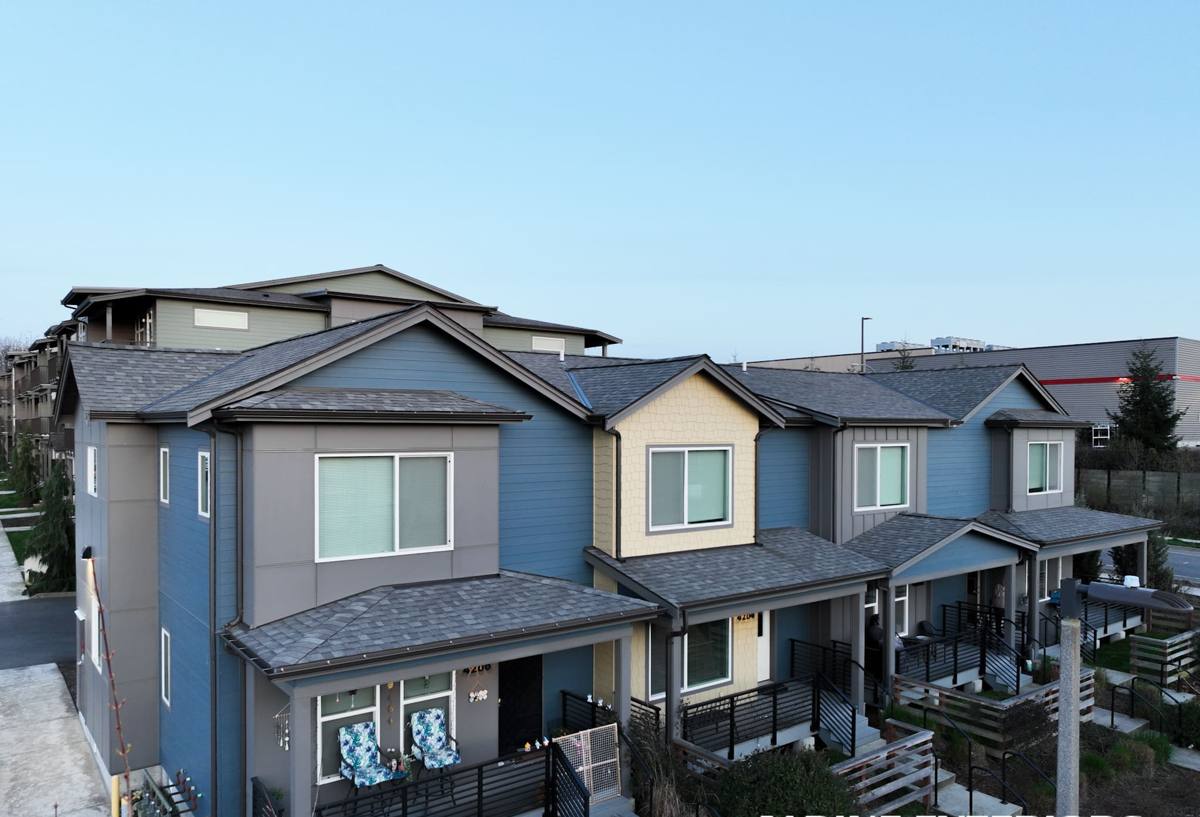
What Ship Harbor Homes Actually Need From Their Siding
Strip away the sales talk and a Ship Harbor home's siding needs to do four things well:
- Shed wind-driven rain without letting water track behind the cladding at laps, corners, and penetrations
- Resist moisture absorption into the siding material itself, since damp siding is what feeds moss, mildew, and paint failure
- Hold a factory finish that doesn't chalk, fade, or need repainting every five to seven years from salt exposure and UV
- Stay dimensionally stable through the area's daily temperature and humidity swings so joints and caulk lines don't open up
James Hardie's HZ5 product line is engineered specifically for this climate zone — the Pacific Northwest's combination of moisture and temperature cycling. That's not a coincidence of marketing; the HZ5 formulation and ColorPlus factory-baked finish are built to handle exactly the salt air, rain, and moss pressure Ship Harbor deals with every year.
Why Moss Season Matters More Here Than People Expect
Anacortes gets a long wet season, and Ship Harbor's tree cover and proximity to water keep humidity elevated even on days it isn't actively raining. Moss doesn't just look bad — it holds moisture against the siding surface, and on absorptive materials that moisture works its way into the substrate over time. Fiber cement doesn't feed moss the way wood-based products can, and Hardie's factory finish resists the kind of surface degradation that gives moss spores something to grip onto in the first place. Good soffit venting, gutter maintenance, and trim work around trees still matter — siding material is one part of the system, not the whole answer.
Why We Don't Install the Alternatives Here
We get asked regularly why we won't quote vinyl or cedar alongside Hardie. Each of those products has real strengths — vinyl is inexpensive and low-maintenance in mild climates, cedar looks genuinely beautiful when new, and engineered wood siding installs fast. But in a coastal Skagit County environment specifically, each carries trade-offs we're not willing to put our name behind:
- Vinyl can warp and become brittle with temperature swings, and its seams and butt joints give wind-driven rain more opportunities to get behind the cladding over a coastal exposure
- Cedar requires ongoing sealing, staining, or painting to keep moisture out, and salt air accelerates the weathering cycle that maintenance is meant to fight
- Primed spruce and other wood-based composites depend heavily on paint film integrity — once that film fails at a cut edge or fastener, moisture intrusion follows quickly in a climate this wet
James Hardie fiber cement is non-combustible, doesn't expand and contract the way wood or vinyl do, and carries a factory finish warranty that isn't dependent on a homeowner's repainting schedule. That combination is why it's the only product we put on a wall.
What a Correct Ship Harbor Installation Involves
Fiber cement siding is only as good as the installation behind it. A rushed or generic install can undercut even the best product, especially in a climate that punishes shortcuts. On every Ship Harbor project we run through the same sequence:
- Wall assessment — checking existing sheathing, house wrap, and flashing condition before anything new goes up, since covering a moisture problem doesn't solve it
- Water-resistive barrier and flashing — correct lapping at windows, doors, and penetrations so water sheds outward and down, never inward
- Rainscreen or proper furring where called for — creating a drainage gap behind the siding so any incidental moisture can escape instead of sitting against the panel
- Manufacturer-spec fastening — correct fastener type, spacing, and depth; overdriven or corrosive fasteners are one of the most common causes of early siding failure we see on inspections
- Joint and butt seam treatment — proper caulking or H-channel per Hardie spec, since open seams are where coastal wind-driven rain finds its way in first
- Trim and corner detailing — using compatible trim products and correct clearances at grade, decks, and roof lines
- Final inspection — walking the whole envelope before we call the job done, not just the parts that are easy to see
Every one of those steps matters more in Ship Harbor's exposure than it would on a sheltered inland lot. Skipping the rainscreen gap or using the wrong fastener might not show a problem for a year or two — but in salt air and driving rain, it shows eventually.
Comparing Siding Options for a Coastal Anacortes Home
| Factor | James Hardie Fiber Cement | Vinyl | Cedar |
|---|---|---|---|
| Moisture resistance | High — engineered for wet climates | Moderate — seams can leak | Requires ongoing sealing |
| Salt air performance | Factory finish holds up well | Can become brittle over time | Weathers faster near salt exposure |
| Maintenance | Occasional wash, no repainting for years | Low, but limited repair options | Regular staining or painting needed |
| Fire resistance | Non-combustible | Combustible | Combustible |
| Typical lifespan to first major service | Decades with correct install | 15-20 years, seam-dependent | 10-15 years between refinishing |
Cost Factors for a Ship Harbor Project
Every home is different, so exact numbers depend on the walk-through, but the main variables that move a Ship Harbor quote are consistent across most projects:
| Factor | Why It Affects Cost |
|---|---|
| Existing wall condition | Rotten sheathing or failed house wrap found underneath adds repair scope before new siding goes on |
| Home size and wall complexity | More corners, dormers, and trim detail means more labor and cutting |
| Siding profile and color | Lap width, shingle-style panels, and ColorPlus color selections vary in material cost |
| Access and site conditions | Tight lots, slopes, or limited staging area near the water can affect labor time |
| Trim and accessory scope | Fascia, soffit, and trim replacement alongside siding changes total project cost |
We give straightforward, itemized estimates rather than vague per-square-foot numbers, because the wall condition underneath is often the biggest cost variable — and that's something we can only assess in person.
Signs a Ship Harbor Home May Need Siding Attention Now
- Visible moss or algae staining on north- or shade-facing walls
- Soft spots, bubbling, or staining near window and door trim
- Paint that's chalking, peeling, or needing repainting more often than it used to
- Visible warping, buckling, or gapping at seams and corners
- Musty smell or interior moisture signs on exterior walls
- Siding that's original to a home built more than 20-25 years ago
None of these automatically mean full replacement — sometimes it's a repair, sometimes it's a maintenance fix. But catching them early keeps a small issue from becoming a wall-sheathing problem, which is a much bigger job.
Why a Crew That Already Works Ship Harbor Matters
Coastal Anacortes work isn't identical to siding work five or ten miles inland. A crew that already works this specific area knows what a Ship Harbor wall assembly is dealing with — the exposure direction that catches the worst wind-driven rain, how much tree cover typically shades a lot, and how the marine layer keeps humidity up even on days that look dry. That local pattern recognition shows up in small decisions during install — where to add extra flashing attention, which corners see the harshest weather — that a crew unfamiliar with the area might not think to prioritize.
It also means we're not learning Skagit County's permitting and inspection expectations on your job. We show up knowing what's expected locally, which keeps the project moving instead of stalling on paperwork or code questions.
Our Process, Start to Finish
A typical Ship Harbor project runs through the same stages regardless of home size:
- In-person walk-through and wall assessment, including a look at existing moisture or moss issues
- Written, itemized estimate covering material, labor, and any sheathing or repair scope found
- Product and color selection from James Hardie's HZ5 lines and ColorPlus finishes
- Scheduling that accounts for weather windows, since installation quality depends on working in reasonably dry conditions
- Installation following manufacturer specification for flashing, fastening, and joint treatment
- Final walk-through so you know exactly what was done and what maintenance, if any, to expect
If you're weighing a siding project on a Ship Harbor home, we're glad to come take a look and give you a straight, no-pressure estimate — no obligation, just an honest read on what your walls actually need.