 Anacortes Window
 Window Installation in Sedro-Woolley: A Skagit Valley Climate Problem
Sedro-Woolley sits at the inland edge of the Skagit Valley, where the flat farmland gives way to the foothills of the North Cascades. It's not a waterfront town, and homes here don't take the direct salt spray that a property right on Puget Sound deals with. But the valley setting brings its own version of the same problem: driving rain that gets funneled and intensified as storms move up the valley from the Sound, humidity that lingers longer here than in more open, breezier parts of Skagit County, and a moss and mildew season that stretches across most of the year on shaded walls and window trim. For windows specifically, that combination matters more than it does for almost any other part of the house, because a window opening is where the building envelope has the most seams, the most moving hardware, and the most places for water to find its way in.
We install windows throughout Skagit County out of Anacortes, and Sedro-Woolley is a regular part of that work. On every window job here, we treat the flashing and installation detail as being at least as important as the window unit itself — a quality window installed with sloppy flashing will leak in this climate, while a solidly built mid-grade window installed correctly will often outlast it.
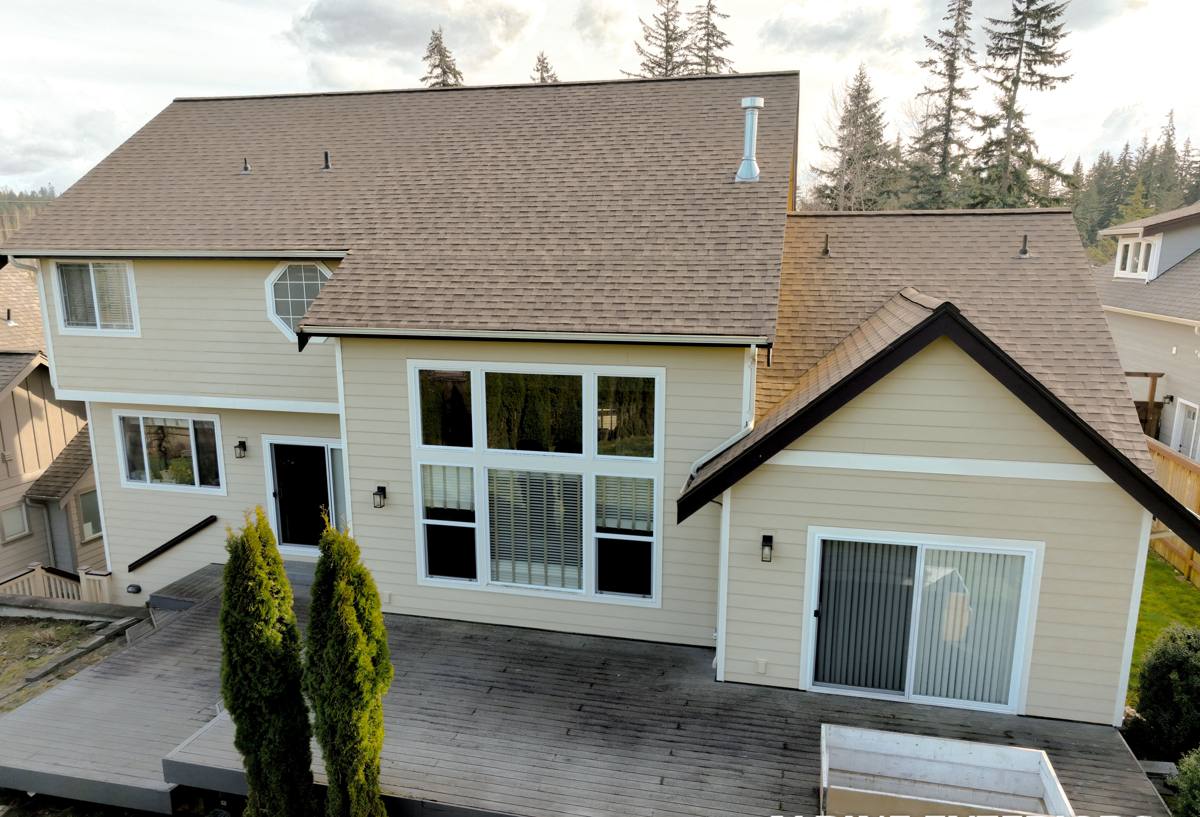
What Sedro-Woolley's Climate Actually Does to Windows
Valley Moisture and Driving Rain
Weather systems moving in off Puget Sound tend to get squeezed and intensified as they push up the Skagit Valley, and Sedro-Woolley catches a real share of that driving rain. Wind-driven rain doesn't fall straight down onto a window — it gets forced sideways into the gap between the frame and the rough opening, which is exactly where a rushed or poorly detailed install starts to fail first. The valley also holds humidity longer after a storm passes than more open, wind-swept parts of the county, so window openings here rarely get a long, clean stretch to dry out between weather events, particularly through fall and winter.
A Long Moss Season
Mild temperatures, filtered light under mature trees, and near-constant moisture add up to a moss and mildew season that runs most of the year in this part of Skagit County. Window sills, trim, and the wood framing around older units are common places it takes hold, especially on north-facing walls or anywhere airflow is restricted. Any spot where water sits instead of draining away — a sill without proper slope, a track that collects debris — becomes a growth surface given enough time.
Salt Air's Reach Up the Valley
Sedro-Woolley isn't a coastal town, so window hardware here doesn't take the same corrosion load a waterfront Anacortes property does. But Skagit County's salt-laden air off Puget Sound still reaches inland on windier weather patterns, adding a low but real corrosion factor to fasteners, hinges, and lower-grade window hardware over time. It's a smaller piece of the puzzle here than closer to the water, but it's one more reason we don't spec hardware built for a dry, inland climate that never sees this kind of exposure.
Freeze-Thaw Cycling
Sedro-Woolley's proximity to the foothills means slightly cooler overnight temperatures and more freeze-thaw cycling in winter than towns closer to the Sound. Window glazing seals and exterior caulking that have already taken on moisture are more prone to cracking and failing under repeated freeze-thaw stress, and it's a slow-motion problem — the kind that's easy to miss until a homeowner notices fogging between panes or a draft that wasn't there a year ago.
Signs a Sedro-Woolley Home Needs Window Attention
- Fogging or visible moisture trapped between the panes of a double-pane window
- Drafts or cold spots near a window frame even when it's fully closed and locked
- Wood sills or trim that feel soft, look discolored, or show visible rot
- Green or dark staining on sills and trim that keeps returning within months of cleaning
- Difficulty opening, closing, or locking a window that used to operate smoothly
- Visible daylight or gaps where the frame meets the surrounding siding or trim
What a Correct Window Installation Actually Involves
Flashing and the Drainage Plane
The window unit itself is rarely what fails first in this climate — it's the flashing around it. A correct installation laps the flashing with the surrounding weather-resistive barrier in the right order, top piece over bottom piece, so water is directed out and away from the rough opening rather than trapped behind it. Caulk has a role in that system, but it's a supplement to proper flashing, not a substitute for it. Caulk alone cracks and breaks down over time, and on repair calls around Sedro-Woolley, caulk used as the only line of defense against wind-driven rain is one of the most common things we find behind a leaking window.
Sill Pans and Sloped Sills
A sill pan under the window creates a backstop that catches any water that does get past the frame and directs it back outside instead of into the wall framing below. Combined with a sill that's slightly sloped rather than dead level, it keeps water from sitting against wood components long enough to feed the moss and rot problems that show up in a valley climate like this one. It's a small detail that's easy to skip on a rushed job and expensive to fix once siding and trim are already closed up around it.
New Construction vs. Replacement Windows
The two aren't installed the same way, and mixing up the approach is a common mistake. New-construction windows have a nailing fin that fastens to the stud framing before the weather-resistive barrier and siding go on, which lets the flashing become part of the wall's drainage plane from the start. Replacement or insert windows are built to fit into an existing, already-finished opening without disturbing the surrounding siding, and they rely on a different sealing approach because the wall around them is already closed. Using the wrong type, or installing either one without following its specific sequence, is how water problems get built into a wall from day one.
Repair vs. Replacement: How We Make the Call
Not every window on a Sedro-Woolley property needs full replacement, and we don't default to recommending it. A window with a failed seal but a sound frame and working hardware is often a reasonable repair candidate. A window with rotted framing or hardware that's been failing for years usually isn't — at that point the labor spent patching it starts costing more over time than doing the replacement would have.
| Condition | Repair Usually Makes Sense | Replacement Usually Makes Sense |
|---|---|---|
| Fogged glass, sound frame | Yes — reglaze or seal replacement | Only if the frame is also compromised |
| Stiff or corroded hardware | Yes — hardware replacement | Not on its own |
| Soft or rotted wood framing | Rarely a lasting fix | Yes |
| Persistent draft despite sealing | Sometimes, if flashing is the actual cause | Yes, if the unit itself is the source |
| Single-pane, no storm window | Possible short-term fix | Yes, for real energy and comfort gains |
Choosing the Right Window for a Valley Climate
We install vinyl and fiberglass window systems suited to the Pacific Northwest's wet, mild climate, and we walk homeowners through real trade-offs rather than pushing one brand as the only right answer. What matters most for a Sedro-Woolley home is a tight, well-built frame, a glazing package that handles both energy performance and condensation resistance, and hardware rated to hold up under valley moisture and the county's occasional wind-driven exposure — not a specific label on the unit.
| Frame Material | Moisture Behavior | Maintenance | Notes for a Valley Climate |
|---|---|---|---|
| Vinyl | Won't rot; performs well in mild, wet climates | Low — no painting or sealing | Solid value option; color and finish choices are more limited |
| Fiberglass | Won't rot; more dimensionally stable across temperature swings | Low, can be painted if desired | Holds up well through repeated wet-dry and freeze-thaw cycling |
| Uncladded wood | Absorbs moisture; needs an intact finish to resist rot | High — regular refinishing | Can work with diligent upkeep, but demanding in this valley's moisture load |
Window Style and How It Sheds Water
Style matters more than homeowners usually expect in a climate like this one. Casement and awning windows seal against their frame with a compression fit when cranked shut, which tends to shed wind-driven rain better than a slider or single-hung window that relies on two sashes meeting along a horizontal or vertical track. That doesn't make sliders or single-hungs a bad choice — they're common for a reason, and plenty perform fine here — but on a wall that catches more direct weather, an awning or casement unit is worth a second look, and it's the kind of trade-off we'll walk through on-site rather than assume one answer fits every wall of a house.
Cost Factors for a Sedro-Woolley Window Project
We don't post fixed prices because every home and every opening is different, but the variables that move the number on a Sedro-Woolley window job are consistent from house to house:
- Number of windows involved and whether any require custom sizing for a non-standard opening
- Condition of the existing framing and sill, and whether water-damaged wood needs repair before a new unit goes in
- Frame material and glazing package selected
- Whether the project is new-construction framing or a retrofit into an existing, finished wall
- Site access, including tree cover and staging room, which varies on the more rural lots common around Sedro-Woolley
- Lead time on ordering, since custom-sized units are typically built to order rather than pulled from stock
Our Process
We start with an on-site look at the existing windows, checking frame condition, seal integrity, hardware function, and how the current flashing ties into the siding around each opening. From there we give a straightforward read on which windows are reasonable repair candidates and which make more sense to replace, along with a written scope before any work begins. Once materials arrive, we handle tear-out, inspect the sill and framing underneath for hidden water damage, and install the new unit with a full flashing and sill pan sequence — not caulk as a stand-in for it. We finish with a walkthrough covering how the windows operate, what normal maintenance looks like, and what to watch for going forward.
A Checklist Before Hiring for Window Work in Sedro-Woolley
- Ask specifically how they handle flashing and sill pan detailing, not just which window brand they sell
- Confirm current Washington contractor licensing and active liability insurance
- Get a written scope that separates the manufacturer's product warranty from the installer's workmanship warranty
- Ask whether they recommend repair or replacement for each window individually, and why
- Ask about realistic lead times, since custom or non-standard sizes can take several weeks to arrive
Why a Local Crew That Already Works Sedro-Woolley Matters
A window installed correctly for a wind-exposed waterfront Anacortes property isn't automatically installed the same way for a valley setting like Sedro-Woolley, and the reverse is just as true. A crew that works this stretch of Skagit County regularly already knows which wall orientations stay damp longest here, where moss establishes first on sills and trim, and how the valley's rain and freeze-thaw pattern actually plays out across a full year rather than on one install day. That's what shapes decisions like flashing lap length, sill pan use, and hardware grade — the details that determine whether a window holds up for one wet winter or for decades.
It also means straightforward accountability. A local company is easy to reach if a question comes up after the job is done, and has a reputation in the community worth protecting rather than a job number in a call queue.
If your Sedro-Woolley home has windows that are drafty, foggy, hard to operate, or just due for an honest look, we're glad to take a look and tell you straight what we find. Use the form below to schedule a free, no-pressure estimate.