 Anacortes Window
 Roof Repair in Sedro-Woolley: A Skagit Valley Climate Problem
Sedro-Woolley sits inland from the Skagit River, at the point where the valley's flat farmland starts giving way to the foothills of the North Cascades. That position gives the town a particular mix of weather that's harder on a roof than the annual rainfall total suggests. Storms move in off Puget Sound and get funneled up the valley, bringing driving rain that hits roof planes at an angle instead of falling straight down. Mild, damp conditions persist for long stretches between storms, which is exactly the kind of environment moss and moisture problems need to take hold. None of that is unusual for Skagit County, but it means a Sedro-Woolley roof rarely gets the long, dry recovery periods that would let small problems stay small.
Anacortes Window Co works on windows, siding, decks, and roofing across Skagit County, including Sedro-Woolley, and roof repair is one of the most common calls we get from homeowners here. Most of the time, a leak or a patch of missing shingles doesn't mean the whole roof is done — it means one specific part of the system failed and needs a correct, targeted fix before the surrounding area gets damaged too.
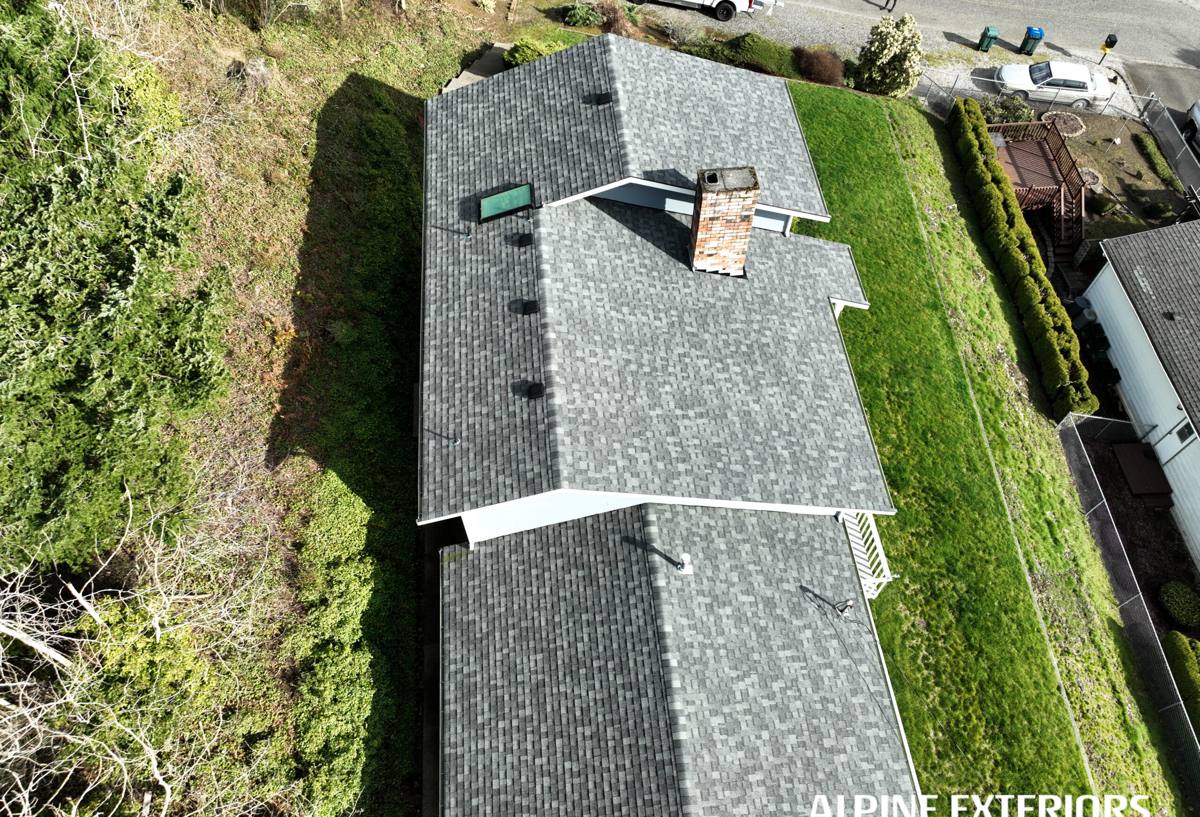
What This Climate Does to a Sedro-Woolley Roof
Driving Rain and Valley Moisture
Wind-driven rain doesn't behave like a garden hose aimed straight down. It gets pushed sideways into roof valleys, under shingle tabs, and around chimneys, skylights, and vent pipes — anywhere there's a seam or a transition for water to exploit. That's exactly where flashing and underlayment quality matter most, and it's exactly where we find the majority of active leaks when we're called out to a Sedro-Woolley home. A roof that looks fine from the ground can still be taking on water at a poorly sealed valley or a lifted flashing edge that's invisible from the driveway.
A Long Moss Season
Mild temperatures, filtered shade from surrounding trees, and moisture that lingers add up to a moss and algae season that runs most of the year in this part of Skagit County. Moss doesn't just sit on top of shingles — it holds water against the roofing material, works its way under tabs and edges, and can physically lift shingles as it grows. A roof with heavy moss buildup is very often a roof with hidden moisture damage underneath that hasn't shown up as an interior leak yet.
Salt Air's Reach Up the Valley
Sedro-Woolley isn't a waterfront town, but Skagit County's salt-tinged air off Puget Sound still reaches this far inland on windier weather patterns. It's a smaller factor here than in towns sitting directly on the water, but it adds a low, steady corrosion load to exposed fasteners, flashing, and metal roofing components over the years. Combined with the valley's rain and moss exposure, it's one more reason repairs need to use materials rated for coastal Pacific Northwest conditions rather than a generic national spec.
Freeze-Thaw Cycling
Sedro-Woolley's proximity to the foothills means slightly cooler overnight temperatures and more freeze-thaw cycling in winter than towns closer to the Sound. Roofing materials that stay saturated and then freeze are prone to cracking and granule loss over repeated cycles. It's a slow, cumulative failure mode — the kind that turns a small crack into a real leak over a season or two, not overnight.
Signs a Sedro-Woolley Roof Needs Repair
Most roof repairs start with a homeowner noticing one of these. Any single item is worth a professional look before the next round of storms:
- Moss buildup in valleys or on shaded slopes, especially if it returns quickly after cleaning
- Granules collecting in gutters or at the base of downspouts
- Missing, cracked, or curling shingles, particularly after a windstorm
- Water staining on interior ceilings, especially near exterior walls, skylights, or chimneys
- Flashing that looks lifted, rusted, or has gaps in the sealant
- Soft spots or a spongy feel when the roof deck is walked on
- Daylight visible through the roof deck from inside the attic
- Recurring leaks in the same location after a previous patch job
Caught early, almost all of these are a straightforward repair. Left through another wet season, several of them turn into deck damage that costs a lot more to put right.
What a Correct Roof Repair Actually Involves
Finding the Real Source, Not Just the Symptom
Water travels before it shows up as a stain. A leak that appears on a ceiling under one part of the roof can often originate several feet away, tracking along rafters or sheathing before it drips somewhere visible. A repair that just patches the spot where the stain appeared, without tracing the water back to where it's actually entering, tends to fail again within a season. Every repair we do starts with tracing the path, not guessing at it.
Checking the Deck Underneath
Once damaged shingles or flashing are pulled back, we check the roof deck underneath before closing anything back up. Soft or water-damaged sheathing gets replaced, not covered over. Skipping this step is the single most common shortcut in a cheap patch job, and it's why a "repaired" roof sometimes leaks again in the exact same spot the following winter.
Matching Materials Correctly
A repair that uses the wrong shingle profile, an incompatible flashing metal, or underlayment that doesn't match the surrounding roof's moisture rating creates a weak point right where the fix is supposed to be strongest. We match materials to what's already on the roof where possible, and we use fasteners and flashing rated for sustained coastal-influenced moisture, not a minimum-code product.
Rebuilding Flashing Details Properly
Most repeat leaks trace back to flashing — at valleys, chimneys, skylights, and roof-to-wall transitions — that was lapped or sealed incorrectly the first time. Flashing has to be layered so water always sheds downhill over the next piece, never into a seam. Getting this detail right is more about technique than materials, and it's where a lot of lower-cost repairs cut corners.
Addressing Moss and Growth, Not Just Covering It
If moss contributed to the damage, we treat the affected area and address the conditions that let it establish in the first place, such as overhanging branches or restricted airflow, rather than just patching the roof and leaving the same growth pattern to cause the same problem again in a year or two.
Common Repair Types and How We Approach Them
| Problem | Typical Cause | Repair Approach | What Happens If Ignored |
|---|---|---|---|
| Isolated leak at a valley or chimney | Failed or improperly lapped flashing | Remove and rebuild flashing to proper lap and seal detail | Leak recurs and spreads to deck and interior framing |
| Missing or lifted shingles after wind | Wind uplift, often on aging or under-fastened shingles | Replace affected shingles and check fastening on adjacent tabs | Exposed underlayment fails quickly under driving rain |
| Heavy moss on shaded slopes | Persistent shade and moisture, long moss season | Moss treatment and removal, shingle repair where lifted | Moisture trapped under moss accelerates shingle failure |
| Soft or spongy deck area | Long-term moisture intrusion through a prior failure point | Cut back to sound decking, replace sheathing, reroof that section | Structural sagging and interior damage over time |
| Recurring leak after a prior patch | Symptom was patched without tracing the actual water path | Full trace-back, correct repair at the real entry point | Continued cyclical damage and repeat repair costs |
Repair or Replace? How We Make the Call
Not every roofing problem calls for a full replacement, and we don't default to recommending one just because a homeowner called about a leak. We look at the age of the roof, how much of the surface is affected, whether the deck underneath has moisture damage, and how many prior repairs the roof has already had. A localized leak on a roof that's otherwise sound and reasonably young is usually a straightforward, honest repair. A roof nearing the end of its rated life, with moss-related damage spread across multiple slopes or a deck showing soft spots in more than one area, is usually more honestly addressed with replacement rather than another round of patchwork that won't hold. We'll walk you through what we actually find and explain the reasoning, rather than pushing toward whichever option happens to be more profitable for us.
Cost Factors in a Repair Decision
The scope of a roof repair depends on a handful of variables that a phone estimate can't account for: how many separate problem areas exist, how much of the deck underneath needs replacing, whether matching shingles or roofing material are readily available, and how much scaffolding or fall-protection setup a particular roof pitch requires. A small, isolated flashing repair is a fraction of the cost of a multi-area repair with deck replacement. We give a written estimate after a physical inspection, not a ballpark over the phone, because guessing at scope before seeing the actual damage does homeowners a disservice.
Our Roof Repair Process in Sedro-Woolley
Inspection First
We walk the roof and the attic space where accessible, looking at flashing, shingle condition, moss patterns, and any interior staining the homeowner has already noticed. We photograph what we find so you can see exactly what we're basing the estimate on.
A Written, Itemized Estimate
You get a clear written estimate that spells out what's being repaired and why, not just a bottom-line number. If we find that the scope is larger than a repair can reasonably address, we'll say so directly rather than quoting a patch job we don't think will hold.
The Repair Itself
Repairs are done to the same standard as a full roof install — correct flashing laps, matched materials, and deck inspection before anything gets closed back up. We don't consider a repair finished until the actual source of the problem has been addressed, not just the visible symptom.
Final Walkthrough
We walk the completed repair with the homeowner, show what was found and fixed, and go over any basic maintenance worth keeping an eye on, like moss regrowth in shaded areas or drainage near a valley that tends to collect debris.
Why a Local Skagit County Crew Matters
A crew that repairs roofs across this county through every season sees how moss, wind-driven rain, and moisture actually behave on real houses over years, not just how a product performs on a data sheet. That shows up in practical decisions on repair day: which flashing details are worth rebuilding correctly rather than just re-sealing, how much moss removal is actually needed versus cosmetic, and which roof sections in a valley town like Sedro-Woolley tend to hold moisture longer because of tree shade or orientation. It also means showing up with the right materials the first time, instead of a return trip because a coastal-rated fastener or matching shingle wasn't on the truck.
Beyond the Roof: Windows, Siding, and Decks
A roof repair sometimes turns up a related problem nearby — a window that's been taking on water at a poorly flashed head, or siding and trim near a roofline that's been absorbing runoff from a failing valley. Anacortes Window Co handles windows, siding, and decks as well as roofing, so if a repair uncovers a connected issue, we can talk through it as part of the same visit instead of sending you to track down a second contractor. The exterior of a house works as one connected system, and treating it that way tends to catch problems before they compound.
If your Sedro-Woolley roof has a leak, missing shingles, or moss buildup you'd rather deal with now than after another wet season, we're glad to take a look and give you a straightforward read on what it actually needs. Reach out using the form below for a free, no-pressure estimate.