 Anacortes Window
 Why Guemes Island Roofs Wear Differently
Guemes Island sits just across the water from Anacortes, but a roof out there earns its keep in ways a mainland roof in town simply doesn't have to. The island gets the same Skagit County weather pattern — wet falls, mild but soggy winters, drier summers — plus everything that comes with sitting out in open Salish Sea air: salt-laden wind, exposure on the bluffs and west-facing lots, and heavy tree cover in the more wooded interior that keeps parts of the roof shaded and damp for months at a time. Add it up and you get accelerated wear from three directions at once — corrosion, wind-driven moisture intrusion, and moss — often on the same roof, just on different slopes.
A roof replacement that ignores any one of those factors tends to look fine for a year or two and then start failing in exactly the spot it was never built to handle. The goal on Guemes Island isn't just "new shingles" — it's a roof system matched to how that specific property sits relative to wind, sun, and tree cover.
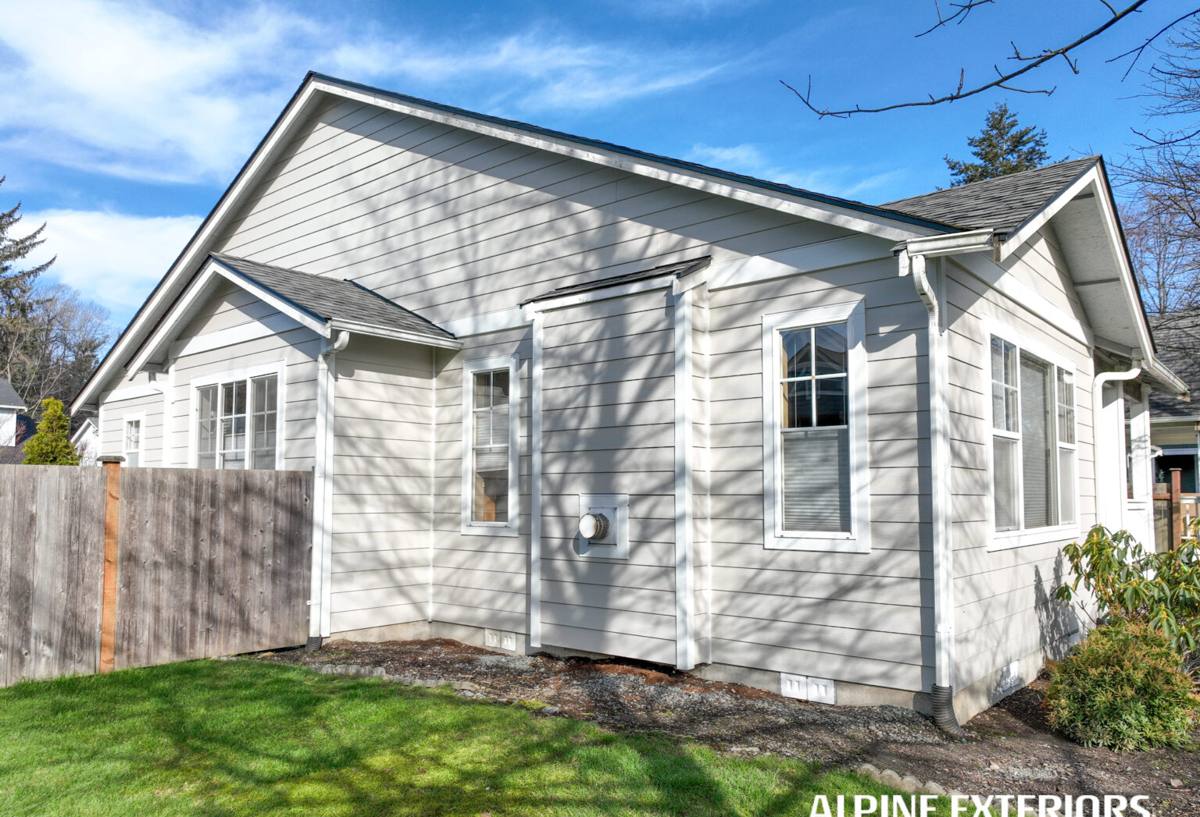
What a Correct Roof Replacement Actually Involves
Tear-off and deck inspection
Every legitimate roof replacement starts with a full tear-off, not an overlay. That's the only way to actually see the deck — and on an island property, deck problems are usually moisture problems: soft spots from a slow leak, staining around old flashing, or sheathing that's been sitting under moss longer than anyone realized. Any damaged sheathing gets replaced before anything new goes down; skipping this step is the single most common shortcut that shows up as a sagging or leaking roof a few years later.
Underlayment and flashing details
In a climate that mixes heavy rain with real wind, the underlayment and flashing matter as much as the shingle itself. That means self-adhering ice-and-water membrane at eaves, valleys, and any roof-to-wall transition, synthetic underlayment across the field, new drip edge, and step and counter-flashing rebuilt (not caulked over) at every chimney, skylight, and dormer. Wind-driven rain finds gaps that a calm-day roof would never expose, so these details get more attention here than they would on a sheltered, inland lot.
Ventilation
A roof that can't breathe holds moisture underneath the deck, which speeds up rot and helps moss and mildew take hold from below as well as above. Balanced intake and exhaust ventilation — proper soffit vents paired with ridge or box venting — is part of a correct install, not an upsell.
Choosing a Roofing Material for Island Conditions
There's no single "best" roofing material for every Guemes Island home — it depends on tree cover, slope, exposure, and budget. Here's how the common options actually perform in this environment:
| Material | Salt-air durability | Moss resistance | Wind-driven rain performance | Typical lifespan here |
|---|---|---|---|---|
| Architectural asphalt shingle (standard) | Good with corrosion-resistant fasteners | Fair — algae/moss-resistant granules help | Good with proper flashing detail | 20–25 years |
| Architectural asphalt shingle (algae-resistant) | Good | Better — copper-infused granules slow growth | Good with proper flashing detail | 25–30 years |
| Standing seam metal | Very good with marine-grade fasteners/coatings | Very good — little for moss to grip | Excellent when properly seamed | 40+ years |
| Wood shake | Fair — needs regular treatment near salt air | Poor without diligent upkeep | Fair — more seams, more maintenance | Highly maintenance-dependent |
We steer most island clients away from untreated wood shake specifically because of the moss and moisture combination — it's not that the material is bad, it's that the upkeep it demands (regular cleaning, treatment, and vigilant maintenance) is a poor match for a property that's harder to get a crew back out to on short notice.
Moss and Shade: The Island's Long Wet Season
Moss doesn't need a rainforest to take hold — it just needs shade, moisture, and time, and the wooded, shaded lots common on parts of Guemes Island provide plenty of all three. Once moss establishes on a roof, it does real damage: it holds water against the shingle surface, works its way under tabs and lifts them, and keeps the deck damp long after the rain has stopped. A roof that looks "mostly fine" with a green tint on the north slope is usually a few years into losing granules and moisture protection underneath that tint.
For a full replacement, that means choosing algae/moss-resistant shingles on shaded slopes where it makes sense, considering zinc or copper strips near the ridge on problem areas, and — just as important — talking honestly about which overhanging limbs are keeping a slope wet enough to grow moss in the first place. Trimming back tree cover a few feet is often the cheapest, highest-value thing a homeowner can do alongside a new roof.
Salt Air, Wind, and Fasteners
Standard fasteners and flashing corrode faster this close to the water, especially on more exposed, west-facing sites. It shows up first in small ways — rust streaking below nail heads, pitted flashing — but it's the kind of small failure that eventually lets water in. A correct install for this environment uses corrosion-resistant (typically stainless or hot-dip galvanized) fasteners and flashing rated for coastal exposure, not the minimum-spec hardware that's fine sixty miles inland. It costs a bit more up front and saves a callback in five years.
Getting Materials and Crews to Guemes Island
The Guemes Island ferry is a small, limited-capacity crossing from Anacortes, and it shapes how a roofing job actually gets run out there. Sailings are limited through the day, there's no lumberyard or roofing supplier on the island, and hauling off a full tear-off's worth of old shingles means every load competes for ferry space same as everything else headed over. A crew that hasn't planned for that shows up mid-morning, realizes they're short a pallet of shingles or a dumpster slot, and loses the rest of the day waiting on the next sailing.
Working the island regularly means building the job around the ferry, not around the ferry around the job:
- Ordering and staging all materials in Anacortes before the first sailing, so the crew isn't making a return trip mid-project
- Scheduling debris haul-off in as few ferry crossings as possible, rather than daily half-load runs
- Carrying tools and backup fasteners on-site rather than assuming a same-day supply run is possible
- Building in a weather buffer, since a wind advisory can affect ferry service same as it affects the roofing schedule
- Coordinating start times around ferry sailings so the crew's full workday is actually spent on the roof
None of this is complicated, but it's the difference between a Guemes Island job that runs on schedule and one that stretches out because logistics weren't planned for up front.
Permits and Working with Skagit County
Roof replacements on Guemes Island fall under Skagit County jurisdiction, and depending on the scope of work — full tear-off versus repair, changes to the roofline, or work near shoreline setback areas — that can mean a permit is required before work starts. A crew familiar with the island already knows what triggers a permit locally and won't leave that step as a surprise partway through the job.
What to Ask Before Hiring a Roofer for Guemes Island
Because the logistics here are genuinely different from a mainland job, it's worth vetting a contractor on more than just price:
- Have they run a job on Guemes Island before, and do they have a real plan for ferry-dependent scheduling?
- Do they tear off down to the deck and inspect sheathing, or just overlay?
- What fasteners and flashing do they use, and are those rated for coastal/salt-air exposure?
- Will they address moss-prone, shaded slopes specifically, or treat the whole roof the same?
- Are they licensed, bonded, and insured to work in Skagit County, and can they show it?
- Do they handle the county permit process, or leave that to the homeowner?
Cost Factors on a Guemes Island Roof Replacement
Pricing on any roof replacement depends on size, pitch, layers to remove, and material — but island jobs carry a few added cost drivers worth knowing up front:
| Factor | Why it affects island pricing |
|---|---|
| Ferry crossings for crew/materials/debris | Time and fare cost built into scheduling, especially for larger haul-off loads |
| Material staging | Everything has to be ordered and pre-staged in Anacortes rather than picked up mid-job |
| Corrosion-resistant hardware | Marine-grade fasteners and flashing cost more than standard-grade |
| Tree/shade conditions | Moss-resistant materials and possible tree trimming coordination add to scope |
| Access and pitch | Same as any roof — steeper, harder-to-access roofs take longer regardless of location |
None of these make a Guemes Island roof dramatically more expensive than a comparable mainland job, but they do need to be planned for rather than discovered halfway through — which is exactly why the estimate should be specific to your property, not a generic quote.
If your Guemes Island roof is showing moss, granule loss, or its age is catching up with it, we're happy to take a look and put together a straightforward, no-pressure estimate — built around your roof, your tree cover, and the ferry schedule, not a one-size-fits-all number. Use the form below to get started.