 Anacortes Window
 Mount Vernon roofs work harder than most people realize. The Skagit Valley sits low and flat, close enough to Skagit Bay and the broader Puget Sound to pick up salt-laden air, wet enough to see driving rain push sideways into laps and valleys most of the year, and shaded enough on a lot of lots to grow moss for months at a stretch. Metal roofing has become a popular answer to that combination — but only when it's specified and installed correctly for this specific climate, not treated as a generic upgrade. This page covers what a Mount Vernon home actually needs from a metal roof, what correct installation involves, and how our process works from first look to final walk-through.
Why Skagit Valley Weather Changes the Calculation
Three conditions drive most of the roofing wear we see in and around Mount Vernon, and they don't act in isolation — they compound.
Salt Air
Airborne salt moving in off the bay accelerates corrosion on anything metal — fasteners, flashing, vent stacks, ridge caps. A panel, coating, or fastener spec that holds up fine well inland can start showing rust or white corrosion streaking within a few years here if it wasn't rated for a coastal-influenced environment. Metal roofing done right accounts for this from the material selection stage, not as an afterthought.
Driving Rain
Rain in this part of Skagit County doesn't fall straight down as often as people assume. Wind off the water and off open valley farmland pushes it sideways, which means it finds its way into laps, seams, and flashing details that would stay dry in a calmer storm. Metal roofing sheds water extremely well on the field of the roof, but every leak we see on a metal roof traces back to a seam, penetration, or flashing detail — never the panel itself.
Moss Season
Shaded, north-facing roof slopes and tree-covered lots around Mount Vernon support a moss season that runs long because the valley doesn't dry out between storms the way a more exposed, open area would. Moss holds moisture against a roofing surface for extended periods, and on organic materials like shingles it works into laps and lifts edges over time. Metal's smooth, non-porous surface gives moss far less to hold onto, which is one of the main reasons homeowners here look at metal in the first place.
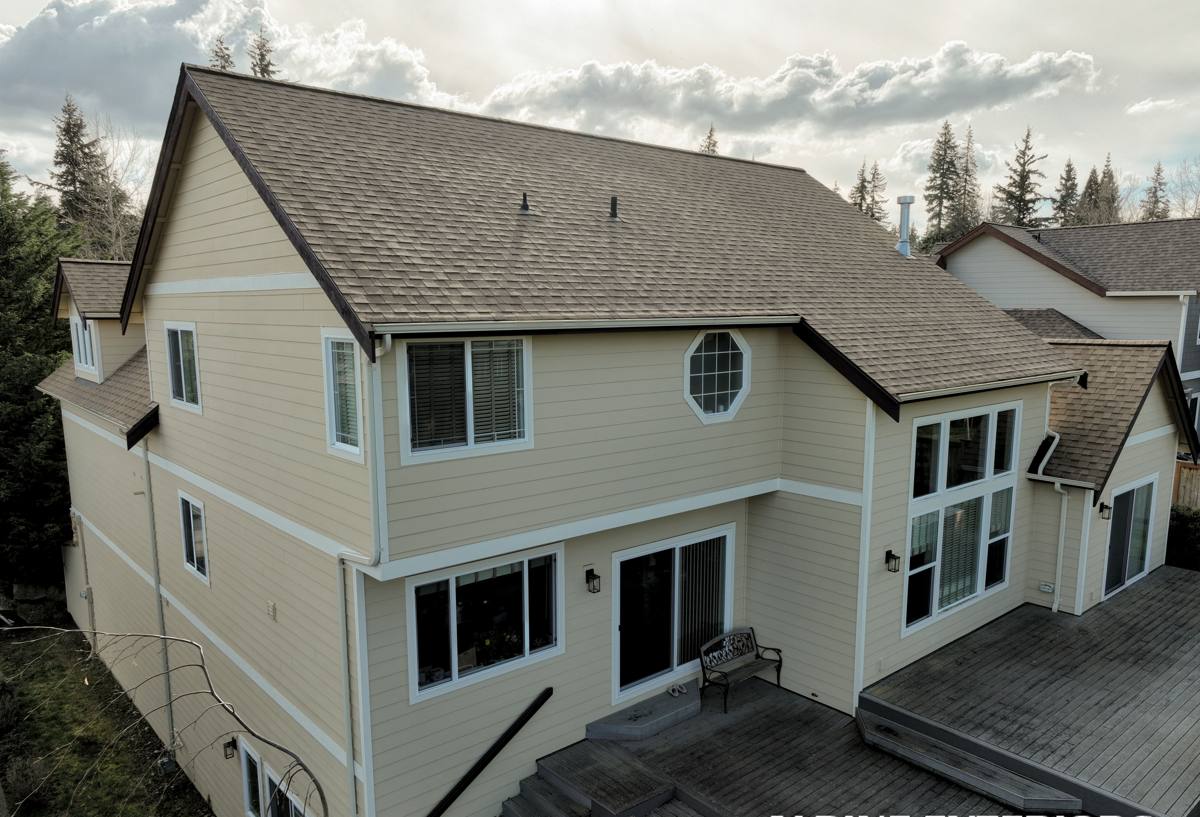
Why Metal Roofing Fits This Climate
Metal roofing isn't automatically the right call for every home or every budget, and we'll say so plainly if that's the honest answer for your house. But for a Mount Vernon roof dealing with sustained moisture and a long wet season, it has real, specific advantages over asphalt shingles.
- Smooth surface sheds water faster and resists moss and algae growth better than a porous shingle surface
- Longer service life than asphalt when installed and maintained correctly, which matters over a full Skagit Valley wet season cycle after cycle
- Lighter weight per square than many shingle systems, which can be an advantage on older framing
- Better performance against wind uplift when panels and fastening are correctly specified for local exposure
- Fewer field seams than a shingle roof to fail over time, when installed with proper panel overlap and sealant practices
The trade-offs are real too: metal roofing typically costs more upfront than an equivalent asphalt job, installation is less forgiving of mistakes, and certain panel styles can be noticeably louder in heavy rain without proper underlayment and decking. We'll walk through all of that honestly during an estimate rather than only pitching the upside.
Standing Seam vs. Exposed Fastener Panels
Not all metal roofing is the same system, and the choice between them matters more in this climate than in a drier one.
| Factor | Standing Seam | Exposed Fastener |
|---|---|---|
| Fastener exposure | Concealed under the seam, no penetrations through the panel face | Fasteners penetrate the panel face directly |
| Long-term leak risk in driving rain | Lower — fewer points where water can work past the fastener over time | Higher over time as fastener seals age and need eventual maintenance |
| Upfront cost | Higher | Lower |
| Typical use case here | Primary residences, long-term ownership | Outbuildings, shops, budget-driven projects |
For a primary residence in a climate that gets sustained wind-driven rain most of the year, we generally recommend standing seam. Exposed fastener systems are a legitimate, more affordable option for secondary structures, and we'll install either one correctly — but we'll tell you plainly which one fits a given project and why.
What Correct Metal Roof Installation Actually Involves
A metal roof is only as good as the details underneath and around the panels. Most of the leaks and premature failures we're called out to inspect on metal roofs trace back to a handful of installation shortcuts, not the material itself.
- Underlayment rated for the full wet-season exposure this valley gets, not a minimum-code product
- Flashing correctly integrated at every valley, wall transition, chimney, and roof penetration — not just caulked over
- Panel overlap and fastening pattern matched to the specific panel profile and local wind exposure
- Coastal-rated fasteners and flashing hardware selected for salt-air resistance, not generic galvanized parts
- Proper ventilation and airflow beneath the roof deck to control condensation, which matters as much as surface drainage on a metal roof
- Ridge, hip, and eave details finished to shed wind-driven rain rather than just standard rain
Skip any one of those and the panel itself can be flawless while the roof still leaks. That's the part of a metal roof job that separates a crew that occasionally installs metal from one that does it as a regular part of their work in this specific climate.
Our Process
We start with a walk of the existing roof and a straight conversation about what your home actually needs — not a generic sales pitch toward the most expensive option. From there:
- On-site inspection of the existing roof, decking condition, and any signs of moisture damage or ventilation problems
- A written scope covering panel type, underlayment, flashing plan, and fastener specification — specific to your roof, not a boilerplate quote
- Tear-off and deck inspection, with any rot or damage found addressed before new material goes on, not covered over
- Installation following manufacturer specifications and the coastal-exposure details this climate calls for
- A final walk-through so you understand what was done and what to watch for going forward
We don't cover up a bad deck to save a day of labor, and we don't upsell a homeowner into standing seam on a project where an honest exposed-fastener job on a shop or outbuilding would serve them just as well.
Metal Roofing vs. Asphalt Shingles for a Mount Vernon Home
| Factor | Asphalt Shingles | Metal Roofing |
|---|---|---|
| Moss resistance | Lower — porous surface holds moisture and gives moss a foothold | Higher — smooth surface sheds water and resists growth |
| Typical service life | Shorter, especially under sustained valley moisture | Longer when installed and detailed correctly |
| Upfront cost | Lower | Higher |
| Wind-driven rain performance | Good when installed correctly, but more seams to maintain over time | Strong on the field; performance depends entirely on flashing and seam detail |
| Noise in heavy rain | Minimal | Noticeable without proper underlayment and decking, manageable with correct install |
Cost Factors for a Mount Vernon Metal Roof
We don't publish blanket pricing because it isn't honest to do so — the real drivers are specific to your roof. What we can lay out plainly are the factors that move a project's cost up or down.
| Factor | How It Affects Cost |
|---|---|
| Panel system chosen | Standing seam runs higher than exposed fastener due to material and labor complexity |
| Existing deck condition | Rot or moisture damage found during tear-off adds repair scope before installation can proceed |
| Roof complexity | More valleys, penetrations, and roof-to-wall transitions mean more flashing labor |
| Access and site conditions | Tree cover, steep pitch, or tight staging can affect labor time and equipment needs |
| Ventilation upgrades | Adding or correcting ridge and soffit ventilation adds scope but protects the deck long-term |
Why a Crew That Already Works Mount Vernon Matters
A crew that regularly works roofs in and around Mount Vernon has already seen how a shaded, moss-prone north slope ages differently from an open, wind-exposed south slope two streets over — and adjusts flashing, ventilation, and panel recommendations accordingly. That's judgment built from repetition in this specific valley climate, not from a spec sheet written for the whole country. It also means someone local is reachable years down the road if a flashing detail or a warranty question needs a second look, instead of chasing down a crew that's since moved on to a different region entirely.
What to Look For When Hiring a Metal Roofing Contractor
- Current Washington contractor licensing, bonding, and active insurance you can verify before signing anything
- A clear explanation of panel type, underlayment, and flashing plan — not just a panel color and a price
- Willingness to explain why standing seam or exposed fastener fits your specific project, not a one-size answer
- A written scope of work and warranty terms you can actually read and understand
- A track record of metal roofing work specifically in Skagit County conditions, not just a general service area claim
- Straight talk about trade-offs — noise, upfront cost, installation sensitivity — not just the upside
Maintaining a Metal Roof Once It's Installed
A correctly installed metal roof in this climate is genuinely low-maintenance compared to shingles, but it isn't zero-maintenance. Keeping gutters and valleys clear ahead of the wet season prevents debris buildup from holding moisture against seams. An occasional visual check after major windstorms catches any lifted flashing or fastener issue early, before a small gap becomes a leak. And checking shaded, moss-prone areas periodically — even though metal resists growth far better than shingles — keeps any buildup from holding moisture against trim and flashing longer than it should. A contractor who installed the work correctly should be able to tell you exactly what to watch for on your specific roof.
Get a Free, No-Pressure Estimate
If you're weighing a metal roof for a Mount Vernon home, we're happy to take a look and give you a straight read on whether it's the right fit for your house and your budget — no pressure, no generic sales pitch. Reach out for a free estimate and we'll walk the roof with you and talk through what we see.