 Anacortes Window
 La Conner sits about as close to the water as a Skagit County home can get, and that proximity shapes almost everything about how siding performs there. Salt air off the water, driving rain that comes in sideways more often than straight down, and a moss season that can stretch from fall through spring all put a heavier load on exterior cladding than homes see even a few miles inland. If you're looking at siding replacement for a La Conner property, the material and the installation details matter more here than almost anywhere else in the region.
What La Conner's Climate Actually Does to Siding
Three things define the exposure in La Conner: salt-laden air, sustained wind-driven rain, and moss growth that gets a long runway to establish itself in the shaded, damp conditions common along the water. Salt air is corrosive to fasteners and finishes, and it accelerates the breakdown of coatings that aren't formulated to resist it. Driving rain doesn't just wet the surface of a wall — it pushes moisture up and under laps, seams, and trim in a way that vertical rain never does, which means the water-management details behind the siding matter as much as the siding itself.
Moss is the most visible symptom of all this. Once it establishes on a shaded wall or in a north-facing corner, it holds moisture against the surface almost year-round, which is a slow, steady stress test that most siding products weren't designed to handle indefinitely. Add in the temperature swings between marine fog and clear, sunny stretches, and you get a cycle of expansion, contraction, and moisture exposure that punishes weak seams and poor flashing faster than a drier inland climate would.
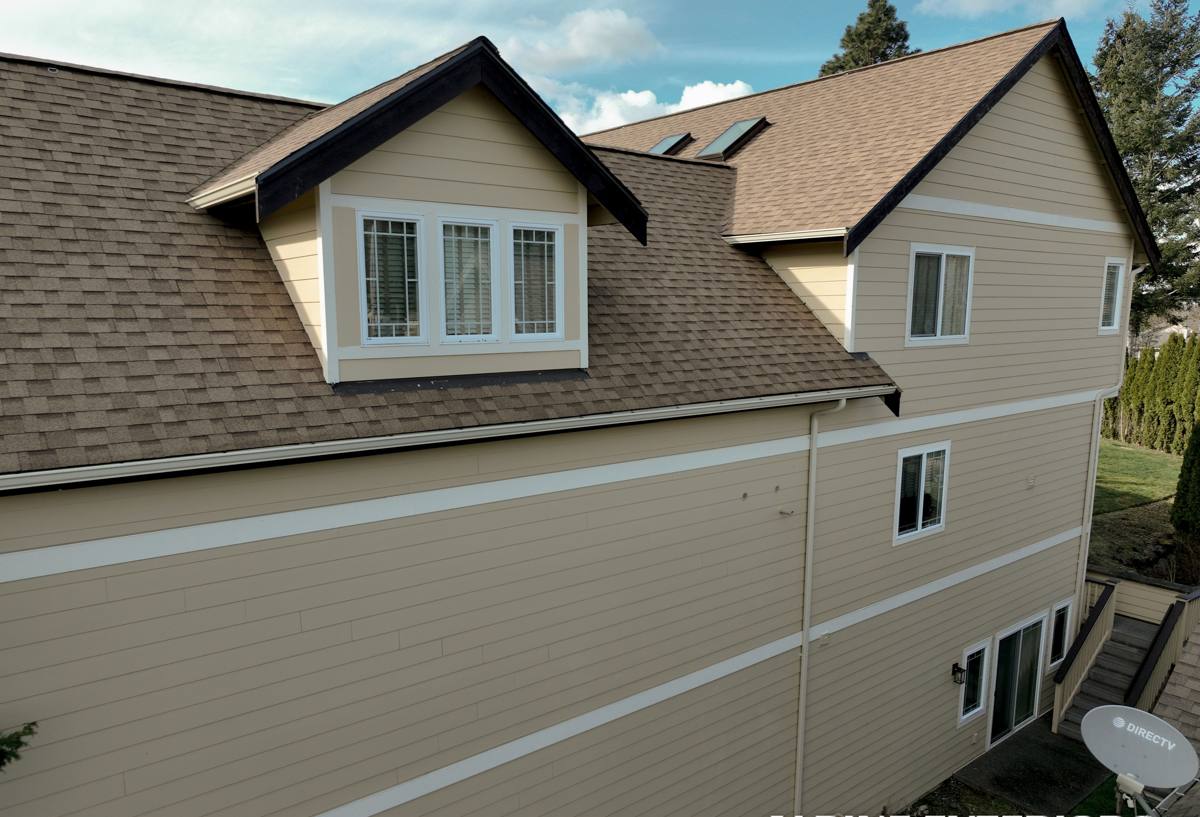
Why Replacement Is Often the Right Call, Not Repair
Homeowners often ask whether a problem area can just be patched. Sometimes it can — a single damaged board or a small section of storm damage doesn't necessarily justify tearing off a whole wall. But siding failure in a marine climate is rarely isolated to the spot you can see. If moisture has been tracking behind the cladding for years, the visible damage is usually the tip of a larger problem in the sheathing or framing behind it.
Signs a La Conner home may need full replacement rather than a patch
- Soft or spongy spots when you press on the siding, especially near the bottom courses or around window and door trim
- Persistent moss or algae staining that keeps returning within a season or two of cleaning
- Visible warping, buckling, or gaps between panels or boards that weren't there a few years ago
- Paint or finish failure — peeling, chalking, or bubbling — across large sections rather than one weathered spot
- A musty smell in interior rooms along an exterior wall, which can indicate moisture has already reached the wall cavity
- Siding that's original to a home more than 20-25 years old, especially if it's never been fully inspected behind the surface
When several of these show up at once, spot repair usually just delays a bigger tear-out later, often after more of the wall assembly has been compromised.
What a Correct Siding Replacement Involves
Tear-off and a real inspection
A proper replacement starts with removing the existing siding down to the sheathing, not just installing over what's there. That's the only way to actually see what the marine climate has done to the wall — rot, fastener corrosion, insulation that's absorbed moisture, or sheathing that needs repair before new siding goes up. Skipping this step is how a house ends up with a beautiful new exterior over a problem that keeps getting worse underneath.
Weather-resistive barrier and flashing
This is the part of the job that determines whether the siding lasts 10 years or 40, and it's largely invisible once the project is done. A continuous weather-resistive barrier, correctly lapped and sealed, combined with proper flashing at every window, door, and roof-to-wall intersection, is what actually keeps driving rain out of the wall assembly. Siding sheds the majority of water, but it's not the primary defense — the barrier and flashing behind it are. In a place like La Conner, where wind-driven rain is routine rather than occasional, corner-cutting here shows up as a moisture problem within a few years, not decades.
Installation to manufacturer specification
Correct clearance from grade and roof lines, correct fastener type and spacing, correct joint treatment, and correct caulking practice all affect how siding performs over time. James Hardie publishes detailed installation specifications for exactly this reason — the product is engineered to perform when installed a certain way, and shortcuts on clearance or fastening are one of the most common reasons siding underperforms in wet coastal conditions, regardless of how good the material itself is.
Comparing Siding Options for a La Conner Property
We install only James Hardie fiber cement, and the table below reflects why that's our standard for this specific climate rather than a generic recommendation.
| Factor | James Hardie Fiber Cement | Vinyl | Untreated Wood / Primed Spruce |
|---|---|---|---|
| Moisture behavior in driving rain | Non-combustible, dimensionally stable, engineered HZ lines for marine exposure | Sheds surface water but relies entirely on the barrier behind it; not itself waterproof | Absorbs moisture readily unless finish is maintained diligently |
| Moss and algae resistance | Factory ColorPlus finish resists staining better than field-applied paint | Can host moss/mildew in shaded areas; hard to clean without surface damage | Prone to moss and rot in shaded, damp conditions without regular treatment |
| Salt air / UV durability | Engineered for coastal exposure; factory finish warrantied against fading | Can become brittle and fade unevenly over time in salt air and UV | Finish breaks down faster under UV and salt, requiring frequent repainting |
| Maintenance over time | Periodic cleaning; no repainting needed with ColorPlus finish | Low maintenance but limited repair/refinish options once faded | Regular repainting and sealing required, especially near the water |
| Fire resistance | Non-combustible | Combustible | Combustible |
This isn't a claim that other materials fail outright — plenty of vinyl and wood-sided homes get by for years, including near the water. It's a reflection of which product holds up most consistently against this specific combination of salt air, driving rain, and moss pressure, which is why it's the only one we put our installation warranty behind.
Our Siding Replacement Process
- On-site assessment — we look at sun exposure, shade patterns, current siding condition, and any visible moisture or moss issues specific to the property
- Tear-off and inspection — existing siding comes off and the sheathing and framing get a real look before anything new goes up
- Repair as needed — any rot, damaged sheathing, or compromised framing gets addressed before the new water-management layer goes on
- Weather-resistive barrier and flashing installation — done to manufacturer spec at every penetration, corner, and roofline
- James Hardie installation — fastened, clearanced, and joined to Hardie's published specifications for the region
- Final walkthrough — trim, caulking, and finish details reviewed with the homeowner before the job is called complete
Why a Crew That Already Works in La Conner Matters
Siding installation isn't one-size-fits-all across Skagit County. A crew that regularly works waterfront and near-waterfront properties in and around La Conner already knows to pay closer attention to north- and shade-facing walls where moss takes hold first, to detail flashing for wind-driven rain rather than just vertical rainfall, and to expect a different maintenance conversation than they'd have on a home set back from the water. That familiarity isn't a marketing point — it changes real decisions on the job, like where to add extra flashing attention or which elevations need a tighter fastening schedule.
What to ask any contractor before hiring them
- Do they tear off existing siding down to the sheathing, or install over it?
- Can they explain their flashing and weather-resistive barrier approach in plain language, not just brand names?
- Do they follow the manufacturer's published installation specification, and will they say so in writing?
- Have they worked on other properties in La Conner or similarly exposed waterfront locations?
- What does their workmanship warranty actually cover, and for how long?
- Are they licensed and insured for exterior work in Washington?
What Drives the Cost of a La Conner Siding Project
Every property is different, but a few factors consistently move the number for waterfront and near-waterfront homes: the extent of hidden moisture damage found once tear-off begins, the complexity of the home's exterior (corners, trim, window and door openings), the amount of surface prep or sheathing repair needed, and the siding profile and finish chosen. Homes that have gone years without an inspection behind the siding sometimes carry more repair work than expected once the walls are opened up — which is exactly why the tear-off and inspection step isn't optional in a proper replacement.
If you're weighing siding replacement for a home in La Conner, we're glad to take a look at what your property is actually dealing with — sun exposure, moss risk, current siding condition — and give you a straight, no-pressure estimate before you commit to anything.