 Anacortes Window
 Why West Anacortes Roofs Take a Harder Hit
West Anacortes sits close enough to the water that roofs here deal with a different mix of stress than homes further inland in Skagit County. Salt-laden air corrodes exposed fasteners and metal flashing faster than it does even a few miles east. Driving rain off the Sound doesn't just fall straight down — wind-driven rain gets pushed sideways under shingle edges, around vent boots, and into any gap that a calmer rain would never find. And the long, wet moss season here means organic growth is working on the roof surface for a good chunk of the year, not just a few weeks.
None of these forces cause dramatic failures on their own. What they do is quietly compromise a roof's weak points — a lifted shingle tab, a hairline crack in old flashing sealant, a spot where moss has held moisture against the decking — so that when an actual windstorm or heavy rain event comes through, the roof fails at exactly those spots first. Storm damage repair in this neighborhood is rarely about one dramatic event. It's usually about a roof whose defenses were already thinning, meeting a storm strong enough to expose it.
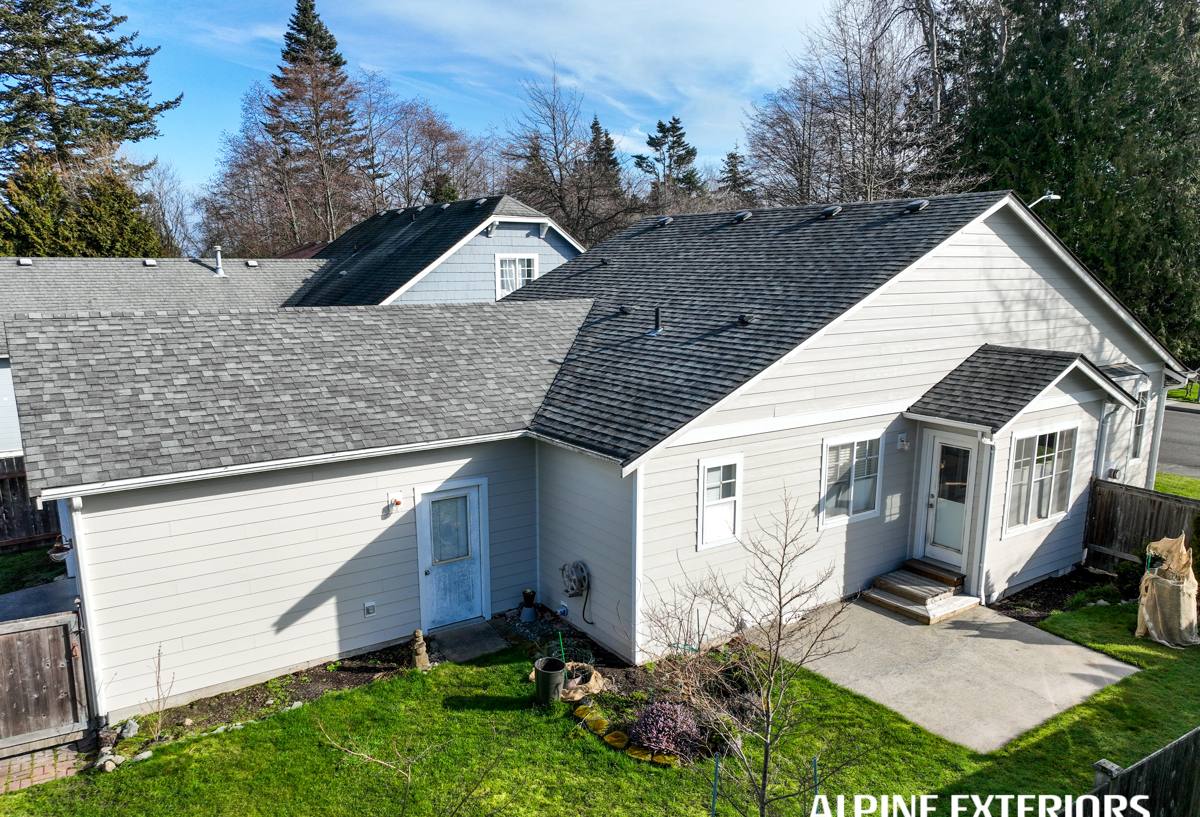
What Storm Damage Actually Looks Like on These Roofs
Homeowners often expect storm damage to be obvious — missing shingles scattered across the yard. Sometimes it is. More often, it's subtler, and the subtle version is what causes the expensive problems if it sits too long.
- Lifted or creased shingle tabs along ridges and rakes, where wind gets underneath and breaks the seal without tearing the shingle off entirely.
- Granule loss in the gutters or at the base of downspouts after a heavy wind-and-rain event, a sign the shingle surface took abrasion.
- Flashing separation around chimneys, skylights, and roof-to-wall transitions, where a small gap lets wind-driven rain track sideways instead of running off.
- Moss wedges at shingle edges and in valleys that have thickened enough to lift the shingle and hold water against it.
- Soft or discolored decking visible from the attic side, usually the first sign that water has been getting through longer than anyone realized.
- Bent or clogged gutters and downspouts from wind or debris, which back water up under the roof edge during the next rain instead of carrying it away.
The moss issue deserves its own mention because it's specific to this climate and it compounds everything else. Moss doesn't just sit on top of shingles — its root structure works into the granule layer and lifts shingle edges just enough for wind and rain to get a foothold. A roof with heavy moss going into a windstorm is far more likely to lose shingles than a clean one, because the moss has already done half the work of prying them loose.
What a Correct Storm Damage Repair Involves
A repair that actually holds up here has to address the storm damage itself and the conditions that made the roof vulnerable in the first place. That means the job isn't finished once the visible damage is patched.
Diagnosis before repair
We start by checking the decking underneath any damaged area, not just the shingles on top. A shingle repair over soft or water-stained decking is a short-term fix that fails again on the next hard rain. If the decking's compromised, that gets replaced as part of the repair, not left for later.
Matching materials, not just covering the hole
Shingles fade and wear at different rates depending on sun and moisture exposure, so a patch using leftover material or a slightly different product batch can stand out and, more importantly, may not seal the same way against the surrounding course. We match shingle type, weight, and where possible, color lot as closely as the situation allows.
Flashing gets rebuilt, not resealed
Around chimneys, vents, and wall transitions — the spots most exposed to wind-driven rain in this area — we prefer to replace and properly lap flashing rather than caulk over a failure point. Sealant is a maintenance item, not a permanent fix, especially once salt air has started working on exposed metal edges.
Moss and organic growth get addressed as part of the repair
If moss contributed to the damage, we clear it from the repair area and surrounding roof plane and talk through longer-term moss control so the same failure doesn't reappear in the same spot next season.
Repair or Replace? Honest Factors to Weigh
Not every storm-damaged roof needs a full replacement, and not every repair is a good long-term investment. The right call depends on a few practical factors more than on the storm event itself.
| Factor | Leans toward repair | Leans toward replacement |
|---|---|---|
| Roof age | Under roughly 12-15 years | Nearing or past typical shingle service life |
| Extent of damage | Isolated to one slope or section | Spread across multiple slopes |
| Decking condition | Solid, dry decking under the damage | Soft, delaminated, or repeatedly repaired decking |
| Moss/algae history | Light, manageable growth | Heavy, recurring growth across the roof |
| Prior repair history | First or second repair | Roof has needed several patches over recent years |
We'll give you a straight answer on which side of that table your roof falls on. A well-timed repair on a roof with good bones is money well spent. Pouring repair after repair into a roof that's genuinely at the end of its service life usually isn't.
Our Process, Start to Finish
- Assessment. We inspect the damaged area, the surrounding roof plane, and the attic side where accessible, so the estimate reflects what's actually happening, not just what's visible from the ground.
- Written scope and estimate. You get a clear description of what's being repaired, what materials are being used, and why — no vague line items.
- Repair work. Decking, flashing, and shingle work is done in the sequence that actually keeps water out, not just the fastest visible fix.
- Cleanup and debris check. Old shingle material, nails, and moss debris are cleared from the roof, gutters, and grounds.
- Final walkthrough. We show you what was repaired and why, and flag anything else worth keeping an eye on.
Working With Your Insurance
Wind and storm damage claims are common enough in Skagit County that most insurers have a fairly standard process, but the documentation matters. We provide clear photos and a written description of the damage tied to the storm event, which gives your adjuster something concrete to work from. We don't inflate a scope of work to pad a claim, and we won't tell you a roof needs full replacement when a targeted repair genuinely solves the problem — our estimate reflects what the roof needs, and you and your insurer can work from that.
Why Local Experience in This Neighborhood Matters
A roofer who works West Anacortes regularly already knows which slope orientations take the worst of the wind-driven rain, how fast moss builds back in shaded, moisture-holding spots near mature trees, and how the salt air here shortens the working life of exposed fasteners and flashing compared to inland Skagit County. That's the difference between a repair that's built for this specific exposure and a generic patch that was fine somewhere drier.
It also means faster response after a storm. A crew that already has customers in the neighborhood can often get to a tarped or leaking roof sooner than one driving in from further away — and in this climate, the gap between "damaged" and "actively letting water into the house" can close in a single hard rain.
A Homeowner's Storm-Season Checklist
- Walk the yard and gutters after any significant windstorm and look for shingle granules or fragments.
- Check the attic (if accessible) for damp insulation, water stains, or daylight coming through the decking.
- Look at valleys and north-facing slopes for moss buildup before it thickens through the wet season.
- Clear gutters and downspouts before the fall rains so wind-driven water has somewhere to go.
- Have flashing around chimneys and vents checked every couple of years, since these are the first points to fail in salt air.
- Don't wait on a small leak — in this climate, a slow drip during moss season can mean months of hidden moisture before it becomes visible.
If a recent storm has left you with missing shingles, a slow leak, or just some peace of mind you're after, we're happy to take a look. Fill out the form below for a free, no-pressure estimate and we'll tell you honestly what your roof needs.