 Anacortes Window
 West Anacortes Puts Extra Stress on a House's Siding
Homes on the water side of Anacortes deal with a combination most siding products were never engineered for: salt-laden marine air, wind-driven rain that hits walls sideways instead of falling straight down, and long stretches of gray, damp weather that keep exterior surfaces wet far longer than they'd stay wet inland. Add the moss and algae pressure that comes with Skagit County's mild, moist winters, and you've got a climate that finds every weak point in a siding system within a few years, not a few decades.
Salt air is corrosive to exposed metal fasteners and trim, and it accelerates the breakdown of finishes that aren't built to handle it. Driving rain finds gaps in flashing and caulking that would never leak in a drier climate. And constant moisture on north-facing and shaded walls is exactly the environment moss and algae need to take hold. None of this means West Anacortes homes need exotic materials — it means they need a siding product that's engineered for coastal Pacific Northwest conditions, installed by people who understand why the details matter here.
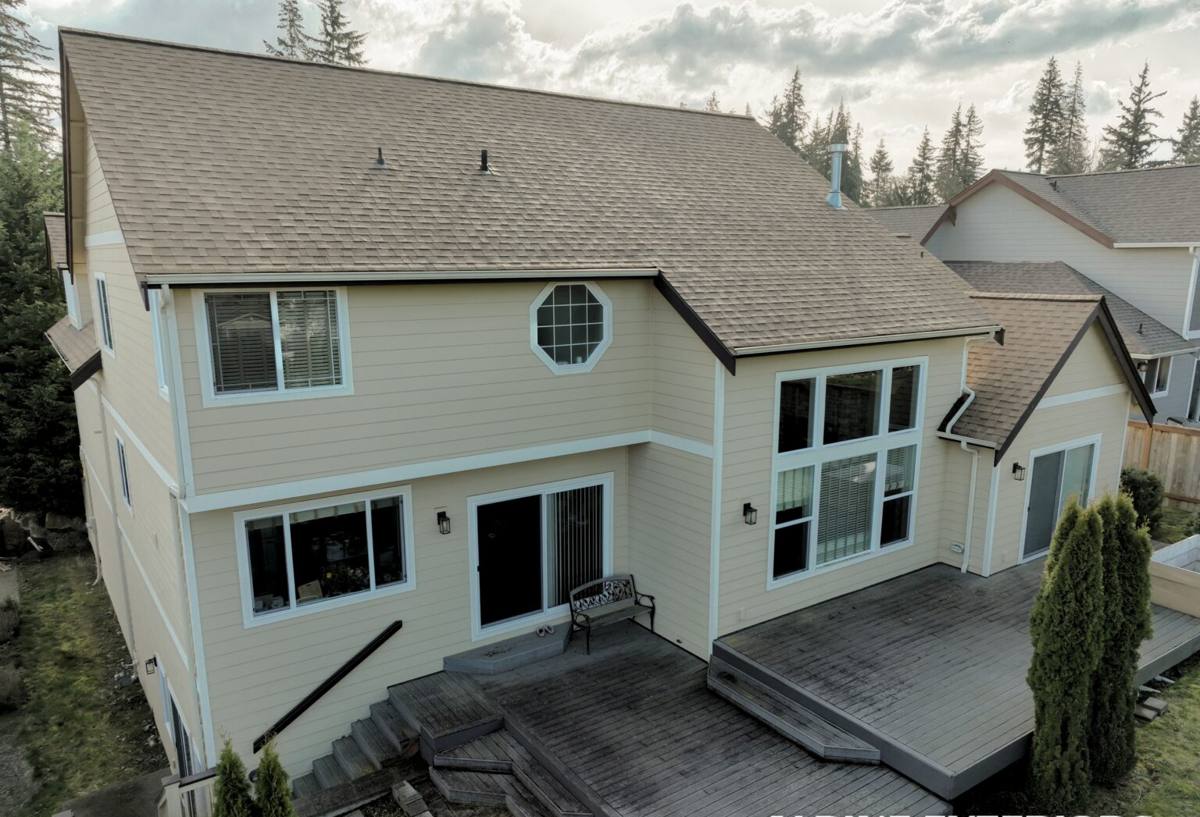
Why We Only Install James Hardie Fiber Cement
We don't install LP SmartSide, vinyl, Cemplank, Allura, or primed wood siding. That's not a marketing position — it's a standard we hold because of what we've seen these products do, or fail to do, in exactly this kind of climate. Fiber cement in general resists moisture, insects, and fire far better than wood-based siding, and it holds its shape and color far better than vinyl in temperature swings and coastal sun. But not all fiber cement is built or finished the same way, which is why we standardized on one manufacturer instead of installing whichever product a supplier happens to have in stock.
James Hardie engineers its siding by climate zone. The formulation used in Western Washington is built for the wet, moderate Pacific Northwest — a different mix than what Hardie ships to the hot, dry Southwest. That climate-specific engineering matters on a peninsula town like Anacortes, where the siding is wet more often than it's dry for a good chunk of the year.
Hardie's ColorPlus finish is also baked on at the factory under controlled conditions rather than sprayed or brushed on site. That matters in a marine climate because factory-cured finishes hold up better against UV, salt exposure, and moisture cycling than field-applied paint, and it means the color coat and the substrate are matched and warrantied as a system rather than two separate products depending on each other to perform.
What Fiber Cement Doesn't Do That Wood and Vinyl Can
Because it's cement-based rather than wood-fiber-based, Hardie siding doesn't rot, and it doesn't feed mold or fungal growth the way wood substrates can when they stay damp. It also won't warp, crack from freeze-thaw cycling, or become brittle and prone to cracking in cold snaps the way some vinyl siding does. Moss and algae can still land and grow on any exterior surface that stays shaded and damp long enough — that's a surface issue, not a material failure — but with fiber cement, surface growth is something you wash off, not something that's degrading the material underneath.
What a Correct Fiber Cement Job Actually Involves
Fiber cement siding is only as good as its installation. Most of the complaints we hear about fiber cement — cracking at butt joints, paint failing early, water getting behind the siding — trace back to installation shortcuts, not the material itself. In a climate like West Anacortes', those shortcuts show up faster than they would somewhere drier.
Clearances and Drainage
Hardie's own installation instructions specify minimum clearances from roof lines, decks, patios, and grade. Siding installed too close to a roofline or patio surface wicks up moisture and never fully dries between rain events. We also install a drainage plane and rainscreen or house wrap system behind the siding so that any moisture that does get past the surface has somewhere to go besides straight into the wall sheathing.
Fastening and Flashing
Every seam, window, and door opening needs proper flashing and correctly placed fasteners — corrosion-resistant, driven at the right depth, and spaced according to manufacturer specification rather than "close enough." In salt air, the wrong fastener choice or a fastener driven too deep or shallow is one of the fastest ways for a siding job to fail early.
Caulking and Paint Lines
Joints and butt seams need to be caulked with a product rated for exterior movement and UV exposure, not general-purpose caulk. Cut edges of Hardie board need to be sealed and touched up with Hardie-approved touch-up paint so the factory finish isn't compromised at every cut — a step that's easy to skip and impossible to see once the job looks "done," but shows up as premature wear within a few years.
How Fiber Cement Compares in This Climate
| Factor | James Hardie Fiber Cement | Vinyl Siding | Cedar / Engineered Wood |
|---|---|---|---|
| Moisture and rot resistance | High — cement-based, doesn't rot | High resistance, but seams and J-channels can trap moisture | Vulnerable without diligent maintenance and paint upkeep |
| Performance in salt air | Engineered finish holds color and integrity well | Can become brittle and fade faster over time | Finish breaks down faster; grain can raise and check |
| Fire resistance | Non-combustible | Combustible, can melt or warp near heat sources | Combustible |
| Maintenance | Periodic wash, occasional caulk check | Low, but damage often means full-panel replacement | Regular repainting or restaining required |
| Typical lifespan when installed to spec | Decades, with a strong manufacturer warranty | Shorter, especially in coastal UV and salt exposure | Shorter unless maintenance is kept up consistently |
None of these are bad products in every situation — vinyl is inexpensive and low-maintenance, and cedar has a look some homeowners love. But for a house exposed to Anacortes' salt air and driving rain, we think the trade-offs on the other two are steeper than most homeowners realize until they're a few years in.
What Drives the Cost of a Fiber Cement Siding Job
| Cost Factor | Why It Matters |
|---|---|
| Home size and wall complexity | More corners, dormers, and cut lines mean more labor and material waste |
| Existing siding removal | Tear-off and disposal of old siding adds time, especially with old wood or vinyl |
| Condition of the sheathing underneath | Rot or water damage found once old siding comes off needs repair before new siding goes on |
| Product line and profile | Lap siding, panel siding, and shingle-style Hardie products carry different material and labor costs |
| Trim and accessory work | Corner boards, window trim, and fascia work add scope beyond the flat wall areas |
| Access and site conditions | Multi-story sections, tight lots, or landscaping obstacles affect scaffolding and staging |
Because every one of these varies house to house, we don't quote fiber cement jobs off a flat per-square-foot number — we walk the house, check the sheathing where we can, and give a written estimate based on what's actually there.
Our Process, Start to Finish
- On-site walk-through to assess existing siding, trim, and any visible moisture or rot issues
- Written estimate covering material, tear-off, prep, and installation scope
- Removal of old siding and inspection of the sheathing and framing underneath
- Repair of any damaged sheathing before new material goes on — never siding over a problem
- Installation of drainage plane, flashing, and Hardie fiber cement to manufacturer specification
- Caulking, touch-up, and trim work to close out exposed edges and seams
- Final walk-through with the homeowner before we consider the job finished
Living With Fiber Cement Siding in a Salt Air, Moss-Prone Climate
Fiber cement is a low-maintenance product, but "low-maintenance" isn't "no-maintenance," especially this close to the water. A little seasonal attention goes a long way toward getting the full lifespan out of the siding and the warranty that backs it.
- Rinse siding periodically with a garden hose to clear salt residue and organic buildup, especially on walls facing prevailing wind and rain
- Keep an eye on shaded, north-facing walls where moss and algae are most likely to take hold, and wash those sections more often
- Trim back vegetation and tree limbs that keep siding shaded and damp longer than necessary
- Inspect caulk lines at trim and window edges every year or two and have gaps resealed before they let water in
- Touch up any cut edges or fastener heads that lose their finish, using the correct Hardie-approved products
- Keep gutters and downspouts clear so overflow isn't running down and pooling against siding
Why Hire a Crew That Already Works West Anacortes
Every coastal neighborhood in Skagit County has its own microclimate — how much wind a wall takes, how much shade a north side gets, how fast moss establishes itself on a particular lot. A crew that's already worked houses in this part of Anacortes has a feel for which walls need extra flashing attention, which sites need more aggressive moss treatment before siding goes up, and which drainage details matter most given how the rain actually hits homes here versus a few miles inland. That local pattern-recognition doesn't replace following manufacturer specs — it's what keeps us from treating every house the same way when the site conditions clearly aren't the same.
It also means faster, more accurate estimates. We're not guessing at how West Anacortes weather treats a wall — we've already seen it, and we build the job around it from the first walk-through.
If your siding is showing its age, or you're planning ahead of a repaint or repair, we're happy to take a look and give you a straightforward, no-pressure estimate for James Hardie fiber cement siding built for a West Anacortes home.