 Anacortes Window
 Building Decks for Oak Harbor's Marine Climate
Oak Harbor sits close enough to the water that every outdoor structure has to answer to the same set of conditions: salt-laden air rolling off the Salish Sea, wind-driven rain that finds its way into joints most decks in drier parts of the state never have to deal with, and a moss season that can run from October clear through April. A deck built here isn't just a Pacific Northwest deck — it's a coastal deck, and it needs to be treated that way from the footings up.
We work out of Anacortes and spend most of our time on projects in exactly this kind of environment, so this isn't theoretical for us. The failures we get called out to fix — corroded fasteners, soft ledger boards, slick moss-covered treads — almost always trace back to a deck that was built to a general Pacific Northwest standard instead of a marine one. The difference matters, and it shows up within the first few winters.
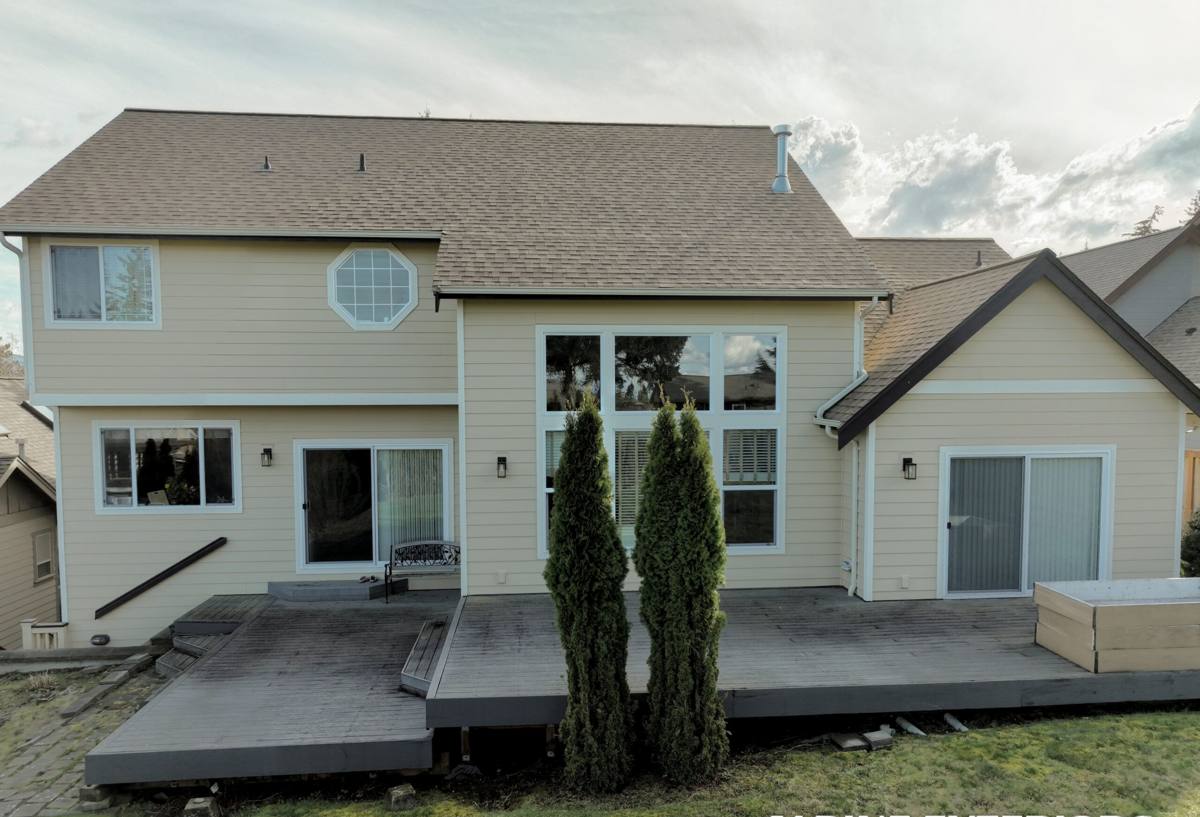
What Salt Air and Driving Rain Actually Do to a Deck
Salt air accelerates corrosion on anything metal — fasteners, joist hangers, railing hardware, even the coating on some pressure-treated lumber. Standard galvanized screws that would last decades inland can start showing rust streaks in a few years this close to the water. Once a fastener starts to corrode, it loses holding strength long before it looks obviously bad, which is part of why deck failures near the coast tend to be more about hardware than about the wood itself.
Driving rain is the second issue. Wind off the water doesn't just fall straight down — it drives sideways into ledger connections, under railing caps, and into any gap where end grain is exposed. Wood absorbs moisture fastest through end grain and through joints, so a deck with unsealed cut ends, poor flashing at the house connection, or decking boards installed tight against each other with no drainage gap is set up to trap water exactly where it does the most damage.
Then there's moss and algae. Skagit County's wet season is long, and a deck surface that doesn't get much direct sun — common on north- or east-facing decks, or ones tucked under trees — can stay damp for weeks at a stretch. That's ideal moss habitat, and moss on decking isn't just unsightly. It holds moisture against the board surface and turns the deck into a genuine slip hazard on wet mornings.
What a Correctly Built Deck Includes
None of this means a deck near Oak Harbor has to be over-engineered or unusual-looking. It means a handful of details get done right that are easy to skip on a lower-bid job:
At the Framing Stage
- Ledger boards flashed properly at the house connection, with a drainage gap or flashing tape behind them — not just bolted directly to the siding
- Stainless steel or heavy-duty coated fasteners rated for coastal or marine exposure, not standard exterior-grade hardware
- Joist tape or a comparable moisture barrier on top of framing lumber, so joists aren't absorbing water through every deck-board screw hole
- Footings set below frost depth and sized for the soil conditions on the specific lot, since drainage and soil type vary a lot across Fidalgo and Whidbey Island properties
- Positive drainage sloped away from the house at the ledger connection
At the Finish Stage
- A consistent gap between decking boards for airflow and water runoff
- Cut ends sealed before installation, not after
- Railing posts through-bolted rather than just lag-screwed into rim joists
- Stair stringers and ledger areas detailed so water doesn't pool against end grain
Each of these adds a small amount of labor and material cost up front. What they buy is a deck that doesn't need major structural repair inside five to seven years — which is roughly the timeline we see on decks built without them in this climate.
Choosing a Decking Material for This Climate
There's no single right answer here — it depends on budget, how much upkeep you want to do, and the look you're after. What matters is picking with the local climate in mind rather than just going with whatever's cheapest at the yard.
| Material | Salt Air / Moisture Behavior | Maintenance | Typical Lifespan |
|---|---|---|---|
| Pressure-treated wood | Good if properly sealed and re-sealed; end grain and fastener points are the weak spots | Annual cleaning, resealing every 2-3 years | 15-20 years with upkeep |
| Cedar | Naturally rot-resistant, but softer and more prone to surface weathering near the coast | Regular cleaning, staining or sealing to hold color and resist moss | 15-20 years with upkeep |
| Composite decking | Doesn't absorb water like wood; performance depends heavily on the specific product's core and cap design | Periodic washing; no sealing or staining needed | 25-30 years, manufacturer-dependent |
| PVC / capped polymer | Fully resistant to moisture absorption and salt corrosion of the board itself | Low — occasional washing | 25-30+ years, manufacturer-dependent |
Whatever material you choose for the decking surface, the hardware and framing underneath it should be built to the same marine standard. A composite or PVC deck surface sitting on standard-grade fasteners and un-flashed ledger connections is still a deck with a hidden weak point — the visible material is only part of the story.
Design Considerations Specific to Oak Harbor Properties
Properties in and around Oak Harbor tend to sit with some exposure to open water or wind corridors, which changes a few practical design decisions:
Wind Exposure
Railing systems and post spacing need to account for wind load, not just code minimums. On more exposed lots, we'll sometimes recommend tighter post spacing or a solid lower rail section to cut down on wind pressure against the deck structure over time.
Elevation and Grade Changes
Many lots on Fidalgo and Whidbey Island have meaningful slope, which means footing depth and support post height can vary a lot across a single deck footprint. This is a case where a site visit tells us far more than a phone estimate ever could.
View Orientation vs. Sun and Moss
The best view orientation on a water-adjacent lot is often the shadiest side of the house — which is also the side most prone to holding moisture and growing moss. That's not a reason to avoid building there, but it does affect material choice, board spacing, and how often the deck will need cleaning.
Our Process
1. Site Visit and Assessment
We walk the property, look at drainage, sun exposure, existing structure if there's a deck to replace, and talk through what you actually use the space for. That last part matters more than people expect — a deck built for morning coffee is a different design than one built for hosting.
2. Design and Material Selection
We go over material options honestly, including trade-offs on maintenance and upfront cost, and put together a design that fits the house and the lot's specific exposure.
3. Permitting
Most new decks and many deck replacements require a building permit, and requirements can differ depending on the jurisdiction your property falls under. We handle the permit process as part of the job rather than leaving it to the homeowner to sort out.
4. Build
Framing first, with all the moisture-management details built in from the start — not added as an afterthought. Then decking, railing, and stairs.
5. Final Walkthrough
We go over the finished deck with you, explain what maintenance it needs and when, and make sure everything meets the standard we agreed on before we call the job done.
Maintaining a Deck in a Salt Air, High-Moisture Climate
Even a well-built deck needs some seasonal attention here. A short annual routine goes a long way toward avoiding the bigger repairs:
- Sweep debris out of gaps between boards regularly — trapped leaves and needles hold moisture against the wood
- Check and re-tighten or replace any fasteners showing rust or corrosion, especially near the ledger and stairs
- Inspect ledger flashing for gaps or failure, particularly after a hard winter
- Clean moss and algae off the surface before it builds up, using a deck-safe cleaner rather than a pressure washer set too aggressively
- Reseal or restain wood decking on the schedule appropriate to the product — typically every 2-3 years
- Check railing posts and connections for movement, which can indicate a loosening fastener or rot starting underneath
- Confirm drainage under and around the deck hasn't been blocked by landscaping changes or debris buildup
Why a Crew That Already Works Oak Harbor Matters
Deck-building know-how that works fine forty miles inland doesn't automatically transfer to a property with real salt air exposure and driving coastal rain. A contractor who mostly works drier, more sheltered parts of the state may not default to marine-grade hardware, proper ledger flashing, or moss-conscious board spacing unless a homeowner specifically asks for it — and most homeowners don't know to ask.
Working regularly in and around Anacortes, Fidalgo Island, and Whidbey Island communities like Oak Harbor means we see how decks actually hold up here over time, not just how they look on installation day. That shapes how we frame, what hardware we spec, and how we talk homeowners through material trade-offs before the first board goes down — which is a very different starting point than a generic deck-building approach applied to a coastal lot.
Get a Free, No-Pressure Estimate
If you're planning a new deck or replacing one that's showing its age in Oak Harbor, we're glad to come take a look, walk the site, and give you an honest read on what it'll take. There's no pressure and no obligation — just a straight assessment and an estimate you can use to make the decision that's right for your home. The form below gets you started.