 Anacortes Window
 Why Burlington Roofs Take a Different Kind of Beating
A roof in Burlington doesn't age the way a roof in a dry inland climate does. Sitting in Skagit County, close enough to Padilla Bay and the Salish Sea to catch salt-tinged marine air, homes here deal with three things working against the roof at the same time: airborne salt that speeds up corrosion on fasteners and flashing metal, wind-driven rain that gets pushed sideways and up under shingle edges instead of falling straight down, and a moss season that can run most of the year on shaded, north-facing slopes. None of these show up as one dramatic failure. They show up slowly, as granule loss, soft spots in the decking, or a slow drip that only appears during the heaviest storms.
A roof replacement done for this climate has to account for all three from the start — not as an afterthought, but built into the material choices, the underlayment system, and the flashing details. That's the difference between a roof that looks fine for a few years and one that actually holds up through twenty or more Skagit County winters.
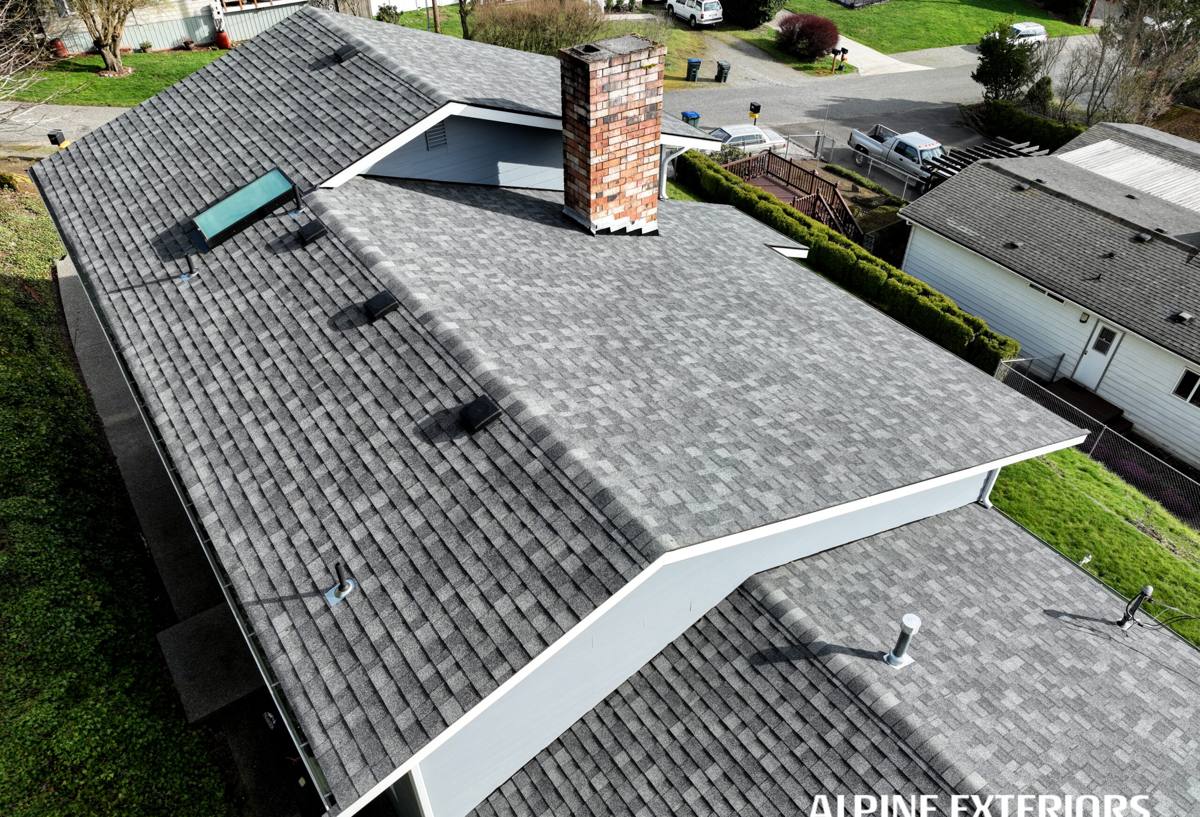
Recognizing When Replacement — Not Repair — Is the Right Call
Not every roof problem means a full replacement. A localized leak at a single flashing point, a handful of storm-damaged shingles, or a clogged valley can often be repaired without tearing off the whole roof. But there's a point where patching individual problems stops making financial sense and starts masking a roof that's failing as a system.
What You Can See From the Ground or on the Roof Surface
- Shingles that are curling, cupping, or cracking across large sections rather than in one isolated spot
- Heavy granule loss showing up in gutters, leaving bald patches that expose the underlying mat
- Moss or algae buildup that keeps returning within a season or two of cleaning, especially on north-facing slopes
- Visible sagging along the roofline, which can point to deck or structural issues underneath
- Multiple layers of shingles already on the roof from a past layover job, limiting future repair options
What Shows Up First in the Attic
The attic often tells the truth before the roof surface does. Water staining on the decking or rafters, daylight visible through the roof boards, damp or compressed insulation, and a musty smell are all signs that moisture is already getting past the roofing system — even if nothing looks wrong from the ground. Because of how much wind-driven rain this area sees, water can travel a surprising distance from the actual entry point before it shows up as a stain, which is part of why an honest inspection matters more than a quick look from the driveway.
What a Correctly Done Roof Replacement Actually Includes
"Roof replacement" gets used loosely, and the difference between a rushed job and a correct one is almost entirely in the details most homeowners never see once the shingles go down.
Full Tear-Off and Deck Inspection
A layover — installing new shingles over old ones — hides problems instead of fixing them and traps moisture between layers. A proper replacement strips the roof down to the decking, which is also the only point in the job where anyone can actually see and address rot, soft spots, or delamination in the plywood or OSB underneath. Any damaged decking gets replaced before anything new goes down; skipping this step is one of the most common ways a "new roof" fails early.
Underlayment and Water-Resistive Barrier
The underlayment is the roof's backup line of defense, and in a climate with this much wind-driven rain, it matters as much as the shingles themselves. Synthetic underlayments and self-adhered membranes at vulnerable areas — eaves, valleys, and around penetrations — resist wind-driven water intrusion far better than older felt products, which can degrade faster in damp, marine-adjacent conditions.
Balanced Ventilation
Intake vents at the eaves and exhaust vents near the ridge need to work together to move air through the attic space. Without that balance, moisture from everyday household use gets trapped, condenses on the underside of the roof deck, and accelerates rot from the inside — a problem that has nothing to do with the shingles and everything to do with airflow.
Flashing at Every Transition
Valleys, chimneys, skylights, and wall intersections are where roofs actually leak — not in the open field of shingles. Correctly formed and properly lapped flashing, using metal that resists salt-air corrosion, is what keeps water from finding its way in at these transition points.
Choosing a Roofing Material for This Climate
Most Burlington-area homes are well served by asphalt shingles, but not every asphalt product performs the same way here, and metal roofing is a legitimate option worth understanding on its own terms.
| Material | Moss & Moisture Resistance | Typical Lifespan Here | Maintenance |
|---|---|---|---|
| Standard 3-tab asphalt | Lower — thinner profile holds less algae resistance over time | 15–20 years | Regular moss and debris removal recommended |
| Architectural/laminate asphalt | Better, especially with algae-resistant granules | 25–30 years | Occasional moss treatment on shaded slopes |
| Standing-seam metal | Excellent — sheds moss and debris, minimal organic growth | 40–50+ years | Low; periodic fastener and sealant checks |
Architectural shingles with algae-resistant granules are a reasonable default for most homes given the length of the local moss season, offering a meaningful step up from 3-tab without the higher upfront cost of metal. Metal earns its price on longevity and low maintenance, but it's a different look, a different installation skill set, and a bigger initial investment — worth discussing honestly rather than assuming it's automatically the "better" choice for every home and budget.
How the Replacement Process Actually Works
A roof replacement runs smoothest when each step happens in the right order, with nothing skipped to save time.
- In-person inspection. We walk the roof and attic, document what we find, and identify any deck or ventilation issues before quoting anything.
- Written estimate. A detailed, itemized bid — material, underlayment type, flashing scope, and any deck repair allowance — not a one-line number.
- Permitting. Skagit County and local jurisdiction permit requirements are handled before work starts, not treated as an afterthought.
- Material delivery and staging. Materials are staged to protect landscaping and minimize disruption to the property during the job.
- Tear-off. The old roofing comes off down to the deck, with the deck inspected and any damaged sections replaced.
- Underlayment and flashing installation. The water-resistive layer and all flashing details go in before a single shingle is installed.
- Shingle or material installation. Installed to manufacturer specification, including proper nailing patterns and exposure for local wind conditions.
- Ventilation check. Intake and exhaust ventilation is verified or upgraded as part of the job, not left as a separate add-on.
- Cleanup and final walkthrough. Full site cleanup, including a magnetic sweep for stray nails, and a walkthrough so you can see the finished work before we consider the job done.
Moss, Moisture, and the Long Game
Even a correctly installed roof needs some ongoing attention in this climate. Moss doesn't just sit on top of shingles — over time its root structure lifts granules and holds moisture against the roof surface, which shortens the life of even a good roofing product if it's left unaddressed for years at a stretch. The goal isn't to eliminate moss entirely, which is close to impossible in a shaded, damp part of Skagit County, but to keep it from establishing long-term and holding water against the roof.
- Keep overhanging branches trimmed back to let more light and airflow reach shaded roof slopes
- Clear gutters and valleys of debris at least twice a year so water has a clear path off the roof
- Have moss physically removed rather than just chemically treated when buildup is heavy
- Check attic ventilation periodically, since blocked or damaged vents undermine even a well-installed roof
- Address any small leak or stain right away — attic moisture problems get more expensive to fix the longer they sit
What to Look for in a Crew That Actually Works This Area
A roofing crew that works Burlington and the surrounding Anacortes area regularly has already seen how salt air corrodes cheap fasteners and which slopes hold moss longest through a wet winter — that's not something a crew based well outside the region, or one that only shows up after a storm, tends to know firsthand.
- Active Washington state contractor license, verifiable directly through the state
- General liability insurance and workers' compensation coverage, provided in writing on request
- A physical local presence and current or recent jobs in the immediate area
- A written, itemized bid that specifies underlayment type, flashing scope, and material grade — not just a total price
- A workmanship warranty separate from the manufacturer's material warranty, with a clear explanation of what each one covers
Be cautious with door-to-door crews that appear right after a windstorm, push same-day signing, or ask for a large deposit before materials are even ordered. A legitimate local contractor doesn't need those tactics.
Warranty and What It Actually Protects
A roofing warranty is really two separate promises, and it's worth understanding both. The manufacturer's material warranty covers defects in the shingle or roofing product itself, but most standard versions are prorated after the first several years unless installed by a specifically certified contractor for an enhanced tier. The workmanship warranty is the contractor's own guarantee against installation errors — which, in practice, cause far more leaks than defective material ever does. A strong material warranty means little if the crew that installed it isn't still around, or willing, to stand behind their own labor a few years down the road.
If your roof is showing its age, or you'd just like an honest, no-pressure opinion from a crew that already knows what Burlington and Anacortes-area weather does to a roof, we're glad to take a look. Fill out the form below for a free estimate — no obligation, just a straight answer about where your roof actually stands.