 Anacortes Window
 Skyline is one of the more exposed pockets of Anacortes, and siding up there has to earn its keep. Between the salt air rolling off the water, the driving rain that comes with a west-facing bluff, and a moss season that seems to stretch longer every year, this neighborhood is a tougher environment for exterior materials than most inland lots in Skagit County. We install James Hardie fiber cement siding exclusively, and Skyline is exactly the kind of place where that choice — and the way it's installed — actually matters.
What Skyline's Climate Asks of a Siding System
A siding product on a Skyline home is dealing with three things at once: salt-laden air that accelerates corrosion on fasteners and finishes, wind-driven rain that pushes water sideways into joints and laps instead of just running down the wall, and shaded, damp conditions that keep moss and algae established for most of the year. Any one of those is manageable on its own. Together, over a couple of decades, they expose every weak point in a lesser siding system or a shortcut installation.
That's why we don't treat a Skyline siding job like a standard re-side. We look at which walls face the water and take the brunt of the wind, which sides sit in shade long enough to stay damp between storms, and what the existing siding and trim are already telling us about how the house has handled that exposure so far.
What Failing Siding Looks Like Up Here
- Caulking that's cracked or pulled away at butt joints and trim, letting wind-driven rain track behind the siding
- Soft or discolored siding near window and door trim, usually a sign flashing wasn't detailed correctly the first time
- Moss and algae staining that keeps returning on north- or tree-shaded walls no matter how often it's cleaned
- Rust streaking from fasteners that weren't rated for coastal exposure
- Chalking, fading, or paint failure on wood or older fiber cement that was never factory-finished for this climate
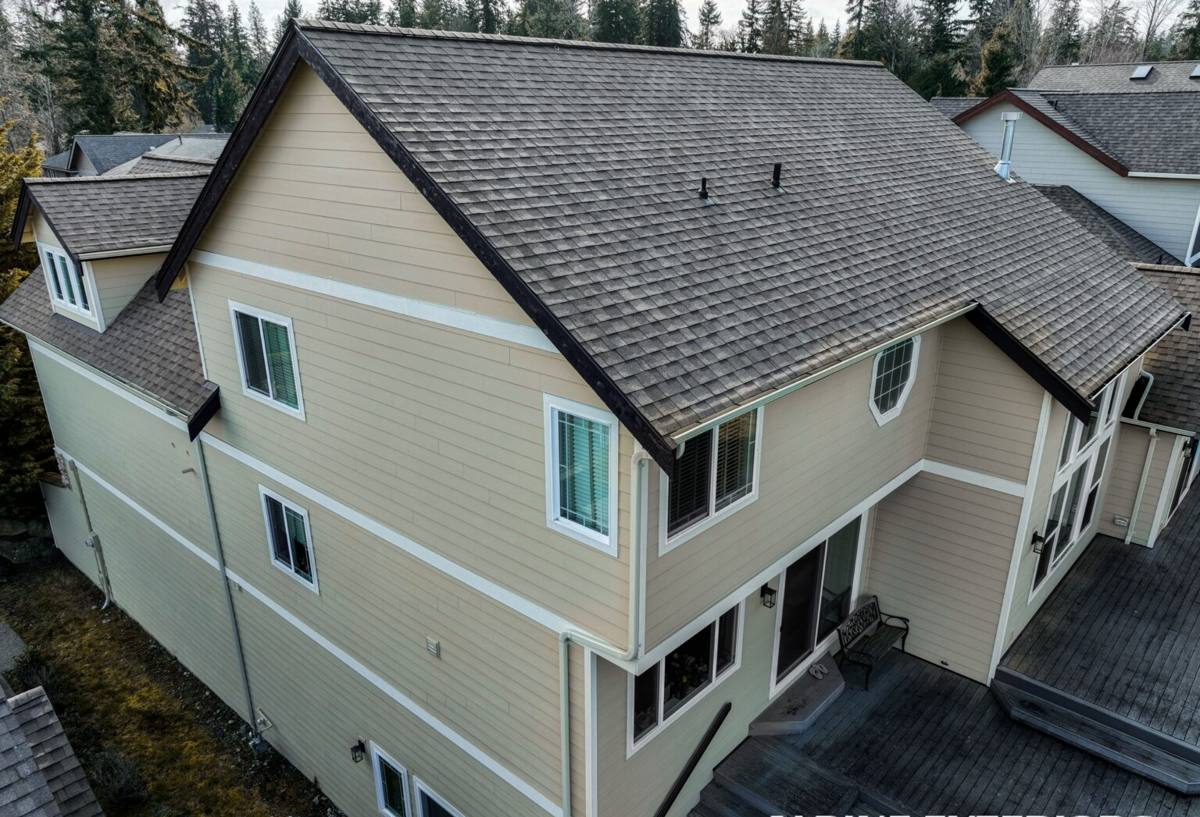
Why Fiber Cement, and Why Only James Hardie
We install James Hardie fiber cement siding exclusively. We don't install vinyl, LP SmartSide, Cemplank, Allura, primed spruce, or cedar, and on a Skyline lot the reasons are practical, not theoretical.
Vinyl isn't a water barrier by itself — it relies entirely on whatever's behind it, and on a wall that takes direct wind-driven rain, that's a weak link we're not willing to build a job around. It also becomes more brittle with age and UV exposure, which shows up as cracking at fastener points over time. Wood siding, whether cedar or primed spruce, needs a real maintenance commitment — repainting, resealing cut edges, watching for rot wherever moisture gets trapped — and a shaded, damp Skyline wall is about the hardest place to keep that maintenance schedule from slipping. Engineered wood products like LP SmartSide use a treated wood-strand substrate that performs well when detailing is followed exactly, but any breach in that treated layer opens the door to the kind of moisture damage this climate is very good at finding.
James Hardie's fiber cement is non-combustible, dimensionally stable in wet-dry cycling, and comes factory-finished with ColorPlus coating designed to resist fading, cracking, and moisture intrusion — engineered specifically for climates like this one. It's not that other products can't work anywhere; it's that we've settled on the one system that holds up consistently in salt air, sustained moisture, and UV exposure without asking the homeowner to fight the climate every year to keep it looking right.
Hardie Product Lines We Use on Skyline Homes
| Product | Where It Fits | Why It Works Here |
|---|---|---|
| HardiePlank Lap Siding | Most full re-sides and additions | Factory ColorPlus finish holds color against salt air and UV better than field-applied paint |
| HardiePanel Vertical Siding | Gable ends, accent walls | Fewer horizontal joints for wind-driven rain to work against |
| HardieTrim Boards | Window and door surrounds, corners | Won't rot or swell the way wood trim does in constant damp shade |
| HZ10 Climate Engineered | Direct water- or wind-exposed walls | Formulated specifically for wetter, harsher exposure zones like coastal Skagit County |
What a Correct Fiber Cement Installation Actually Involves
Fiber cement siding is only as good as the assembly behind it. Most of the siding failures we get called out to inspect in this area trace back to installation shortcuts, not the material itself — gaps in the water-resistive barrier, missing or misaligned flashing, fasteners driven wrong, or clearances that were never set correctly at the ground or roofline.
- A continuous, properly lapped water-resistive barrier behind the siding, with flashing integrated at every window, door, and penetration — not caulked over as an afterthought
- Correct fastener type, spacing, and depth per Hardie's published installation specs, since over- or under-driven fasteners are one of the most common causes of premature cracking
- Proper clearance from grade, roofing, and decks so siding isn't sitting in standing water or snow load against the bottom course
- Factory-cut and factory-primed edges kept intact wherever possible, with any field cuts sealed per manufacturer spec before installation
- Caulking only at the joints Hardie's details call for — not as a substitute for correct flashing
Installed this way, Hardie siding is built to go decades without repainting and to shrug off the wet-dry cycling that causes wood and vinyl to fail early. Installed as a shortcut, it can develop the same moisture problems as any other siding — which is exactly why the installation details matter as much as the product choice.
Our Process on a Skyline Job
We start with a walk-around of the existing siding and trim, checking for soft spots, staining, and flashing that's already showing signs of failure, since that tells us what we're likely to find once the old siding comes off. From there, tear-off exposes the sheathing, and we address any rot or moisture damage before anything new goes on — no correct siding job can cover up a wet wall assembly and expect it to hold.
Next comes the water-resistive barrier and flashing at every window, door, and penetration, done before a single piece of Hardie siding is hung. Then the siding itself goes up to manufacturer spec — correct fastening, correct clearances, correct lap and joint treatment — followed by trim, caulking at the joints that call for it, and a final walk-through to check every detail before we call it finished.
What Drives Cost on a Skyline Siding Project
| Factor | Why It Matters |
|---|---|
| Tear-off and sheathing condition | Rot or moisture damage found once old siding comes off adds repair scope that's hard to price until it's exposed |
| Home access and lot terrain | Bluff lots, steep grades, and limited staging space affect scaffolding and material handling time |
| Trim and detail complexity | More windows, corners, and roof intersections mean more flashing and trim work per square foot |
| Siding profile and finish | Lap versus panel siding, and color choice within Hardie's ColorPlus range, affect material cost |
| Existing siding removal | Multiple layers of old siding or extensive rot repair add labor beyond a straightforward re-side |
We don't quote a job without seeing the walls first, and on a Skyline property especially, what's behind the existing siding often matters as much as what's going on top.
Living With It Once It's Installed
Hardie's factory finish is built to go a long time without repainting, but it's not zero-maintenance in this climate. We recommend an annual look at caulked joints and trim for cracking, a rinse-down of shaded walls where moss and algae tend to establish, and prompt attention to any staining near windows or the foundation line, since that's usually the first visible sign of a flashing issue rather than the siding itself failing. None of that compares to the upkeep a wood or vinyl wall demands in the same conditions, but it's worth doing consistently rather than waiting for a problem to become obvious.
Why a Crew That Already Works Skyline Matters
Skagit County's coastal microclimates vary block to block, and Skyline's mix of bluff exposure, salt air, and tree shade is something you learn by working on homes there repeatedly. We know which walls are going to take the worst of a winter storm, which flashing details actually earn their keep on a site like this versus which ones are just code minimums, and how to plan around narrow driveways, limited staging area, and tree cover that affects scaffolding — all things that come up more on a Skyline lot than on a flat, open property elsewhere in Anacortes.
If your Skyline home has siding that's cracking, staining, or holding moss no matter how often it's cleaned, we're glad to take a look. A free, no-pressure estimate gets you a straight read on what's actually going on with the siding and what it would take to fix it right — no obligation, just an honest answer.