 Anacortes Window
 Sedro-Woolley Roofs Take a Different Kind of Beating
Sedro-Woolley sits inland along the Skagit River, tucked closer to the foothills than the coastline. That position changes what a roof deals with compared to a house right on the water. You get less direct salt spray, but you get more of everything else that comes off Puget Sound weather systems as they push inland and collide with the terrain: sustained wind gusts funneling through the valley, long stretches of driving rain, and a canopy of mature trees that keeps roofs shaded, damp, and slow to dry out. That combination is exactly what moss and algae need to take hold, and it's exactly what wears down flashing, sealant, and shingle granules faster than a manufacturer's warranty timeline assumes.
A roof here doesn't usually fail all at once. It fails in stages — a few lifted shingles after a windstorm, a soft spot where moss has been holding moisture against the decking, a flashing seam that finally gives out after its third or fourth wet season. Storm damage repair in this area isn't just about patching what a single event broke. It's about recognizing that the storm often just finished off something the climate had already been working on for years.
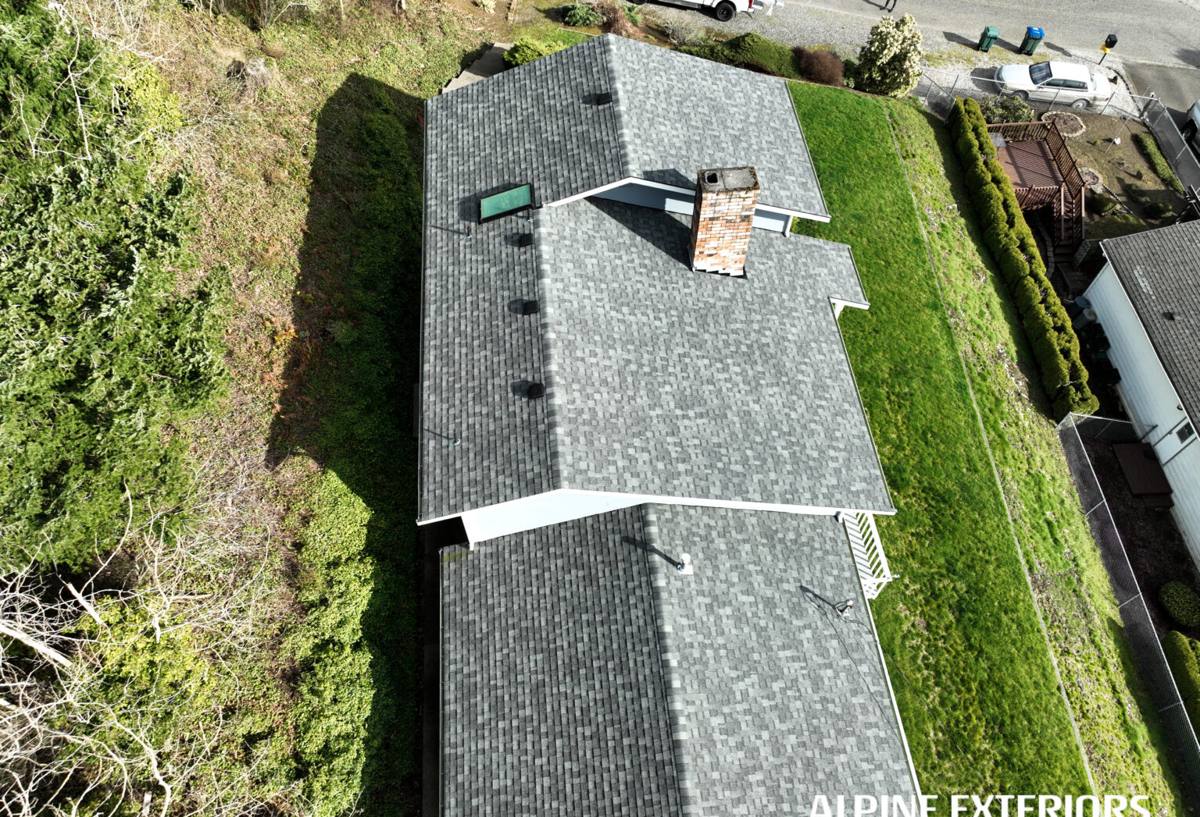
What Actually Counts as Storm Damage
Homeowners often assume storm damage means a hole you can see from the ground. Most of the time it's less obvious than that, and the less obvious kind is what causes the expensive water intrusion problems six months later.
Wind Damage
Wind doesn't have to tear a shingle off to damage it. Uplift can break the seal on the adhesive strip without visibly moving the shingle, which means it looks fine from the driveway but will lift and let water underneath during the next storm. Ridge caps and the shingles nearest roof edges and valleys are usually the first to go because that's where wind pressure concentrates.
Impact Damage
Falling branches are the most common impact source in this area, given how many mature conifers and big-leaf maples overhang residential roofs. Impact can crack shingles, dent metal flashing, or puncture underlayment without leaving an obvious hole — the damage shows up as a stain on the ceiling weeks later.
Water Intrusion Around Penetrations
Vent stacks, chimney flashing, and skylight curbs are where most storm-related leaks actually originate, not the open field of the roof. A storm can flex a roof enough to crack an old sealant bead or shift a flashing piece that was already marginal.
Granule Loss
Driving rain and hail-like debris impact can strip the protective granules off asphalt shingles. This doesn't cause an immediate leak, but it accelerates UV and moisture damage to the shingle underneath, shortening the roof's remaining life.
How We Approach a Storm Damage Repair
The process is the same whether the damage is obvious or something we need to go looking for.
1. Ground-Level and Roof Assessment
We start by walking the property and checking gutters, downspouts, and the ground around the foundation for granules, shingle fragments, or flashing pieces — that tells us a lot before we ever get on the roof. Then we inspect the roof surface itself: shingle condition, flashing seals, valleys, penetrations, and the ridge line.
2. Identifying the Actual Damage Source
Water stains inside the house don't always show up directly below the roof problem — water travels along rafters and decking before it drips. We trace the path back to the source rather than just patching where the stain appears.
3. A Clear, Written Scope
You get a plain explanation of what's damaged, what's simply aged and due for maintenance, and what's urgent versus what can be scheduled. We separate storm-caused damage from pre-existing wear so you know exactly what you're paying to fix and why.
4. The Repair Itself
Depending on scope, that means replacing damaged shingles and matching them as closely as possible to the existing roof, resealing or replacing flashing, addressing any compromised decking underneath, and clearing moss or debris that contributed to the failure so the same spot doesn't fail again next season.
5. Final Check
Before we consider the job done, we recheck the repaired area and the surrounding roof for anything we'd want to flag now rather than have you discover during the next storm.
Repair or Replace? What Actually Drives That Decision
Not every storm-damaged roof needs a full replacement, and not every roof that looks fine after a storm is actually fine. The honest answer depends on a few concrete factors, not on how the roof looks from the street.
| Factor | Repair Usually Makes Sense | Replacement Worth Considering |
|---|---|---|
| Roof age | Under 12-15 years, in otherwise good condition | Already near or past the shingle's expected service life |
| Damage extent | Localized to one section, valley, or penetration | Spread across multiple slopes or repeated failures in different spots |
| Decking condition | Solid, dry decking under the damaged area | Soft, delaminated, or water-stained decking found during inspection |
| Moss/algae history | Isolated growth, roof otherwise sound | Long-term moss growth that's degraded shingle granules broadly |
| Shingle match | Discontinued or faded shingles can be reasonably blended | Shingle line discontinued and mismatch would be very noticeable |
When a roof is borderline, we'll tell you it's borderline. There's no advantage to us in oversizing a repair job, and there's no advantage to you in patching a roof that's going to need full replacement within a couple of years anyway.
Materials That Hold Up to This Climate
For storm repairs in a shaded, damp, wind-exposed area like Sedro-Woolley, the materials matter as much as the workmanship.
- Algae-resistant shingles — Most major manufacturers now embed copper or zinc granules that slow algae and moss growth. On a heavily shaded roof, this is worth prioritizing over a slightly lower-cost standard shingle.
- Properly lapped, sealed flashing — Flashing failures cause more storm-related leaks than shingle failures. We install flashing with correct overlap and fresh sealant rather than relying on old material that's already been through several wet seasons.
- Ice-and-water shield in vulnerable zones — Valleys, eaves, and around penetrations get an added self-adhering membrane layer, which matters more here than in drier climates because those are the spots where driving rain finds a way in.
- Matched shingle color and profile — When we can source a close match, we do. When the exact product is discontinued, we'll tell you honestly what your options are rather than installing a visibly mismatched patch.
We steer away from lower-grade three-tab shingles for storm repairs in this area — not because the product is defective, but because their thinner profile and shorter warranty period make them a poor match for a climate that's already testing every seam and edge on a roof. That's our standard, based on what holds up here, not a claim about any manufacturer.
Working With Your Insurance Adjuster
If the damage is significant enough to file a claim, documentation matters more than almost anything else in the process. We photograph the damage before starting any work, note wind speed or storm date where relevant, and provide a written scope that an adjuster can review alongside their own inspection. We're not a public adjuster and won't promise a claim outcome — that's between you and your insurer — but we make sure the roof-side documentation is thorough and accurate so the claim reflects what actually happened up there.
Signs Worth a Post-Storm Inspection
Most storm damage isn't dramatic enough to notice from the ground, which is exactly why it goes unaddressed until it's a bigger repair. After any significant wind or rain event, it's worth checking for:
- Granules collecting in gutters or at downspout outlets
- Shingles that look lifted, curled, or out of alignment at the edges or ridge
- New or expanding moss patches, especially on shaded slopes
- Water stains or discoloration on interior ceilings, particularly near chimneys, skylights, or vent penetrations
- Debris — branches, needles, leaf mats — built up in valleys where water is meant to channel off the roof
- Visible daylight or gaps around flashing when viewed from the attic
Any one of these on its own might be minor. Two or three together usually means it's time for a closer look before the next storm turns a small problem into a ceiling repair.
Why It Matters That We Already Work Sedro-Woolley Roofs
A roofing crew that mostly works drier, more exposed areas of the state will approach a Sedro-Woolley roof the same way they'd approach any other roof — patch what's visibly broken and move on. That approach misses the moss growth quietly undermining a valley, or the flashing that's marginal but hasn't failed yet. Working repeatedly in Skagit County means recognizing the patterns specific to this area: which roof orientations hold moisture longest under tree cover, which flashing details tend to fail first in wind-driven rain, and how to tell storm damage apart from the slower climate-driven wear that was already underway. That local pattern recognition is what keeps a repair from being a temporary fix.
Get a Straightforward Look at Your Roof
If a recent storm has you wondering whether your roof needs attention, we're happy to take a look and give you a clear, honest read on what we find — no pressure, no inflated scope. Use the form below to request a free estimate and we'll get back to you to schedule a time that works.