 Anacortes Window
 Mount Vernon's Climate Is Harder on a Roof Than It Looks
Mount Vernon sits inland along the Skagit River, but it's still very much part of the Skagit Valley's wet weather pattern. Storms roll in off the Salish Sea and Puget Sound and dump driving, wind-blown rain for days at a stretch, not just straight-down showers. That kind of rain finds the weak spots in a roof system that a calmer climate would never expose — lifted shingle tabs, marginal flashing, a valley that was never quite sealed right.
Then there's moss. Between the tree cover common on Mount Vernon lots, the valley humidity, and long stretches of overcast, shaded weather, moss season here runs longer than most homeowners realize — often eight months or more out of the year. Moss doesn't just look bad. It holds moisture against the roofing material, works its way under tabs, and accelerates granule loss on asphalt shingles.
Homes closer to the water, including parts of Anacortes, deal with salt-laden air that speeds up corrosion on fasteners and metal flashing. Mount Vernon is somewhat more sheltered from direct salt exposure, but it's not immune — regional moisture and airborne salt still reach inland over time, especially on homes with less tree cover breaking up the wind. The combination of rain volume, moss, and coastal-influenced air is exactly why a roof built for a drier climate, or installed without local know-how, tends to fail early here.
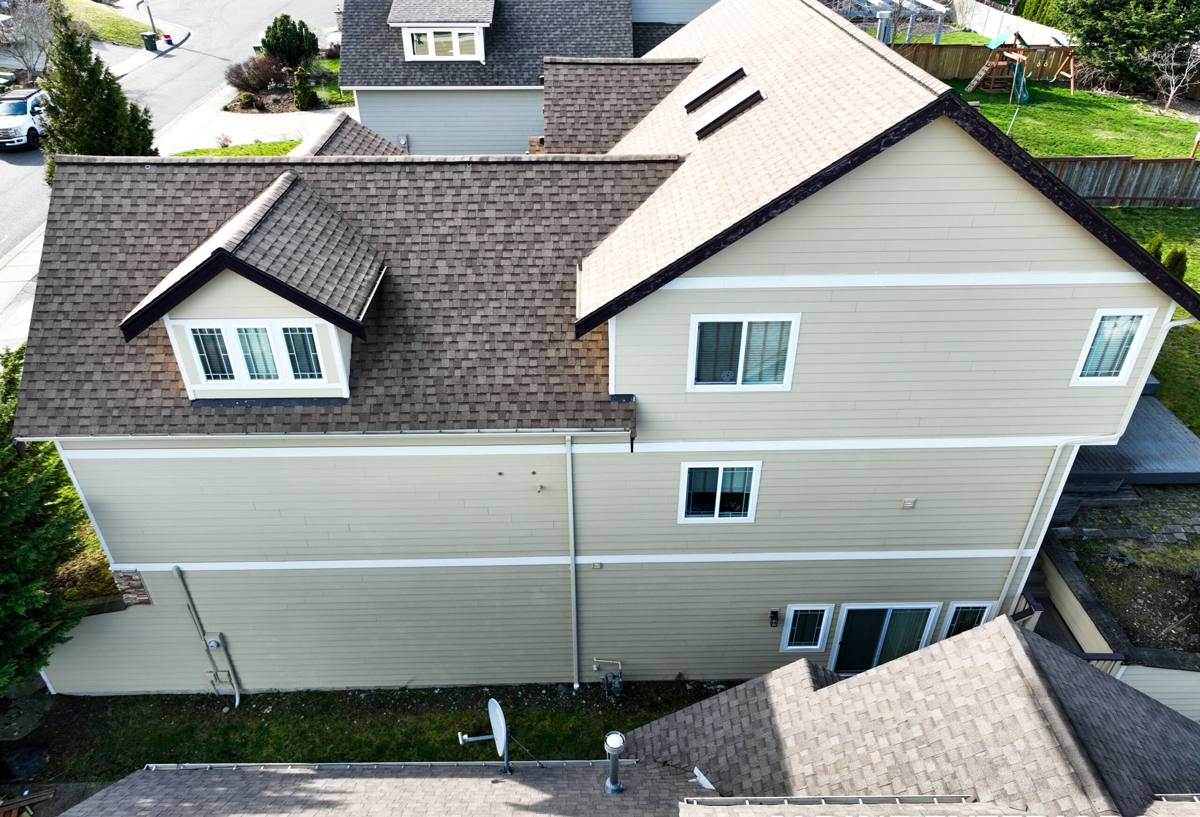
Signs a Mount Vernon Roof Needs Full Replacement, Not Another Patch
Not every roof problem calls for a full tear-off. But there's a point where patching becomes a waste of money, and in this climate that point arrives faster than homeowners expect. Watch for:
- Moss mats thick enough to lift shingle edges, rather than just surface staining
- Granule buildup in gutters and downspouts, a sign the shingles are wearing thin
- Curling, cupping, or cracked shingle tabs, especially on south- and west-facing slopes
- Soft or spongy spots underfoot on the roof deck, or sagging visible from the ground
- Daylight, water stains, or musty smell in the attic
- Leaks that keep returning in the same spot after repairs
- A shingle roof already past 20-25 years old, regardless of how it looks from the street
If you're only seeing one or two of these, a repair may still make sense. Several at once, or a roof already at the end of its expected service life, is usually the point where a new installation costs less over time than continuing to chase leaks.
What a Correct New Roof Installation Actually Involves
Tear-Off and Decking Inspection
A proper job starts with removing the old roofing down to the deck — not layering new shingles over old ones. Overlaying traps moisture, hides deck damage, and shortens the life of the new roof. Once the deck is exposed, every sheet gets checked for rot, delamination, or soft spots, particularly around plumbing vents, chimneys, and valleys where water concentrates. Any bad decking gets replaced before anything new goes down; skipping this step is one of the most common ways a new roof fails early.
Underlayment and Ice-and-Water Shield
Given how much wind-driven rain this region gets, underlayment choice matters more here than in drier climates. Self-adhering ice-and-water shield belongs at eaves, valleys, and around every penetration — the places where wind can drive rain uphill under the shingles. A synthetic underlayment across the rest of the field adds a second line of defense the shingles alone don't provide.
Flashing Details
Flashing failures, not worn-out shingle fields, cause most of the leaks we get called out to inspect. Step flashing at walls, counterflashing at chimneys, and properly formed valley metal all need to be installed correctly the first time, since they're what actually stops water at the roof's transitions and penetrations.
Ventilation
A roof deck that can't breathe traps moisture from inside the house, which condenses, softens the decking from underneath, and feeds moss growth from below as well as above. Balanced intake and exhaust ventilation is part of a correct installation, not an upgrade.
Choosing a Roofing Material for the Skagit Valley
There's no single "best" roofing material for every home — it depends on your budget, roof pitch, tree cover, and how long you plan to stay in the house. Here's how the common options hold up against this region's rain and moss pressure:
| Material | Moss & Moisture Resistance | Typical Lifespan Here | Maintenance |
|---|---|---|---|
| Standard 3-tab asphalt | Lower — thinner profile holds less algae-resistant granule | 15-20 years | Regular moss treatment recommended |
| Architectural (laminate) asphalt | Good, especially with algae-resistant granules | 25-30 years | Occasional moss/debris cleaning |
| Standing seam metal | Very good — sheds moss and moisture with little to hold onto | 40-50+ years | Low; periodic fastener/sealant check |
| Cedar shake | Requires the most upkeep in a wet, shaded climate | Varies widely with maintenance | High — regular treatment and inspection needed |
We'll be direct with you: in a climate this wet and shaded, cedar shake demands a maintenance commitment a lot of homeowners underestimate, and we'll say so upfront rather than let you find out the hard way. Architectural asphalt with algae-resistant granules is the most common, cost-effective choice for Mount Vernon homes; metal is worth serious consideration for homeowners planning to stay long-term or dealing with heavy tree cover and shade.
Our Installation Process, Start to Finish
- On-site inspection of the current roof, decking, and attic ventilation
- Written estimate with a clear scope — materials, tear-off depth, and any decking allowance
- Material selection, ordering, and a scheduling window built around the weather forecast
- Full tear-off and deck inspection, with any damaged sheathing replaced
- Ice-and-water shield, underlayment, flashing, and ventilation components installed
- Shingle or panel installation per manufacturer specification
- Full site cleanup, including a magnetic nail sweep of the yard and driveway
- Final walkthrough with you and delivery of warranty paperwork
We schedule around weather rather than push through it, since a roof installed in a dry window seals and cures far better than one rushed between storms — an easy step to skip if a crew is trying to keep a tight schedule regardless of conditions.
Ventilation and Moisture: The Detail Many Installers Skip
It's common for a roofing crew to focus entirely on what's visible from the street — shingles, flashing, gutters — and skip evaluating whether the attic can actually vent properly. In a valley climate with this much ambient humidity, an unbalanced or blocked ventilation system traps warm, moist air against the underside of the deck. Over a few years that moisture softens sheathing, promotes mold and rot from below, and can void a shingle manufacturer's warranty outright, since most warranties specifically require adequate ventilation. Checking and correcting intake and exhaust balance is part of every installation we do, not a line item we upsell separately.
What Drives the Cost of a New Roof in Mount Vernon
| Cost Factor | Why It Matters |
|---|---|
| Roof size and pitch | More square footage and steeper pitches mean more material and labor time |
| Number of existing layers | Tearing off two layers of old shingles costs more than one |
| Decking condition | Rotted sheathing found during tear-off has to be replaced before installation continues |
| Material choice | Standard asphalt, architectural asphalt, and metal carry very different material costs |
| Ventilation upgrades | Adding or correcting intake/exhaust venting adds labor and materials |
| Roof complexity | Valleys, dormers, skylights, and chimneys all add flashing work and time |
| Site access | Steep lots, limited driveway access, or tall trees can affect equipment and disposal costs |
Because so much of the final cost depends on what's found once tear-off starts — especially decking condition — we won't give you a number over the phone. A firm, written estimate has to come after an actual inspection.
What to Ask Before You Hire a Roofing Crew in Mount Vernon
- Are you licensed and bonded with Washington State, and currently insured?
- Will I get a written scope of work, not just a one-line price quote?
- Who pulls the building permit, and is that included in the price?
- What's included in the warranty — materials only, or workmanship too — and how long does each last?
- Do you handle decking repairs at a set rate, or is that a surprise change order later?
- Is site cleanup, including a magnetic nail sweep, part of the job?
- Can you show me examples of similar roofs you've installed in this area?
A contractor who answers these plainly, in writing, before asking for a deposit is worth trusting more than one who just quotes a number and a start date.
Why Local Mount Vernon Experience Matters
Roofing crews that actually work Skagit County regularly know the permitting process at the local building department, understand how tree cover and shade patterns on specific lots drive moss growth, and have seen firsthand which flashing and ventilation details hold up against years of valley rain versus which ones fail in three or four seasons. That kind of pattern recognition doesn't come from a single job — it comes from doing this work in this climate, on this kind of housing stock, over and over. It's also the difference between a company you can call back in five years for a warranty question and one that isn't around anymore.
If you're weighing a repair against full replacement, or just want a straight answer on what your roof actually needs, we're happy to take a look and walk you through it — no pressure, no obligation. Use the form below to request a free estimate.