 Anacortes Window
 Why Conway Decks Face a Different Set of Problems
Conway sits low in the Skagit River delta, close enough to the water and open farmland that decks here deal with a specific combination of weather most inland homes never see: salt-tinged air drifting up from Skagit Bay and Puget Sound, long stretches of driving rain that come in sideways during winter storms, and a moss and algae season that can run eight or nine months out of the year in shaded or north-facing spots. Any one of those factors is manageable. All three together, applied to a deck that sits low to the ground or backs up to trees and fields, is what actually determines whether a composite deck holds up or starts showing problems within a few years.
This isn't a generic "composite decking" pitch. It's what we've learned building and repairing decks specifically in and around Conway and the surrounding Anacortes area of Skagit County — where the ground stays damp longer than it does even a few miles inland, and where a deck built to a national spec sheet without local judgment tends to disappoint the homeowner.
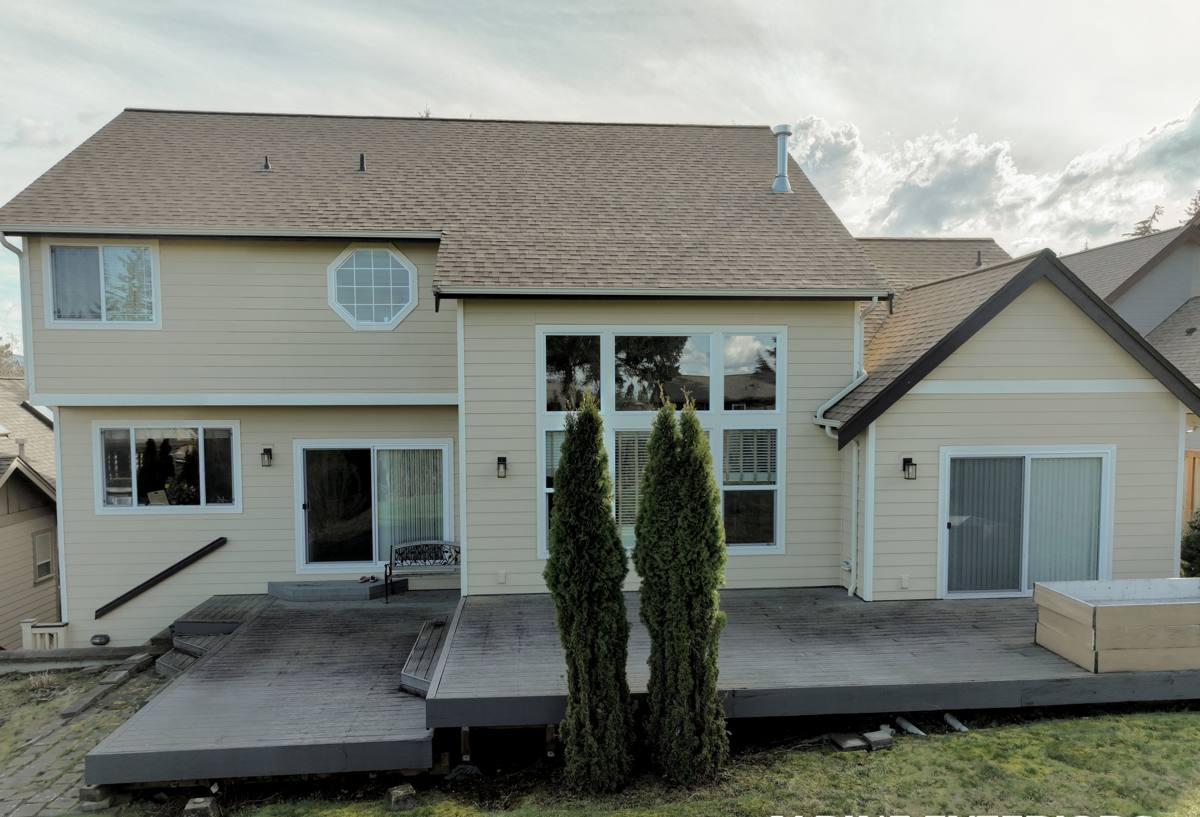
What a Correct Composite Deck Build Looks Like Here
Composite decking itself is a mature, reliable product. Most of the failures we get called out to inspect aren't the board failing — they're the substructure, fastening, or drainage underneath it being built for a drier climate than Conway actually has.
Substructure and Framing
Composite boards are heavier than wood and behave differently under load and moisture cycling, so joist spacing and framing need to match the manufacturer's spec for composite, not the looser spacing that's fine under a cedar deck. In a wet-ground area like Conway, we also pay close attention to how the substructure itself is protected — joist tape or an equivalent moisture barrier on top of the framing keeps standing water from working its way into the wood joists and rim boards that are still doing the structural work under any composite deck.
Fasteners and Hardware
Salt-influenced air accelerates corrosion on hardware that isn't rated for it. We use fasteners and structural connectors rated for coastal or marine-adjacent exposure, not general-purpose exterior-grade hardware. This matters more here than it does for a deck built twenty miles inland — a fastener that's "fine" in a drier county can start staining or weakening years earlier this close to the water.
Drainage and Airflow Underneath
Low-lying lots and heavy rain mean the ground under a deck can stay saturated for days after a storm. If the deck sits low with poor airflow underneath, that moisture has nowhere to go — which is exactly the condition that grows moss and algae on the underside of boards and accelerates hardware corrosion. A correct build accounts for ground clearance, grading away from the structure, and enough ventilation that the space under the deck can actually dry out between storms.
Choosing the Right Composite Board for This Climate
Not all composite boards handle wet, low-light conditions the same way. The biggest distinction that matters for Conway is whether a board is fully capped on all four sides or only capped on the visible faces, since the cut ends and grooved edges are where moisture actually gets in over time.
| Board Type | How It Handles Moisture | Best Fit |
|---|---|---|
| Fully capped composite | Protective shell on all sides resists moisture absorption and staining, including at cut ends when properly finished | Shaded, low-airflow, or ground-level decks common in Conway |
| Partially capped composite | Visible faces resist moisture well, but exposed core edges can absorb water over time | Elevated, sunny, well-ventilated decks with good drainage |
| Uncapped / early-generation composite | More prone to moisture absorption, staining, and surface mold in damp, shaded conditions | Not recommended for Conway's typical site conditions |
| PVC decking | No wood content, so it doesn't absorb moisture, but behaves differently underfoot and expands/contracts more with temperature swings | Homeowners prioritizing zero moisture absorption over a wood-look feel |
We don't push one brand as the only option. What we do insist on is matching the board's construction to where it's actually going on your property — a low, shaded deck near mature trees needs a different spec than a sunny, elevated one, even on the same lot.
Our Process for a Conway Composite Decking Project
- Site assessment — we look at grade, drainage, sun exposure, and how close the deck sits to trees, gutters, or downspouts that could be dumping extra water onto or under it.
- Substructure plan — framing, joist protection, and footing depth are specified for our soil and moisture conditions, not a generic national default.
- Material selection — we walk through board options with you based on that specific site, not a one-size answer.
- Installation — proper fastening pattern, expansion gaps, and edge treatment at every cut end, since that's where moisture problems start.
- Final walkthrough — we check railing, stair, and edge details against code before calling the job done, and go over basic care with you.
Living With a Composite Deck in Skagit County
Composite decking is marketed as low-maintenance, and compared to wood it is — but "low-maintenance" doesn't mean "no maintenance," especially in a climate with a real moss season. Moss and algae feed on organic debris and moisture, and a composite deck that sits under trees or in constant shade will grow a green film on its surface just like a roof or a walkway will if it's left alone.
The good news is that composite surfaces are easy to keep ahead of once you know the pattern:
- Sweep leaves, needles, and pollen off the deck regularly, especially going into fall — that debris is what feeds moss growth over winter.
- Rinse the deck a few times during the wet season with a garden hose and a stiff-bristle (not metal) brush to keep algae film from taking hold.
- Keep gutters and downspouts near the deck clear so you're not dumping extra concentrated runoff onto one section of boards.
- Check under the deck once a year for standing water or debris buildup that's blocking airflow.
- Avoid pressure-washing at close range or high PSI directly on composite boards — it can etch the surface and isn't necessary if you stay ahead of buildup.
None of this is difficult, but it does mean composite decking in Conway asks a little more of you seasonally than the same product would in a drier climate. Homeowners who know that going in are the ones who stay happy with their deck for the long haul.
Cost Factors for Conway Composite Decking Projects
Every deck is different, so we don't quote firm numbers without seeing the site, but these are the factors that actually move the price on a Conway project:
| Factor | Why It Matters Here |
|---|---|
| Ground clearance and grading | Low, wet lots sometimes need additional grading or drainage work before the deck framing even starts |
| Board tier (capped vs. partially capped vs. PVC) | Fully capped boards cost more up front but hold up better in shaded, damp spots |
| Substructure protection | Joist tape, coastal-rated fasteners, and footing depth add cost but reduce long-term repair risk |
| Deck size and complexity | Stairs, multiple levels, and railing style all add labor and material |
| Access for equipment and materials | Rural or tree-lined Conway lots sometimes require more manual material handling than an open suburban lot |
We'll walk your specific site with you and explain exactly where your money is going before any work starts — no surprise change orders for conditions we should have caught in the initial assessment.
A Homeowner's Pre-Project Checklist
If you're planning a composite deck in Conway, these are worth thinking through before you get quotes:
- How much sun does the deck location actually get through the day, and does that change by season?
- Is the deck footprint near trees, gutters, or downspouts that could be adding extra moisture?
- How low will the deck sit relative to the ground, and is there room for real airflow underneath?
- Do you want a fully capped board for the lowest maintenance, or are you comfortable with a bit more seasonal upkeep in exchange for other tradeoffs?
- Is your existing substructure (if this is a resurfacing job) actually sound, or does the framing need to be addressed too?
Why a Local Anacortes-Area Crew Matters
Composite decking is installed differently in Conway than it would be on a dry, elevated lot on the east side of the state, and a crew that only works from the manufacturer's generic install guide won't always catch that. A crew that already works Skagit County knows which lots hold water, which board types actually shrug off a wet, shaded winter, and which fastening details matter more here because of the salt air coming off the water. That local pattern recognition is the difference between a deck that needs attention every year and one you mostly forget about.
If you're weighing a new composite deck or replacing tired boards on an existing structure in Conway, we're happy to come take a look, walk the site with you, and give you an honest, no-pressure estimate — including whether your current substructure is worth keeping. There's a form below to get that started.