 Anacortes Window
 Why West Anacortes Decks Take More Abuse Than Decks Inland
A deck built a few miles inland in Skagit County lives a different life than one built in West Anacortes. Being this close to the water means more airborne salt settling on every surface, longer stretches of driving rain coming off the strait, and a shoulder season that stays damp and shaded long enough for moss and algae to get established before summer ever dries things out. None of that is a reason to avoid a deck — it's just the set of conditions the deck has to be built for from day one.
Wood decking in this environment needs re-staining or sealing on a schedule most homeowners fall behind on, and once a board starts absorbing water at the end grain or around fasteners, rot follows. Composite decking was designed to sidestep a lot of that, but "composite" isn't one product — the board, the substructure underneath it, and the hardware holding it together all have to be chosen and installed with this specific climate in mind. A board rated for a dry inland yard doesn't automatically perform the same way forty feet from salt spray.
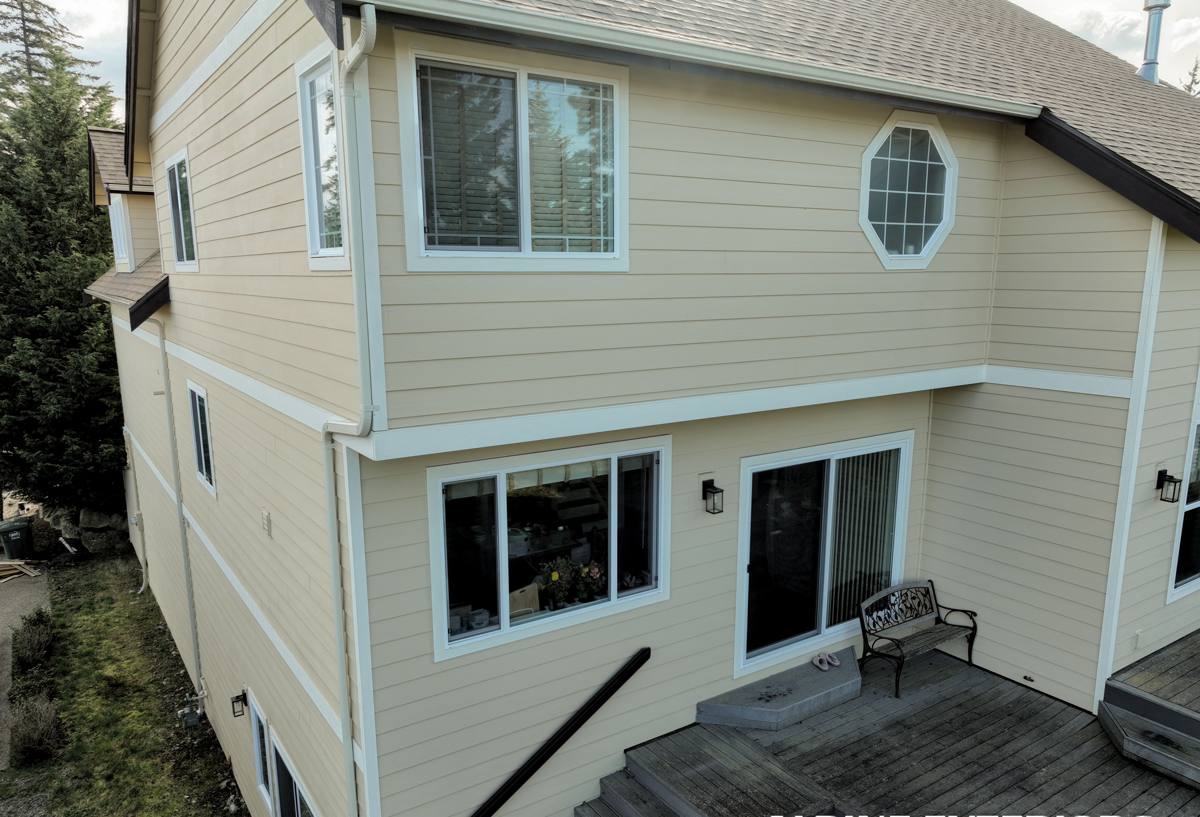
What a Correctly Installed Composite Deck Looks Like Underneath
Most of what determines whether a composite deck lasts is invisible once the project is done. The boards get the attention, but the framing underneath is what actually takes the punishment from West Anacortes weather.
Substructure and Spacing
Composite boards need tighter joist spacing than a lot of homeowners expect, especially on diagonal patterns or with lower-density boards, because composite has more thermal movement and more flex under load than solid wood. Gaps between boards need to be sized correctly for both drainage and for the board's expansion in temperature swings — too tight and boards can buckle; too wide and they trap debris and hold moisture right where you don't want it.
Flashing and Ledger Connections
Where a deck attaches to the house, the ledger board and its flashing are doing the real waterproofing work. In a climate with this much driving rain, a poorly flashed ledger is one of the most common places we find hidden rot on decks we're asked to replace or repair — the decking on top can look fine for years while the connection to the house is quietly failing behind it. Proper flashing, correct fastener choice, and a drainage gap between the ledger and the siding are not optional details here.
Ventilation Underneath
Low-clearance decks and decks built close to grade need airflow underneath to keep the substructure from staying damp between rain events. In a place that gets a long stretch of overcast, low-drying-power weather every year, a deck with poor underside ventilation stays wet longer than one built with clearance and airflow in mind, even if the decking on top is fully composite.
Choosing the Right Composite Board for a Marine Climate
Not all composite decking is built the same way, and the differences matter more here than they would in a drier, inland climate. The main choice most homeowners are weighing is between capped composite, uncapped composite, and PVC decking, with pressure-treated wood as the baseline comparison.
| Material | How It Handles Salt Air & Rain | Maintenance | Typical Trade-Off |
|---|---|---|---|
| Pressure-treated wood | Absorbs moisture at cuts, fasteners, and end grain; prone to splitting and mildew in shaded, damp areas | Annual or biannual staining/sealing | Lowest upfront cost, highest ongoing labor |
| Uncapped composite | Resists rot but the exposed surface can absorb some moisture and stain or fade faster near salt spray | Occasional cleaning; more prone to surface staining over time | Lower cost than capped composite, shorter cosmetic lifespan in this climate |
| Capped composite | Protective outer shell resists moisture absorption, staining, and fading; handles salt exposure well | Periodic washing to keep moss and grime from taking hold | Higher material cost, longer service life with less upkeep |
| PVC decking | Fully synthetic, essentially immune to moisture absorption and salt staining | Low; mainly washing | Highest material cost, different look and feel than wood-grain composite |
For most West Anacortes homes, we steer people toward capped composite as the honest middle ground — it holds up to salt air and moss without the ongoing maintenance burden of wood, and it costs less than full PVC while still offering strong stain and fade resistance. Uncapped composite still has a place on a tighter budget, but we're upfront that it won't stay clean-looking here as long as a capped board will.
Railings, Fascia, and Fasteners: Where Salt Air Does the Most Damage
The decking surface gets the attention, but salt air is just as hard on the metal components of a deck — railing hardware, joist hangers, screws, and post brackets. Standard zinc-coated fasteners can corrode faster in a coastal environment than they would a few miles inland, and a corroded fastener under a composite board is a hidden problem that doesn't show up until something starts to loosen or stain the decking around it.
We use fasteners and structural hardware rated for coastal or corrosive-environment use on West Anacortes projects, not because it's required everywhere, but because it's the difference between hardware that lasts as long as the decking above it and hardware that becomes the weak point in twenty years. The same logic applies to railing systems — aluminum and composite railing components generally outperform untreated steel or lower-grade fasteners this close to the water.
Our Process, Start to Finish
- On-site assessment. We look at existing framing (if there is any), grade and drainage around the deck footprint, sun and shade exposure, and how close the site is to salt spray and prevailing wind.
- Material walkthrough. We go over board options, colors, and railing systems in person, with honest trade-offs on cost, appearance, and long-term maintenance for this specific site.
- Permitting. Deck projects in Anacortes typically require a permit depending on size, height, and attachment to the house. We handle that process rather than leaving it to the homeowner.
- Substructure build. Proper joist spacing, ledger flashing, corrosion-resistant hardware, and ventilation clearance get built before a single composite board goes down.
- Decking, railing, and trim installation. Boards, fascia, and railing are installed to the manufacturer's spacing and fastening specs, adjusted for our climate's expansion and contraction behavior.
- Final walkthrough. We go over care and cleaning expectations so the deck actually reaches its full service life instead of getting neglected the way a lot of wood decks do.
Living With a Composite Deck in a Moss-Prone Climate
Composite decking is lower-maintenance than wood, not maintenance-free. In a climate that grows moss on north-facing roofs and shaded fences without much effort, a deck under trees or against the house can grow a thin film of algae or moss in the gap lines and low-airflow corners if it's never cleaned. That's a surface issue, not a structural one, but it's worth staying ahead of.
- Sweep debris (needles, leaves, seed pods) out of board gaps regularly — trapped organic matter is what feeds moss and algae growth
- Wash the deck surface a couple of times a year with a mild soap-and-water scrub or a composite-safe cleaner, especially in shaded areas
- Avoid pressure washing at close range or high PSI on composite boards — it can damage the capped surface
- Trim back overhanging branches or shrubs that keep sections of the deck shaded and slow to dry
- Check railing posts and fastener points once a year for any early signs of corrosion staining
- Keep gutters and downspouts near the deck clear so runoff isn't dumping extra water onto the decking or substructure
What Drives the Cost of a Composite Deck in West Anacortes
Every deck quote is a little different, but the same handful of factors move the price up or down on most West Anacortes projects: the grade of composite board chosen (capped vs. uncapped vs. PVC), the size and shape of the deck, height above grade (which affects railing and stair requirements), the condition of any existing substructure, and how much site prep or access work is needed. A straightforward, low, single-level deck on easy access ground costs meaningfully less than a raised deck with multiple stair runs, custom railing, or difficult site access.
Composite decking generally costs more upfront than pressure-treated wood, but it closes that gap over time by eliminating the recurring cost of sanding, staining, and sealing a wood deck every couple of years — a cost that's easy to underestimate until you've done it a few times in a climate this wet.
Why It Matters That This Crew Already Works West Anacortes
A lot of deck problems we get called to fix started with a good product installed the wrong way for the local conditions — the wrong fastener grade, a ledger flashed for a drier climate, or joist spacing that worked fine somewhere with less rain but wasn't tight enough for the movement composite boards see here. A crew that regularly works West Anacortes already knows the wind exposure patterns, the drainage quirks of this part of Skagit County, and what the local permitting process actually requires, instead of learning it on your project.
That local familiarity also shows up in smaller ways — knowing which sides of a lot tend to hold shade and grow moss faster, understanding how salt spray behaves depending on how exposed a lot is to the water, and having already worked through the city's permitting steps enough times to not slow the project down. It's the difference between a deck that's built to a spec sheet and a deck that's built for the specific block it's sitting on.
If you're weighing a new composite deck or replacing an aging wood one in West Anacortes, we're happy to walk the site, talk through honest options for your budget and exposure, and put together a free, no-pressure estimate using the form below.