 Anacortes Window
 Building Decks That Hold Up in Burlington's Skagit Valley Climate
Burlington sits inland in the Skagit Valley, a little removed from the open salt water that pounds Fidalgo Island, but it shares the same weather system. The same low-pressure fronts that bring driving rain and salt-laden air off Rosario Strait and Padilla Bay roll straight through the valley. Add the valley's flat, poorly draining farmland soils and the long gray stretch from October through May, and you get a climate that is genuinely hard on outdoor wood structures. Moss doesn't need salt air to take hold — it needs shade, moisture, and time, and Burlington has all three for most of the year.
A deck built here has to shed water fast, dry out between storms, and resist the slow biological growth that eats into softwood and clogs composite boards. That's a different design conversation than a deck built for a dry climate, and it's one we have with every Burlington homeowner before a single post goes in the ground.
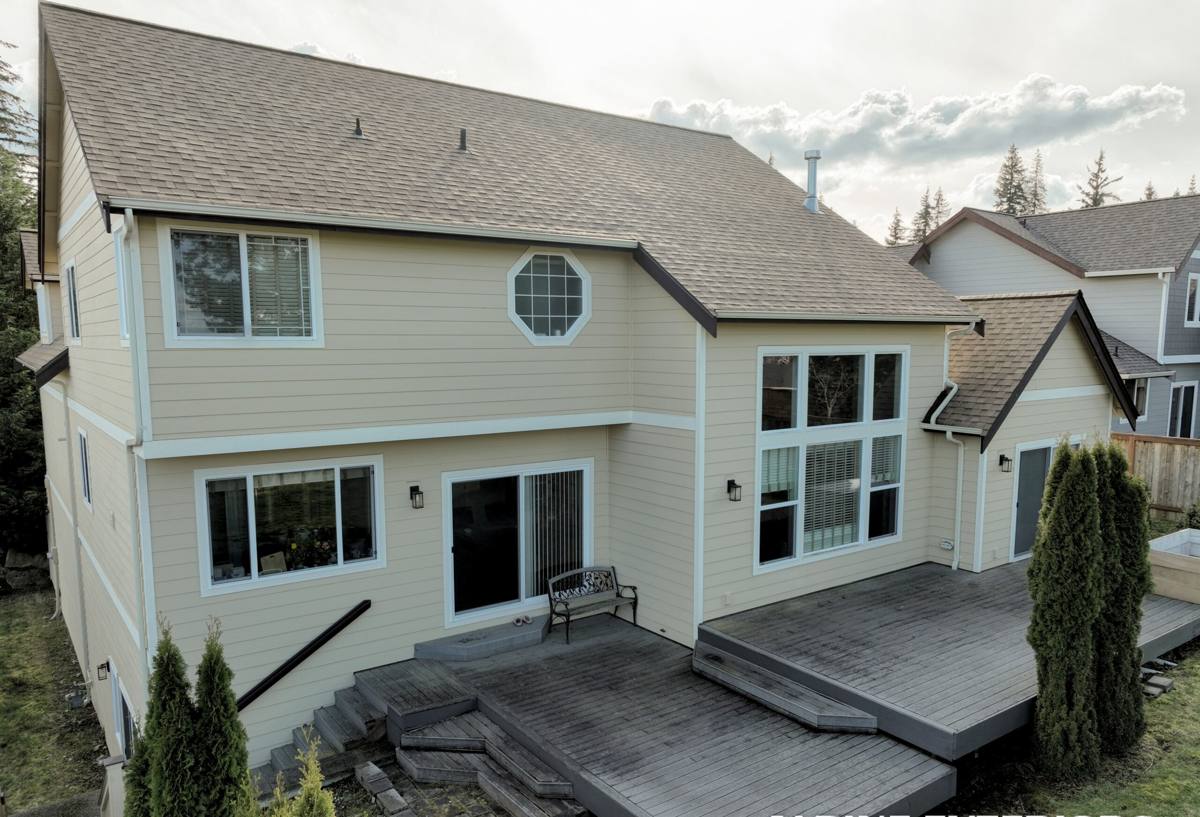
What Burlington Homes Actually Need From a Deck
Most of the decks we get called out to repair or replace in this area fail for the same handful of reasons, and almost none of them are about the wood species or brand of composite that was used. They fail because of how the deck was built.
- Ledger boards flashed poorly, letting water track behind the siding and into the rim joist
- Joists and beams spaced or sized without enough margin for our wet load conditions
- Footings set too shallow or without proper drainage gravel, so they heave or settle in saturated soil
- Decking installed tight with no gap for expansion, trapping moisture and debris between boards
- No airflow underneath the deck, so the framing never fully dries out between rain events
Fix the structure and the drainage first, and the deck surface — whatever material you choose — has a fighting chance against the climate. Skip those basics and even a premium composite deck will show rot in the framing within a decade.
Decking Material Options for This Climate
There's no single "right" material for every Burlington home — it depends on budget, how much upkeep you're willing to do, and how the deck sits relative to shade and moisture. Here's how the common options actually perform once they've spent a few Skagit winters outside.
| Material | Moisture & Moss Behavior | Maintenance | Typical Lifespan Here |
|---|---|---|---|
| Pressure-treated fir/hem-fir | Absorbs water readily; needs a sealed, ventilated build to resist rot | Annual cleaning and re-sealing recommended | 15-20 years with upkeep |
| Cedar | Naturally rot- and insect-resistant, but still needs sealing to fight moss and graying | Sealing every 1-2 years for appearance and moisture protection | 20-25 years with upkeep |
| Capped composite | Doesn't absorb water into the core; surface can still host surface moss/algae in shady, damp spots | Periodic washing, no staining or sealing | 25-30+ years |
| PVC decking | Fully moisture-resistant, best resistance to moss staining of the group | Occasional washing | 30+ years |
We install all of the above depending on what a homeowner wants, but we're honest about trade-offs. Composite and PVC cost more up front and eliminate the sealing cycle, which matters a lot in a climate where "reseal every year" often turns into "reseal every three years" and the wood pays for it. Wood costs less initially and has a warmer, more traditional look, but only holds up if the maintenance actually happens on schedule.
Framing and Fasteners: Where Decks Actually Fail First
The decking surface is what you see, but the framing underneath is what determines whether the deck is safe and long-lived. In a climate this wet, we treat a few details as non-negotiable:
Ledger Attachment and Flashing
Where the deck attaches to the house is the single most common failure point we find on older Burlington decks. Water that gets behind an unflashed or poorly flashed ledger board doesn't just rot the ledger — it migrates into the house framing and siding. We flash every ledger connection with a proper drip cap and moisture barrier, not just lag bolts and caulk.
Fastener Corrosion
Standard fasteners corrode faster in coastal Washington's damp, mineral-heavy air than most homeowners expect, even set back from the water like Burlington is. We use hot-dip galvanized or stainless hardware rated for ground contact and treated lumber, matched to the type of decking so there's no galvanic reaction between dissimilar metals.
Footings and Drainage
Skagit Valley soil holds water. Footings need to sit below the frost line and on a bed of compacted gravel that lets water drain away from the concrete instead of pooling against it, which is what causes heaving and slow structural movement over the years.
Airflow Underneath
A deck built low to the ground with no ventilation path traps humid air against the joists year-round. We build in clearance and, where grade doesn't allow enough natural height, use ventilation strategies to keep air moving under the structure.
Our Deck Building Process
Every deck we build in Burlington goes through the same sequence, adjusted for the specific site conditions.
- Site walk and design conversation — we look at drainage, sun and shade exposure, existing grade, and how the deck will connect to the house before recommending materials or layout.
- Structural plan and permit prep — footings, beam sizing, and ledger attachment are engineered to local code and the specific soil and load conditions of the site.
- Permitting — we handle the permit application and inspection scheduling with the local jurisdiction so nothing gets built that has to be torn out later.
- Footings and framing — footings poured or set on proper drainage gravel, framing built with corrosion-resistant hardware and correct spacing for our climate's moisture load.
- Ledger flashing — full moisture barrier and flashing detail where the deck meets the house, inspected before decking goes down.
- Decking installation — boards installed with manufacturer-specified gapping for drainage and material expansion.
- Railing, stairs, and finish details — built to current code for guard height and baluster spacing.
- Final walkthrough — we go over maintenance expectations for the specific material installed so there are no surprises down the road.
Permits and Code in Skagit County
Most decks above a certain height or attached to the house require a building permit in Skagit County jurisdictions, and inspections typically happen at the footing stage and again at final. Skipping permitting on an attached deck isn't just a legal risk — it also becomes a real problem at resale, when an unpermitted structure can hold up a sale or trigger a required retrofit. We pull permits as a standard part of the job and coordinate inspections so the process doesn't fall on the homeowner.
Maintenance by Material: What to Actually Expect
Homeowners are often surprised by how much the maintenance schedule differs by material, especially in a climate that pushes moss and mildew growth hard. Here's a realistic checklist by material type.
- Wood decks: annual wash with a deck cleaner formulated for moss and mildew, inspection for soft or checked boards, resealing every 1-2 years depending on sun exposure
- Composite decks: seasonal rinse with soap and water or a composite-safe cleaner, prompt removal of leaf litter and debris that traps moisture against the board
- PVC decks: occasional rinse, spot cleaning in shaded areas prone to surface algae
- All decking types: keep gutters and downspouts clear so roof runoff isn't dumping extra water onto or near the deck surface
- All decking types: check fastener heads and railing connections annually for movement or corrosion
Skipping this schedule is the number one reason a deck that should last 25 years starts having problems at year 10 — moss holds moisture against the surface, and moisture is what does the damage, not the moss itself.
Why Local Experience Matters for a Burlington Deck
A crew that mostly builds in drier parts of the state will often under-detail flashing and ventilation because it simply hasn't had to solve for a climate this wet. Working across Anacortes, Fidalgo Island, and into the Skagit Valley communities like Burlington means we see the full range of how this region's moisture and moss pressure plays out — from waterfront homes with direct salt exposure to inland valley lots with heavier soil drainage issues. That experience shapes decisions that don't show up on a materials list: how deep the footings go, how the ledger gets flashed, how much slope the decking needs for drainage, and which fasteners actually hold up here long-term.
It also means we know the local permitting process and inspection expectations, so the project moves without avoidable delays.
Cost Factors Worth Understanding Upfront
Deck pricing varies a lot based on size, height off grade, material choice, and site access, so we won't quote a number without seeing the site. What we can say is which factors move the price the most:
| Factor | Why It Matters |
|---|---|
| Decking material | Composite and PVC cost more per square foot up front than wood but reduce long-term maintenance spend |
| Height and stairs | Taller decks need more substantial framing, railing, and stair structures, which adds labor and material |
| Ground conditions | Poor drainage or difficult access can add footing and excavation work |
| Attachment type | Ledger-attached decks require flashing and structural tie-in work that freestanding decks don't |
| Railing and finish details | Custom railing, built-in seating, or lighting add cost beyond the base structure |
We walk through these factors on-site so a homeowner understands what's driving the number, not just what the number is.
If you're planning a new deck or replacing one that's showing its age in Burlington, we're happy to take a look and put together a straightforward, no-pressure estimate. There's a short form below to get started.