 Anacortes Window
 Roofing in West Anacortes: A Different Set of Demands
West Anacortes sits close enough to the water that homes here deal with a version of Pacific Northwest weather that's a little more aggressive than what you'd find further inland in Skagit County. Salt-laden air moves off the bay and settles on every exposed surface, driving rain comes in sideways during winter storms, and the shaded, moisture-heavy stretches of the neighborhood grow moss on roofs faster than almost anywhere else in the county. Asphalt shingle roofing can absolutely hold up here, but only if it's specified and installed with those three factors in mind from the start.
A lot of roofing problems we get called out to inspect in this part of Anacortes aren't failures of asphalt shingles as a product. They're failures of installation choices that didn't account for the local environment — the wrong underlayment, skipped ventilation details, or fasteners that weren't rated for a marine climate. Get those right and a shingle roof in West Anacortes will do exactly what it's supposed to do for its full service life.
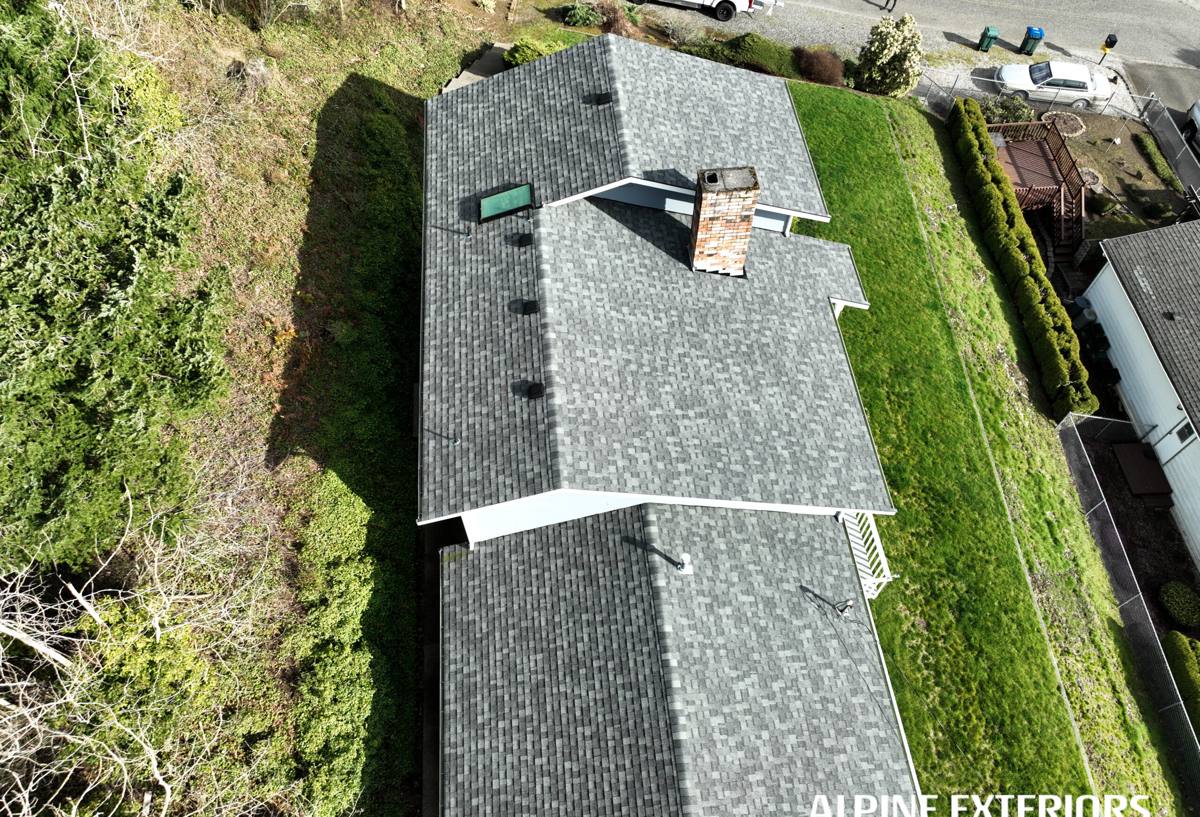
What Salt Air, Rain, and Moss Actually Do to a Roof
Salt Air and Corrosion
Airborne salt accelerates corrosion on anything metal — flashing, fasteners, vent stacks, and drip edge. Standard electro-galvanized fasteners can start showing rust streaks on shingles within a few years in a marine-influenced area like West Anacortes. That staining isn't just cosmetic; it's a sign the fastener itself is degrading, which eventually means reduced holding power exactly where you don't want it.
Driving Rain and Wind-Driven Water
West Anacortes gets weather off the water that pushes rain sideways into roof edges, valleys, and any place where two roof planes meet. Water doesn't need a big gap to find its way in during a real storm — it needs a small one and enough wind pressure. That's why valley work, sidewall step flashing, and eave protection matter more here than they would on a roof in a more sheltered inland location.
Moss Season
Shaded roof sections, north-facing slopes, and areas under tree canopy in this neighborhood stay damp long after a storm has passed. That prolonged moisture is exactly what moss needs to establish. Left unchecked, moss holds water against the shingle surface, works its way under shingle tabs, and lifts them enough that wind and rain can get underneath. A roof that's fighting moss for eight or nine months a year needs design choices — like zinc or copper strips at the ridge and reasonable tree clearance — that a generic re-roof spec often skips.
What a Correctly Built Shingle Roof Looks Like Here
A shingle roof built for this specific part of Anacortes isn't a different product line — it's the same asphalt shingle system most homeowners already know, assembled with details chosen for the local climate rather than a generic national spec sheet.
- Corrosion-resistant fasteners and flashing — stainless or heavier-coated hardware in place of standard electro-galvanized where it's exposed to salt air
- Ice-and-water or high-quality synthetic underlayment at eaves, valleys, and around every penetration, not just where code minimums require it
- Balanced intake and exhaust ventilation so moisture from inside the house doesn't add to what's already landing on the roof from outside
- Proper valley and step flashing sized and lapped for wind-driven rain, not just standard gravity drainage
- Moss-resistant details at the ridge and in chronically shaded sections, plus honest guidance on tree trimming where it affects roof drying
- Shingle rated for wind exposure appropriate to a near-water location, with the nailing pattern and fastener count to match
Underlayment and Fastener Comparison
| Component | Standard Spec | West Anacortes Spec |
|---|---|---|
| Fasteners | Electro-galvanized roofing nails | Hot-dip galvanized or stainless in salt-exposed zones |
| Underlayment | Felt or basic synthetic, minimum coverage | Synthetic or ice-and-water at eaves, valleys, and penetrations |
| Flashing | Standard aluminum | Heavier-gauge or coated flashing at valleys and walls |
| Ridge treatment | Standard cap shingles | Zinc/copper moss-control strip where shading is significant |
| Ventilation | Ridge vent only | Balanced ridge and soffit intake sized to the attic |
Reading the Signs of a Roof That's Losing the Fight
Homeowners in this part of Anacortes usually notice one of a few things first, and each points to a different underlying issue:
- Dark streaking or green-black patches, especially on north-facing or shaded slopes — active moss or algae growth
- Granule buildup in gutters or downspouts — accelerated wear, often worse on roofs with poor ventilation or aging shingles
- Rust-colored streaks below fasteners or flashing — corrosion from prolonged salt exposure
- Soft spots, sagging, or interior ceiling stains near valleys or chimneys — water intrusion that's already reached the sheathing
- Lifted or curling shingle tabs — wind damage or moss that's worked underneath the shingle edge
None of these on their own mean a full replacement is necessary. But any of them are worth a real inspection rather than a guess, because in a marine climate a small entry point tends to become a bigger problem faster than it would somewhere drier.
Repair, Re-Roof, or Full Tear-Off: How We Decide
Not every roofing call in West Anacortes ends in a full replacement, and we don't push customers toward one when it isn't warranted. The decision usually comes down to a few honest questions:
- How much service life is left in the field of the roof? Isolated damage on a roof with years of life left is usually a repair.
- Is the sheathing still sound? Moisture that's reached and softened the decking changes the scope regardless of shingle age.
- Is the underlying system (underlayment, flashing, ventilation) adequate? If the original installation skipped details this climate needs, a like-for-like repair just delays the same failure.
- Is moss or algae staining cosmetic or structural? Surface discoloration can often be cleaned and controlled; lifted shingles from moss intrusion usually can't be spot-repaired reliably.
We'll walk the roof, tell you what we actually see, and give you the honest range of options — including doing nothing yet if that's the right call.
Our Process for West Anacortes Homes
1. On-Site Inspection
We look at the roof itself, the attic ventilation, visible flashing points, and any interior signs of moisture before recommending anything. Roofs in this area often have site-specific issues — shading from trees, proximity to the water, roof pitch and orientation — that change what the right spec looks like.
2. Straightforward Estimate
You get a written estimate that spells out materials, fastener and underlayment choices, and scope of work — not just a bottom-line number. If repair is the right call instead of replacement, that's what we'll propose.
3. Installation Built for the Climate
Corrosion-resistant hardware, proper underlayment at vulnerable points, correct ventilation balance, and attention to valleys and flashing — the details covered earlier in this page, applied consistently rather than as upgrades you have to ask for.
4. Cleanup and Final Walkthrough
We clear the site of debris and old material, and walk the finished roof with you so you know what was done and what to watch for going forward, including basic moss-prevention maintenance if your property has shaded sections.
Why Local Experience Matters for This Job
Asphalt shingle roofing is a common product, but installing it correctly in a marine, moss-prone microclimate like West Anacortes isn't something every crew adjusts for. A contractor who mostly works drier, inland parts of Skagit County may default to standard fastener and underlayment specs that hold up fine there but fall short a few miles closer to the water. A crew that already works in this specific area knows which slopes hold moss longest, which fastener grades actually last, and which flashing details matter most when a storm is coming off the water rather than passing overhead.
That local familiarity shows up less in what's visible from the ground and more in the parts of the job that determine whether the roof is still performing well in fifteen years — the underlayment nobody sees, the fastener spec, the ventilation balance. Those are the details worth asking about when you're comparing bids for a roof in this neighborhood.
Cost Factors to Expect
| Factor | How It Affects Cost |
|---|---|
| Roof size and pitch | More square footage and steeper pitches increase labor and material needs |
| Number of layers to remove | Tear-off of existing layers adds labor and disposal cost versus a single-layer roof |
| Decking condition | Soft or damaged sheathing found during tear-off requires replacement before new roofing goes on |
| Corrosion-resistant hardware and flashing | Upgraded fasteners and flashing cost more than standard-grade materials but reduce long-term maintenance |
| Ventilation upgrades | Adding or correcting soffit/ridge ventilation adds modest cost but protects the whole roof system |
| Access and roof complexity | Multiple valleys, dormers, or difficult access add time and labor |
Ready for a Straight Answer on Your Roof?
If you're seeing moss, granule loss, staining, or you just know your roof's age is catching up with it, we're happy to take a look and tell you honestly what we find — whether that means a repair, a partial re-roof, or a full replacement built for what West Anacortes weather actually throws at a house. Use the form below to request a free, no-pressure estimate.